Disability event builds community of care, understanding
At UND’s second Disability Awareness Day, dozens of people gather in Memorial Union Ballroom to share knowledge

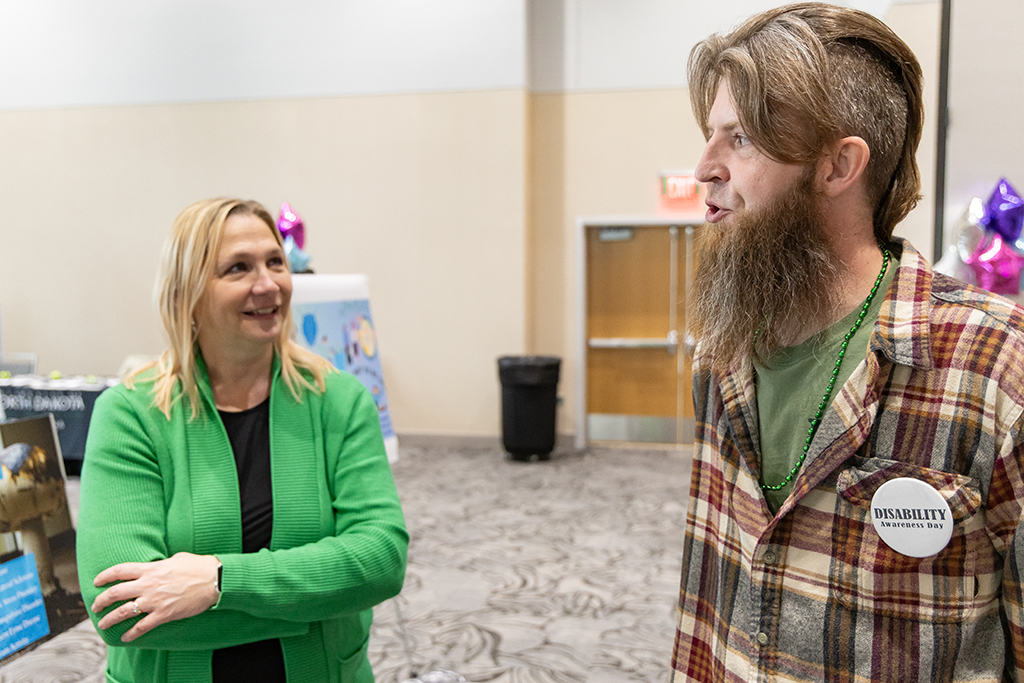
Dozens of students, faculty and other guests filtered in and out of the Memorial Union Ballroom on Monday to take in UND’s second Disability Awareness Day.
“I always say disability is the one group you can join at any time,” said Lee Ann Williams, clinical assistant professor and program director for Inclusive Rehabilitation Sciences within the College of Education & Human Development. “It’s not really a matter of when or if because disabilities definitely touch all of us in some capacity.
“That’s why we need to make an effort to understand the different aspects of disabilities and the organizations that are out there to help. That knowledge equips us for different phases of life.”
And building a good base for that lifetime knowledge was the focus of this year’s event.


Research and resources all in one place
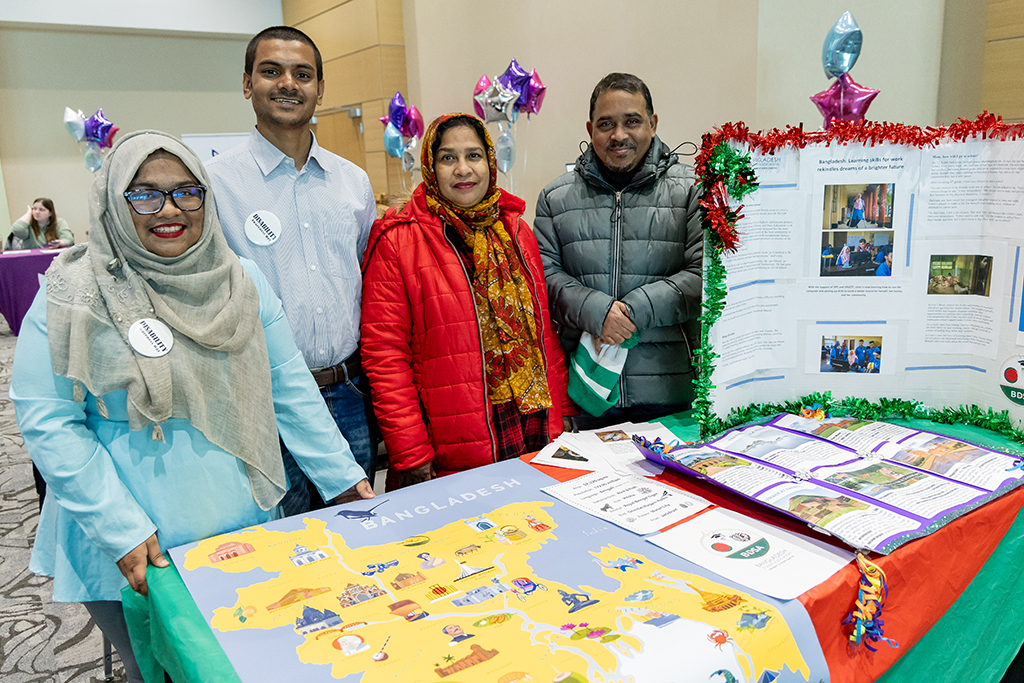
Students presented about 40 research posters — covering everything from dementia and de-escalation techniques to cerebral palsy and psilocybin-assisted therapy — and nearly the same number of support organizations from both on and off campus were represented.
“We had a really great inaugural event, but after hearing feedback last year, we decided to switch things up a bit,” Williams said. “We wanted to continue to give a voice to disabilities through the student posters, but we also wanted to bring in more advocacy groups so people could make those connections, too.”
Among the many tables spread throughout the large ballroom were advocates for the North Dakota Association for the Disabled, the Brain Injury Network, the North Dakota Vision Services/School for the Blind and North Dakota School for the Deaf, as well as the University Counseling Center, UND Pride Center and The Hilyard Center.

A deeper understanding of disabilities
“An event like this gives you a deeper level of knowledge,” Williams said. “You have the opportunity to meet all of these people in one place. How often do you get to do that? You just don’t, so this was a chance for students to develop their skills and build resources and community as well.”
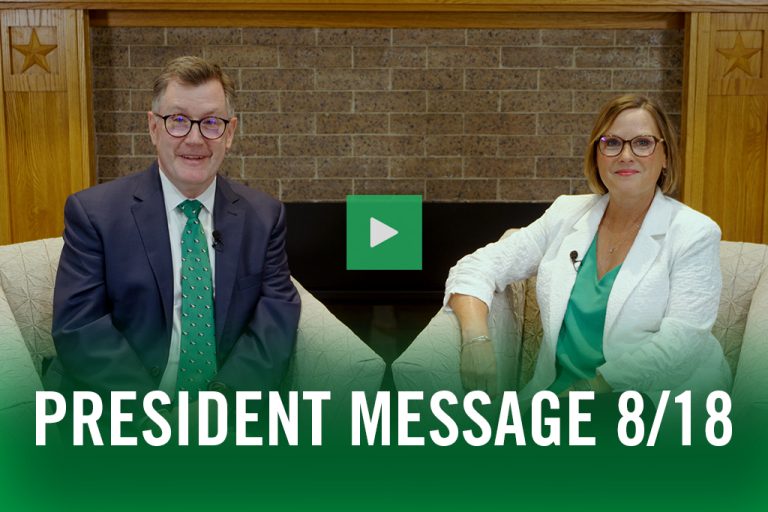
And that community is exactly what President Andy Armacost said he witnessed when he stopped by to visit with students and other participants.
“This event is incredible because it shows the amazing work that’s happening both on the research front and also with all the support groups and professionals who are trying to address disabilities of all kinds,” Armacost said. “The support that we provide to everyone on our campus really matters, and to see so many people gathered here to discuss and help others learn about the different challenges people face is a reflection of the heart of UND.
“This serves a vital purpose, and it ties to our Strategic Plan and the sense of love, care and support that we hope to provide everyone.”
Personal connections to disability
Williams added that many of the presenters Monday were speaking from the heart because they had some sort of personal connection to their disability topic.
“They select their own poster topics, so it’s been very meaningful to them,” she said. “For the undergraduates, the research aspect also is a unique experience because they’re still finding their way and learning just what that research product is.
“For them, it becomes very empowering because they discover how they can take that research into future studies. And for me, it’s wonderful to see them grow as future professionals.”
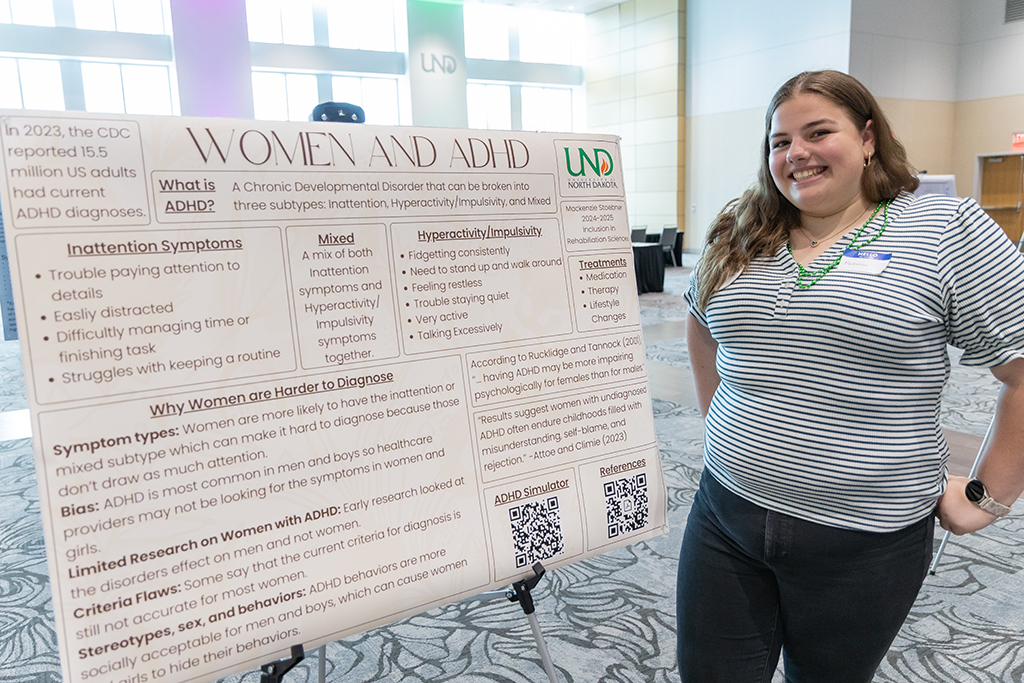
Mackenzie Stoebner, a student in the 3+3 Pre-Occupational Therapy program, was one student with firsthand knowledge of her disability topic.
In fact, Stoebner said she knew she was somehow different all of her life, but it wasn’t until her first year of college that she was diagnosed with ADHD.
The developmental disability most often is diagnosed in boys, she said. The Centers for Disease Control and Prevention actually reports as much as a 3:1 disparity in diagnosis — a difference attributed to girls’ symptoms being more subtle and less disruptive.
“When boys get fidgety and interrupt, it’s seen as more normal for them. It’s kind of looked at as boys will be boys,” she said. “But girls aren’t diagnosed as often because they’re more likely to show signs of inattention or mixed symptoms.
“And if they do show signs of hyperactivity, they often try to hide it because of the stereotype that girls are supposed to be calm and collected.”
And it’s that lack of as many overt physical symptoms that makes the disability so easy for others to misunderstand.
In Stoebner’s case, the fidgeting made it difficult for her to sit or stand without bouncing her foot or moving from side to side. And she struggled to focus, keep a routine or stay on task.
“I know it took me forever to explain to my roommates what I needed to do just to be able to do the same simple things that they found to be really easy,” she said.
For instance, it was almost impossible for her to watch a 45-minute online lecture in one sitting.
“After about 15-20 minutes, I wasn’t fully listening anymore. I’m trying to take notes, but pretty soon, I end up just doodling,” she said. “I heard someone else say today that it’s like your brain is on 40 different tabs at once, and it just keeps going. That’s exactly what it was like for me.”

Finding the right help
Stoebner said it was someone at the University Counseling Center who suggested she check with her doctor to see if her anxiety medication might need to be adjusted. She made the appointment, completed some tests and eventually was diagnosed with inattentive ADHD with mixed symptoms.
Now, with proper medication and treatment, she’s not only finishing her assignments on time, she says she’s finally able to sleep through the night. And she’s also learned new techniques to help her stay focused on her studies.
“I really hope this day gave people a chance to take a step back and think, ‘Hey, this person may be struggling with something that I don’t understand. Maybe I need to look at that in a different way,’” she said. “I was reading posters on autism and bipolar disorder today. It just gives you a deeper understanding of something you might not have thought of before. Sometimes you just need to look at someone else’s perspective.”
>> Do you want to read more UND Today stories? Just hit the link or go to our home page to subscribe to our twice-weekly newsletter.