GRAD Day highlights student research at UND
At Memorial Union event, students showcase findings that could dramatically shape future
Energy, microlearning and radon, oh my!
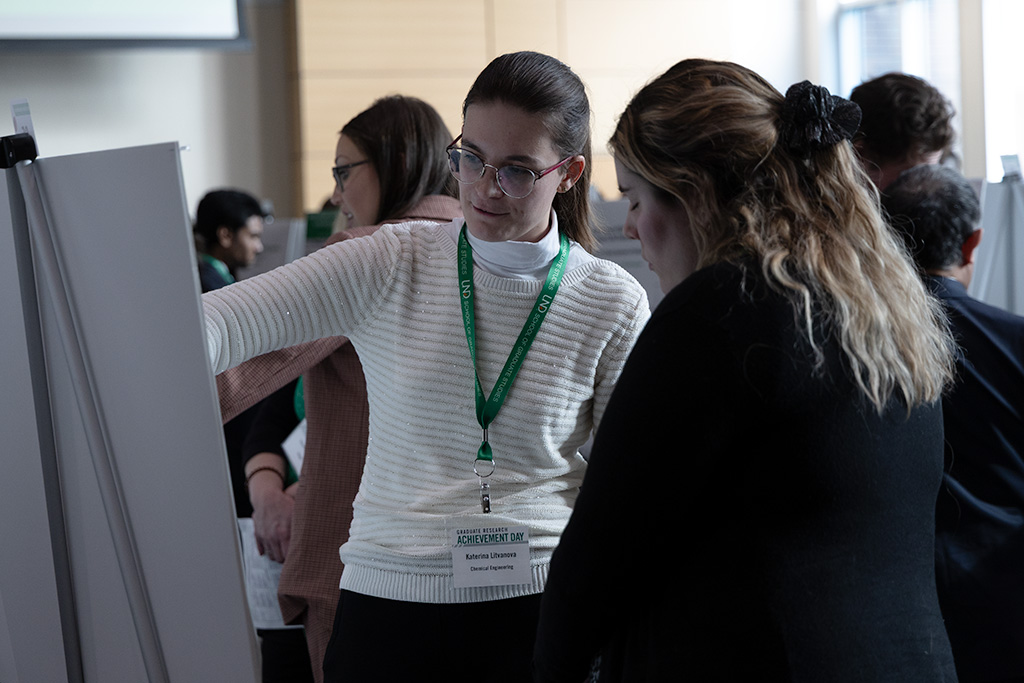
At the Graduate Research Achievement Day (GRAD) event on Feb. 27. students from various disciplines presented their work, pointing to posters that showed how their studies could influence areas such as energy sustainability, workplace learning and radon testing.
During his introduction to the award ceremony, Scott Snyder, vice president for Research and Economic Development, described the core of what makes events such as GRAD Day — which is hosted by the School of Graduate Studies and Division of Research & Economic Development — so special.
“All of you, regardless of the discipline that you are in, are active in discovering,” he said. “You are pushing forward the boundaries of knowledge through all of the work that you do, and you should be incredibly proud of yourselves.”
More than 200 students, faculty and attendees filled the Memorial Union ballroom to discuss the research Snyder referred to, giving a glimpse of some of the impressive research happening at UND.
Grad students working toward energy advancements
While Alam focuses on renewable energy stability, Ashraf Mohammed, a master’s student in geological engineering, is working on a different solution: enhanced geothermal systems. His research targets the Deadwood Formation, a deep rock formation in North Dakota known for permeability — a factor that makes heat extraction challenging.
His solution? Injecting biopolymer gel to seal fractures in the rock, ensuring that heat remains trapped and can be efficiently transferred to the surface for electricity generation.
“We’re testing whether biopolymer gel can block fractures and improve heat retention,” Mohammed said. “Our simulations show that this method reduces temperature loss, making geothermal energy a viable clean energy source for the state.”
With North Dakota’s growing energy demands, enhanced geothermal systems could provide a reliable and sustainable alternative to fossil fuels, Mohammed suggests. His research, funded by the North Dakota Industrial Commission (NDIC), could play a vital role in bolstering North Dakota energy resources.
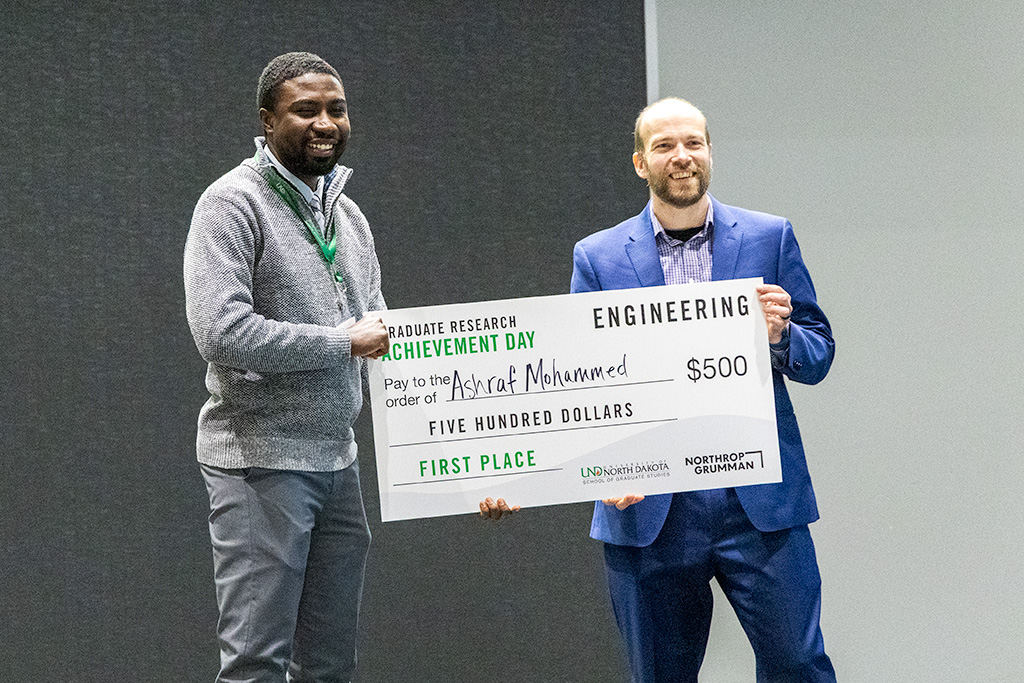
Mohammed, who took home first place in the Engineering category at the day’s end, worked for the Ghana Geologic Survey Authority before coming to UND. He said that this research gave him a chance to study something new and expand his interests.
“I have a passion and love for anything subsurface. My background is in geophysics. So, any resource that is under our feet, I’m interested in it,” he said. “This also happened to be a new area for me, and I was so fascinated by using heat from the ground to generate power. That’s what really motivated me, and this kind of renewable energy can compliment our existing energy sources.”
Mohammed, who started studying at UND last spring, said he was surprised by the effectiveness in using biopolymer gel for this purpose. He hopes to explore the economic viability of the method as he continues his research.
In another energy-adjacent presentation, Muhammad Alam, a doctoral student in electrical engineering, explored the viability of a method to keep wind and solar energy sources stable, even in unpredictable circumstances.
The U.S. aims to surpass 50% renewable energy use by 2035, Alam explained, but there are still kinks that need to be worked out. His research explores how artificial intelligence can optimize energy distribution and prevent disruptions when there’s an unexpected spike in demand.
“In Northern California, temperatures hit 90 degrees in February this year,” Alam explained. “That means millions of people turned on their air conditioners unexpectedly. That put a strain on the power. My research uses AI to ensure power systems remain stable and reliable.”
Alam that he’s interested in leveraging AI to relieve some of the stress on the grid, analyzing large data sets to predict weather patterns and energy production so that no one goes without power.
“We are just at the beginning of using AI in energy optimization,” he said. “If we can integrate AI with traditional power systems, we can make renewable energy more reliable and efficient.”
Microlearning and public health messaging
As energy researchers push for a more sustainable future, Sike Olateru-Olagbegi, a graduate student in instructional design, hopes to revolutionize the way people learn in the workplace.
Her research focuses on microlearning, a method of teaching that delivers bite-sized training sessions no longer than 15 minutes long. They represent a stark contrast to traditional, hour-long training modules.
Many may be familiar with the 45 minute or hourlong training videos meant to acclimate employees to new practices or programs, but Olateru-Olagbegi says the method comes with some baggage.
“In the digital age, people have a lot of information to consume, and they aren’t very patient. The ways that humans process and memorize information are limited,” she said. “Microlearning delivers the most important information in a way that is accessible and easier to retain.”
To start, she conducted a study at a company in West Africa with 186 participants in two groups, all of whom received the same training material. She gave the information to one group through traditional, 90-minute sessions, and to the other through well-designed, 15-minute microlearning sessions.
After testing both groups, Olateru-Olagbegi found that there was no significant difference in the retention of information between them. She said that these results were promising, and that microlearning could be used as a way to increase productivity and limit training fatigue.
“When you eliminate all of irrelevant information and focus on the most important areas, it increases the ease of understanding and the motivation of employees,” she said. “It also makes training more accessible. The trainings could be accessed anywhere through smartphones or other devices.”
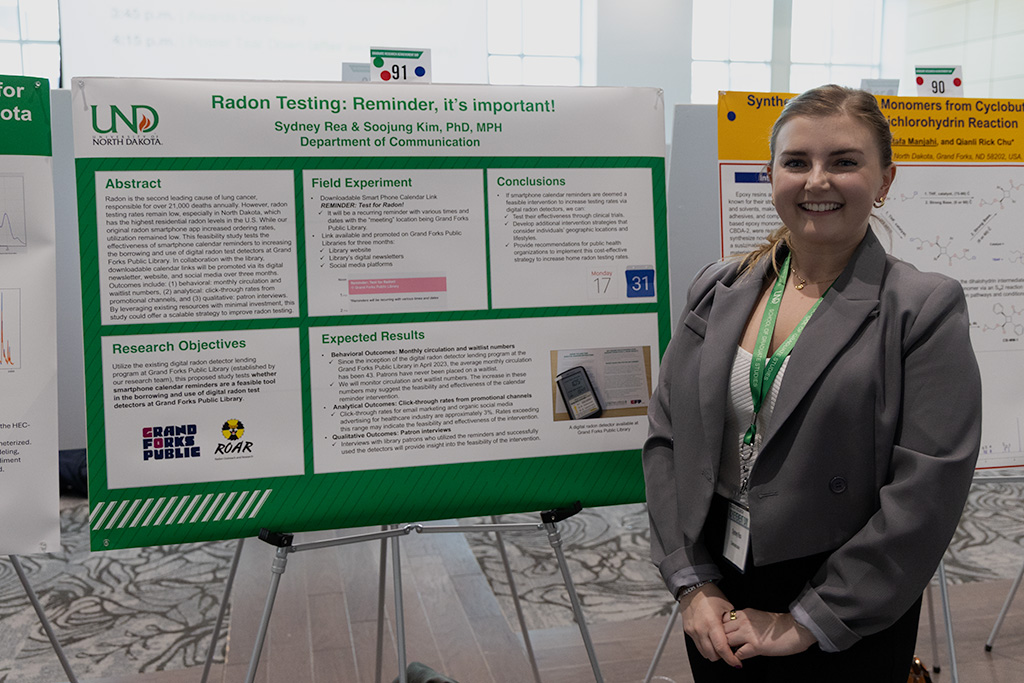
Similarly, Sydney Rea, a graduate student and research assistant in Communications, explored new ways to help people retain information, this time with a public health angle.
Rea works with Soojung Kim, chair and associate professor of Communications, on UND’s Radon Outreach And Research (ROAR) initiative. The initiative offers free radon tests though public libraries in the state.
Radon testing is important, Rea said, especially because North Dakota has some of the highest radon levels in the nation. But many residents remain unaware of the risks associated with this odorless, invisible gas, which is the second leading cause of lung cancer.
Kim’s efforts have helped educate the public on the importance of testing their homes for radon, with many Grand Forks residents picking up the free tests. The problem? Many of these tests go unused.
“We wanted to explore that human behavior aspect. Why aren’t people using these tests and how can we motivate them?” Rea said.
The researchers explored downloadable apps and other methods of reminding North Dakotans. But some of those methods are expensive, while other, cheaper options (such as text message reminders and emails) can get lost in the deluge of notifications people get day-to-day.
Rae and Kim’s answer: Use push notifications through calendar apps.
“Right now, we’re testing to see whether a simple calendar reminder — a downloadable alert that reminds them to use their kit — can increase follow-through rates,” Rae said.
Rea hopes this will be a free, effective method to increase the likelihood that people will use their radon test kits, but she and Kim have yet to start clinical trials or studies to confirm that. Still, she said she has learned a lot through the process.
“Working with Soojung Kim on this, I realized that this is a real risk to North Dakotans,” she said. “Being a lifelong, born and raised North Dakotan, it really stuck out to me, and I think it’s important that we bring attention to it. And, if there’s something we can do to change things and help, that’s the overall goal.”
GRAD Day 2025 awards
Below is a full list of the awards given in each category, as selected by a panel of judges.
The School of Graduate Studies GRAD Day event and its prizes were made possible through the following sponsors: the city of Grand Forks; the Grand Forks Region Economic Development Corp.; Northrop Grumman; True North Equipment; the UND Center for Innovation; and the UND Office of Research & Economic Development.
February 26 | Virtual Program Award Winners
1st Place – Kim Berthet, Earth System Science & Policy
2nd Place – Rashid Ahmad, Indigenous Health
3rd Place – Sydney Johnson, Nursing
February 27 | On Campus Award Winners
Natural Sciences:
1st Place – Darius Quansah, Biomedical Sciences
2nd Place – Diane Tangmi, Chemistry
3rd Place – Ashlyn Herron, Biology
Professional, Social Sciences, Arts, and Humanities:
1st Place – Muhammad Salahuddin, Educational Foundations & Research
2nd Place – Dedan Kusaga, Education, Health, & Behavior Studies
3rd Place – Torosa Johur, Teaching & Leadership
Engineering:
1st Place – Ashraf Mohammed, Geological Engineering
2nd Place – Kobena Eghan, Civil Engineering
3rd Place – Jude Musongong, Chemistry