‘Real research for real people for real problems in real time’
Meet Dr. Marjorie Jenkins, UND’s new VP for Health Affairs and dean of the School of Medicine & Health Sciences
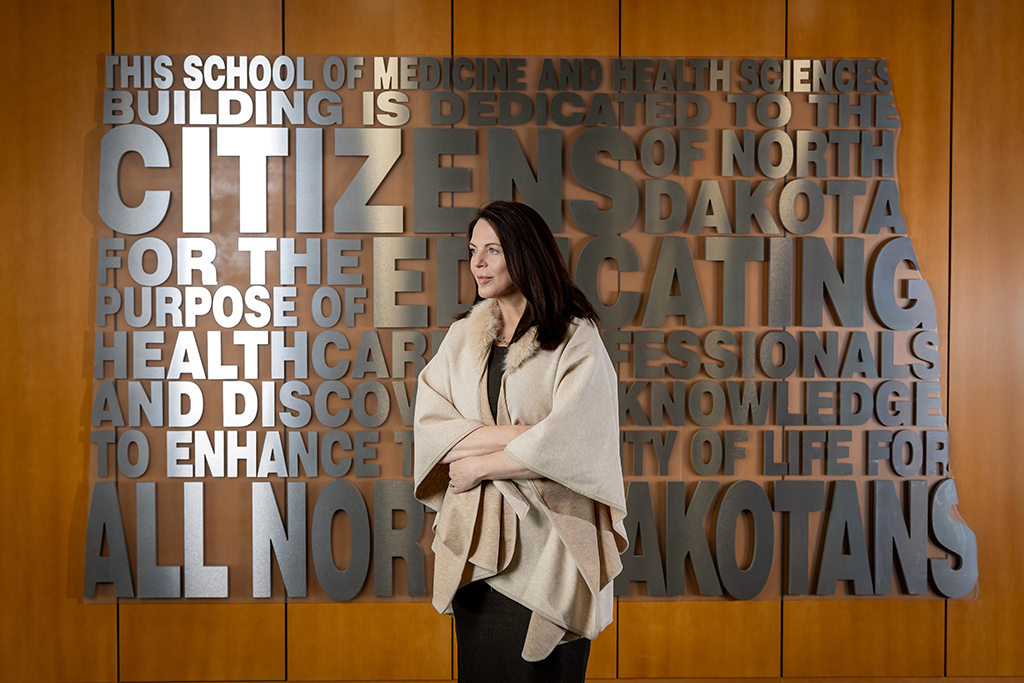
Editor’s note: Dr. Marjorie Jenkins, an internist and women’s health specialist by training, took office on Dec. 1 as UND’s new vice president for Health Affairs and dean of the School of Medicine & Health Sciences. Recently, she sat down with UND Today to answer questions about her background, her interests, her excitement about coming to UND and her hopes and plans for the School.
* * *
You arrived on campus in January, just as North Dakota’s legislative session in Bismarck, N.D., was getting underway. It seems like you had to hit the ground running as dean. How have you fared in these first few, busy months?
Fortunately, I followed Dr. Joshua Wynne, who was an amazing leader. It was great to follow such a successful, legacy leader, and he’s built a great team. I’ve been very well supported, and the University as a whole has such great momentum and lots of successes under President Armacost.
I’ve also been very much impressed by the trajectory of UND and where the School of Medicine & Health Sciences fits so prominently within the University and the state. I’ve traveled to Bismarck several times during the legislative session, which has been pretty fast and furious, so that has been really interesting.
I also found my way to Minot and Fargo, so I have been to all of our campuses. It has been wonderful to meet the people who are supporting our students, our residents and our communities across the state.
Getting to Bismarck and seeing how the legislative process works here, what were some of your takeaways? What were your experiences like in that setting?
It has been wonderful to get to meet our legislators and really feel, up close and personal, the pride and respect they have for what the School of Medicine & Health Sciences brings to the state of North Dakota. I also found legislators to be approachable and willing to hear us and listen to what the needs are, as well as about our success and what we’ve done across the state and for the state.
It has been a positive experience for me — even better than what I thought it would be.
Moving from South Carolina to North Dakota — during winter, no less — was likely a big change. How has that been for you and your family?
My husband, Steve, is still in South Carolina, readying our house to sell. We’ve been married for 33 years. He actually went with me to Bismarck for my first testimony. He flew into Fargo, and we drove to Bismarck together. I can’t wait for him to get here.
To be quite honest, I am loving the cold weather. I think I have an affinity for cold weather. Who would have thought? I grew up in Kentucky and Tennessee, and we raised our family in Texas. So, never in my wildest dreams did I think I would appreciate these winters. As one of my associate deans will say, “It’s bitter out there.” And yes, sometimes it is, but I’ve really enjoyed it. It’s beautiful at times, looking out the window at the snow.
That doesn’t mean I’m not counting the days until spring and summer! When I interviewed, I must have hit the three most beautiful days in Grand Forks. It was sunny with temperatures in the 70s. It was like they ordered the weather for me when I first came here.
With respect to your personal and professional background, can you talk about what brought you to this role and what intrigued you about the opportunities at UND?
I have had a long career in academic medicine, and I was in Texas for quite a while. Then, I moved on to the FDA for four years before applying to be the dean at the University of South Carolina School of Medicine in Greenville.
I never thought I would be a dean; I really enjoyed being a physician, teaching and doing research. So, it wasn’t on my career bucket list, but the Greenville job came up and it really spoke to me — the mission, why the school was started, its partnership with the community.
I say I am a product of divine intervention. I’m always planted where I’m supposed to be, and I have a lot of blind faith. So, when my tenure finished at South Carolina, the search firm called me, the same one that first recruited me. They said, “We hear that you might be available for a new opportunity, and we’re going to tell you about the job before telling you where it is.” I thought, “Ok, here we go.”
They described this wonderful school of medicine, the only medical school in a rural state. Rural health really speaks to my background, growing up as the youngest of eight in Appalachia. I’ve always gravitated toward universities that have a rural health focus.
Eventually, they told me where this place was. Honestly, I am not that great at geography. I had to look at a map to see where Grand Forks was, and I knew North Dakota was “up here” and close to Canada.
That’s what brought me here — the purpose of this medical school. I learned they actually codified its purpose in the North Dakota Century Code. I love that. I don’t need to guess what the legislators want from this medical school, because they wrote it out. It’s to serve North Dakota for the benefit of its people and to improve the quality of their lives. I can live and lean into that every day.
I can’t believe I was fortunate enough to be selected to be the dean here. I feel blessed to be in this role.
In these first weeks, how have you approached the listening, learning and adjustments required for leading the School of Medicine & Health Sciences?
For a school with a footprint so large, I have been having a lot of one-on-one time with people in addition to meeting people at the campuses and in those communities. We’ve had some receptions, and I have had people reaching out to me who have worked at the School of Medicine & Health Sciences for a long time. They want to talk about their experiences and perspectives, and I am always ready to take those meetings.
Understanding the history and various perspectives of people who are here, working in the trenches every day to teach our students and conduct the research and outreach, is valuable. It’s awesome to be able to sit down for those conversations.
As I mentioned, the legislative session has been fast and furious. They do a lot of work in 80 days here. Since Dec. 1, when I started, I have been there four times. That has been an opportunity to get to know that community. We have a campus in Bismarck, connected to our Center for Family Medicine, so I have been able to do some double duty there in getting to meet people.
People have asked about my vision for the School, and I say that my vision will be a shared vision. In order to get to that point, I need to have time to really hear, have some Town Halls and get feedback from folks. I suspect that it will come in the next few months, with me giving a presentation to the broader community around what I have found in this amazing school and also where I think I can, as a leader, help them achieve continued success.
During that time, have any priorities emerged as far as areas you want to address and/or maintain through your roles as dean and vice president for Health Affairs?
Unique to this role is the multiple health care systems that we work with. I’ve been meeting with our clinical faculty; we have more than 1,200 clinical community faculty who teach our students. It is an amazing model to have more than 1,000 physicians out there teaching the next generation.
Eighty percent of family medicine doctors in North Dakota are our alumni, and one in two of all doctors and physicians in the state are our alumni. So, we have quite a broad community out there.
I’ve also been talking to the health care systems about what the partnership has felt like, what the collaboration has felt like and what their strategic goals are. I’m thinking about how we can move that partnership forward and help them meet their purpose: taking care of North Dakotans. That’s been a stakeholder group that I have made a lot of effort to meet with, and I still have several more to meet and have regular conversations with as we move forward.
Areas that are front of mind for me include the partnerships we can have with our health care systems to integrate the academics and the clinical to serve North Dakota and our research portfolio. Under Dr. Wynne’s leadership, we doubled our research portfolio in external funding to almost $40 million. I think we can keep leveraging that to build our research portfolio, looking at big data and population health data to help us inform how to better serve North Dakotans and their health care needs.
I have enjoyed learning about our health sciences programs, which we didn’t have in South Carolina. We have programs for physician assistants, occupational therapists, physical therapists, public health, medical lab sciences and sports medicine. Touring the laboratory spaces and meeting students in the biomedical, clinical and translational research graduate programs has also been exciting. I’m looking forward to connecting with Master of Public Health and Indigenous Health graduate students this spring. That is such a rich environment for multidisciplinary research and for educating our learners across the health sciences and medicine about team training — real-world, hands-on team training.
How do we take care of patients? We do it as a team, so we really have a unique opportunity here.
Regarding how UND approaches medical education, what have you been happy to see, and where do you see potential for innovation — especially considering UND’s focus on rural medicine?
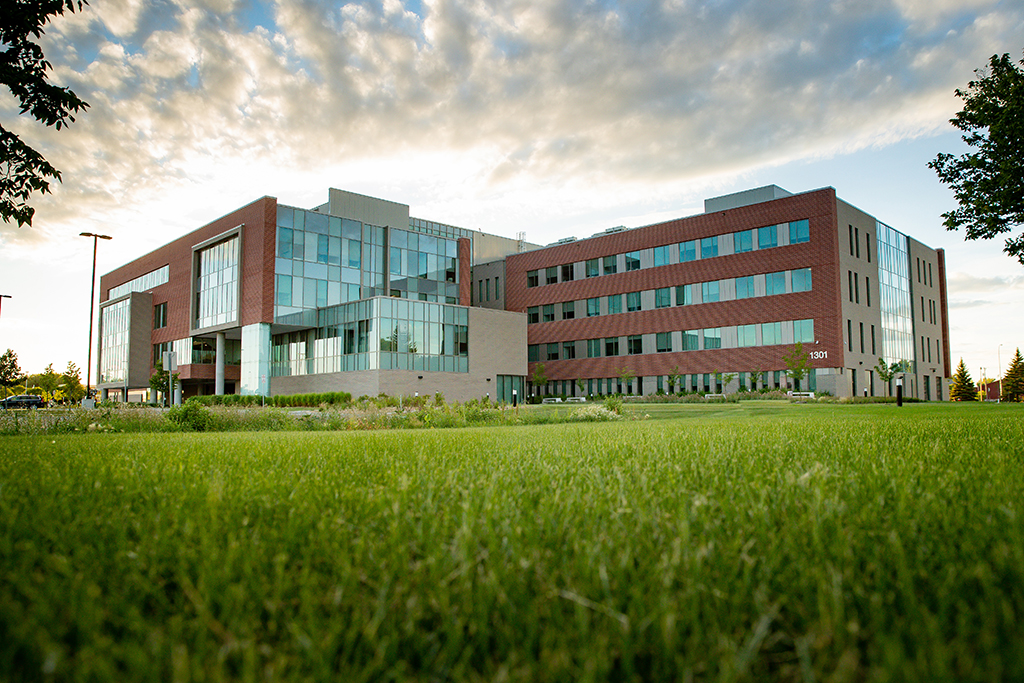
One thing I’ve really valued is the ability to build relationships with our College of Nursing & Professional Disciplines. You may have heard that we’re looking to build a 95,000-square-foot addition to the SMHS and bring that College over to have us all in one location. That would be a real game-changer for us, as far as team teaching.
I’m also so excited about working with Dean Maridee Shogren. She is an awesome leader and out-of-the-box thinker. We are really synergizing about future team training and integrating artificial intelligence into our medical education and health sciences education.
Artificial intelligence is already becoming part of our daily lives. People are starting to use ChatGPT instead of Google — it’s just becoming more and more familiar to people.
But what we need to understand and what we need to teach is that AI is built on real-world data. Machine learning and AI are only as good as the data you provide.
Now, there are some very straightforward things about health care delivery for nurses, physicians and other health professions where AI can limit some of the administrative busy work and let us focus on caring for the patient. However, there are places where you do not want to take the human out of health care.
I think that with our University — including all of the disciplines out there — and with all of the disciplines in the health system, we have a unique opportunity to work together to show where the technology of AI meets humanity. That is in the health care field. That is health sciences.
UND has been unique in talking about bringing the humanities into technology. I think that is a great opportunity for us, working with the College of Nursing & Professional Disciplines.
I can’t wait to have that addition to our School — that additional space for us to grow our research, teaching and understanding of technology such as AI. That is going to be an awesome thing for North Dakota.

We’ve previously reported on UND’s progress in reducing medical students’ debt burden in a strategy focused on tuition value, unique programming and scholarship support. From your experience, how are you considering the balance of keeping UND’s offerings affordable while remaining competitive with peer institutions?
I think the value proposition for this university, and what I know in my limited time here, is No. 1 our president. President Armacost is a transformational leader and has brought such a great amount of success to the campus. If you look around, you see construction and growth in a lot of different areas. That’s a real positive.
Coupled with that, however, is the reality of inflation we’re all living through. This means increased prices for our students in a lot of ways. In our M.D. program, the average student will leave with $164,000 in debt. That is more than I paid for my first two houses together.
The ripple effect of that debt, in tandem with undergraduate debt, is a top priority for us. That was a huge priority of Dean Wynne’s, to lower the debt. We used to be above the national average for debt load, but now we’re way below.
The other piece is scholarships and being able to bring scholarships into the School. We have a state-sponsored RuralMed program where students can receive full tuition and fees for medical school, almost $170,000, and train to serve in North Dakota for five years in a rural community.
We have a lot of resources here that we are using to try lower the debt load for students, and yet we are dealing with an increase in technology costs. We’re very technology-heavy, and should be for our learners who are digital natives who expect that, but there are costs and upkeep with that.
So, we’re trying to balance the value proposition of what we bring to our students with attempting to keep our prices as low as possible while at the same time delivering that high-quality education that students won’t be able to experience anywhere else.
While UND reached a significant milestone in achieving R1 classification, it faces headwinds from federal funding changes and uncertainty. How do you see the School of Medicine & Health Sciences adapting and maintaining its research and service to the state and community?
I’m not often called an optimist. I’m more of a realist. When I got the announcement that we were officially named a Carnegie R1 research university, I knew that was a game-changer for us. That changes what we can accomplish in research. It opens a lot of opportunities, and it feels great to now be a part of.
From my past experiences, I’ve seen what the robustness of that ranking can bring to the research portfolio.
Regarding the indirect cap that people have probably heard or seen in the news, where federal organizations such as the National Institutes of Health are capping at 15%: There are many federal organizations that give out grants. Our indirect rate, currently, is 41%. This is a number that is negotiated from university to university, so most places have a different rate. Private universities in the northeast might have something like a 68% rate.
When you couple all of our research projects together, some grants such as foundation grants and state grants won’t have any indirects included. So, when we look at our entire portfolio, our effective rate is lower than 41%, but it’s still millions of dollars that will be lost if this is allowed to take effect. That is significant in impacts to graduate programs, post-docs, undergraduates and health sciences and medicine learners who are working in labs with researchers. The ripple effect of this is potentially huge.
People are working toward that not taking effect and having a more strategic approach to indirect costs at the federal level.
But here is where my optimism comes in. We have a huge amount of opportunity here to grow our research and do what I’ve told some of our legislators and stakeholders: real research for real people for real problems in real time.
I’m a big believer in discovery research, getting us to new drugs and therapeutics and saving lives. That’s important to me. But we also need answers today for our rural health, for our people across the state whom we serve. We are uniquely positioned to do that type of research.
For example, just look at the top three areas that impact North Dakotans: cardiovascular stroke, cancers and mental health. We have the expertise, and we can grow those areas to create collaboration with health care partners to deliver 21st century solutions for North Dakota. I think that’s where we’ll be going, and if we talk again in a couple of years, I’m sure we’ll be able to share some big successes in that space.
It’s a fluid time, and I know that there is a lot of stress and anxiety in the system and for people. I totally appreciate that. I think we will weather this well at our medical school.
Part of that is the amazing University we’re part of, but also the state we live in and the support that we have from our legislators and communities.
We have talked about this already, but a bill has been introduced to provide around half of the funding necessary for an addition to the SMHS building, called the Health Professional Collaborative Facility. This new facility, if constructed, would reportedly move the majority of health care disciplines together, under one roof.
Can you talk about the School’s aspirations for this move, and how it would affect students’ experiences, whether training as nurses, therapists or physicians?
There is an organic growth that happens when you’re in a space with your fellow students. If they’re from different disciplines, you have different conversations and share experiences. That just happens with the physicality of being in the same place.
But the Health Professional Collaborative Facility will build out what is known as a simulation hospital. That will be an emergency room, inpatient beds, a surgery suite and more that will allow our students to do real-world training. This addition will also allow us to be a convener for health care providers across the state, to come in and learn scenarios, techniques and take that back to their critical access areas: their communities.
In addition, having all of the health professions and professional programs in nursing in the same space will give us an opportunity to grow really collaborative, multidisciplinary research programs. We can have students learning and debriefing in the same space, allowing us to learn what other team members are doing, what they bring to the team and to respect their expertise.
Back in the day, even before I went to medical school, I think the physician was seen as kind of the leader. The physician led everything, everyone asked the physician what the answer was, and the physician gave the direction.
But now we understand that the best quality care is done when we have multiple professions giving that input and working together to provide the best quality care for the patient. That is where the uniqueness of this new facility will come in.
The value proposition here is that team training, building out our center for teaching and training that I mentioned before.
There is also a practicality, in that we’re going to be moving our faculty and students from Columbia Hall, which was the former medical school building. I have learned it was a hospital, and people tell me they were born in that building.
We still have 20,000 square feet of labs and teaching in that building. With it being taken down in the next few years, we’ll start moving in the summer.
And moving 20,000 square feet to our current building is going to be a stretch. Some might not know that we teach almost 1,000 undergraduates; we teach basic science courses such as physiology and anatomy. Our undergrads get a unique experience of having a donor body anatomy lab, in a medical school lab, and I think that’s something we want to continue delivering to our students.
Again, this in part points to the practicality of adding to the current SMHS building and why we’re pursuing that in this legislative session.
If we start today in planning, getting shovels in the ground and outfitting the building, we’re still looking at a four-year window before we have that addition. So, I always say the future begins right now. That’s where we’re headed, and it’s going to be wonderful as value added to the state and to our students.
As far as where that effort is in development, how are you seeing that process play out right now?
When we talked about the Century Code and the codifying of the purpose of the medical school, that document also includes an advisory council for the School. On that council are four state legislators: Sens. Robert Erbele and Tim Mathern and Reps. Gretchen Dobervich and Jon Nelson.
In their roles, they are advocates who also provide feedback and guidance. The senators sponsored the bill in the Senate, which was a $95 million bill with $40 million that UND was committed to bringing in via private fundraising. That bill did not get the funding from the Senate Appropriations Subcommittee, but they did keep the bill alive and with a study to look at what the building would bring, to look into it further.
Now, we’re in crossover, so the bill will be considered in the House, which means there will be another opportunity for us to talk about the need for that building, the funding and our commitment to raise 45% of that total.
We think that’s definitely doable. UND has a track record there, with Nistler College being an example.
With the president’s supportive leadership, we’ve been able to bring that forward to the state. We’re very excited. I look forward to having conversations with House members and presenting our needs and the value of such an investment.
We’ve been talking about quite a few things at a pretty high level, but is there anything else that you want to say to our campus community members and general audience?
I came here with a great respect for what has been accomplished at the medical school and across the state, in all of our programs, since its inception.
I am a student-centered dean. I feel like our first stakeholder, and why we’re called a “school,” is because we have students. Supporting those students, wherever they are in their academic careers, is very important to us. That’s how we pay it forward. And I look forward to getting integrated with the community and becoming part of it. I look forward to having Steve here to be part of that experience.
And for those who I haven’t met yet, I look forward to meeting you and hearing your perspectives about what they see for their medical school as we move forward. And thank you, UND Today, for the opportunity to chat.