Calling political balls and strikes
Non-partisan reporting essential during times of increased polarization, says Hagerty Lecturer and UND alum Ian Swanson, editor-in-chief of The Hill
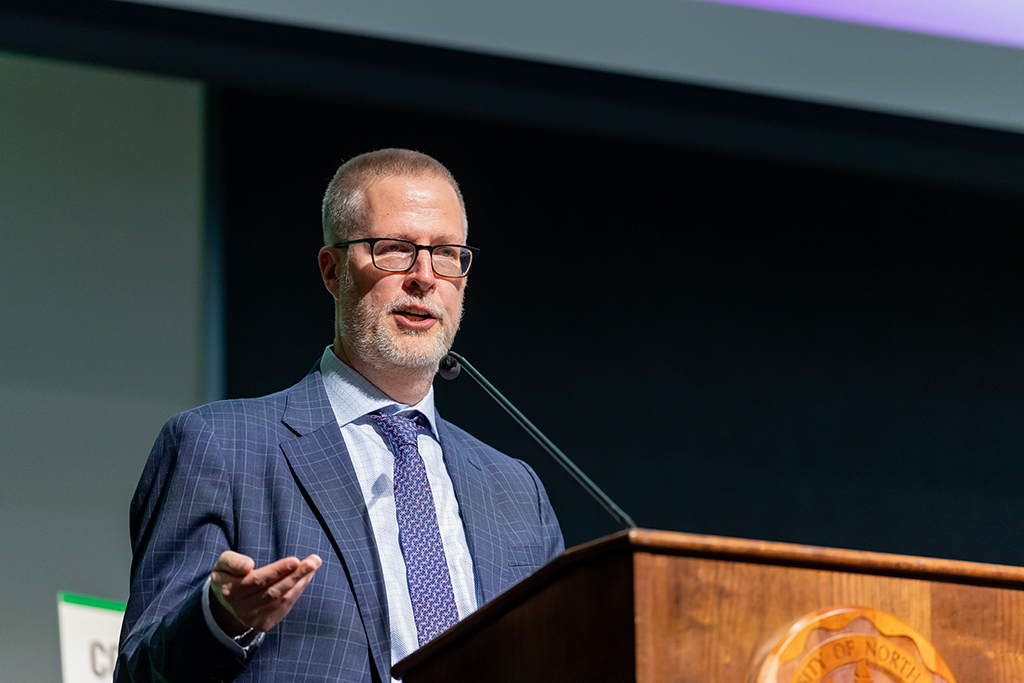
Last month, UND welcomed back to campus a prominent alumnus who delivered a lecture outlining the past, present and future landscape of journalism.
Ian Swanson, editor-in-chief of the Washington-based political news publication The Hill, delivered the University’s annual Hagerty Lecture. The series honors the late Jack Hagerty, longtime editor of the Grand Forks Herald.
After graduating from UND in 1992 with a bachelor’s degree in Journalism, Swanson founded the High Plains Reader – an independent publication covering news, arts and entertainment in the region. He then worked for the Grand Forks Herald, covering the North Dakota Legislature among other beats.
Swanson spoke fondly about his time at the Herald, stating that it gave him the political reporting experience he needed to transition to a larger publication.
“Those were the first times I got to ask questions of people who were voting on things – flood relief, funding for higher education – that were affecting my community back in Grand Forks,” he said. “That gave me the bug to want to get to Washington and cover things on a national scale.”
In 2007, Swanson joined The Hill as a reporter covering Congress and international trade, before being promoted to his current role.
In his lecture, Swanson spoke of the importance of non-partisan reporting in a world in which both the media and political environments have grown increasingly polarized.
“We’ve tried to call the political balls and strikes,” he said. “When we read a news article or watch a report on television, we want to believe that the people giving us the news don’t have an agenda other than getting to the truth. It’s especially true at a time when the country is divided as it is, and people aren’t trusting each other.”
Swanson likened news sources with a clear bias to “professional wrestling,” and although he conceded there is likely a place for such outlets in the world of modern journalism, they come with costs.
One such cost, he said, is the erosion of trust in the media.
Swanson cited a 2025 Gallup poll in which only 28 percent of Americans surveyed agreed with the statement that “the media is reporting the news fully, accurately and fairly.” This figure represents a steep decline from around 70 percent in 1974, when outlets such as the Washington Post were lauded for their rigorous investigative reporting that uncovered the Watergate scandal.
Swanson called that period “the pinnacle for trust in news sources,” and opined that the fragmentation of traditional media sources into a mix of news, entertainment and opinion has led to declining trust in reporting.
“If you read or watch exclusively conservative or liberal sources, you are going to be told one side is right and the other is wrong, regardless of whether a minority opinion might have a point,” he said.
Another cost of declining engagement with traditional media sources, Swanson said, is the decline of newspapers in the United States – 2,500 of which have closed since 2005.
Social media – and its algorithms tailored to users’ political proclivities – can be especially pernicious to objectivity and discourse, Swanson added.
“If you’re getting most of your news from social media, it can really lead you into an echo chamber of your own creation,” he said. “When I got my start in journalism, there was no social media, and I thank my lucky stars on that every day – even though I like keeping in touch with people on Facebook.”
Asked about the rise of artificial intelligence and its impact on journalism, Swanson argued that the technology is no substitute for in-depth reporting.
“Luckily, one thing AI can’t do – at least not yet – is have a conversation with a politician or aide involved in a backroom deal or negotiation,” he said. “That kind of reporting at the state, local or federal level will remain valuable as long as people are willing to invest in it.”
In a midterm election year marked by major campaign issues – among them immigration and trade policy, a rising cost of living and the future of AI – Swanson concluded his address with an appeal for objective journalism.
“Journalists will and should be on the frontlines reporting on how our political leaders address these issues,” Swanson said. “They should be asking tough questions and holding our leaders accountable for their answers. There’s a long, proud tradition of newspapers in this country of news outlets that have a perspective, and I think that’s valuable. But to deal with some of these big issues, we need plenty of reporters and editors acting as non-partisan arbitrators.
“My experiences at The Hill have given me hope for that, and I hope everyone in the audience will help by demanding it from the media you engage with.”