Vera Kelsey, UND’s woman of the world
In honor of Women’s History Month, learn more about UND’s history-making 1914 graduate, Vera Kelsey
Finding compelling subjects for feature stories in the pantheon of UND graduates is not hard. For example, Era Bell Thompson, Cora Smith Eaton King and Helen Hamilton are among the notable, history-making women to have studied at UND.
But because of this wealth of talent, some figures — despite their impressive achievements — fade from memory and are in some ways lost to time.
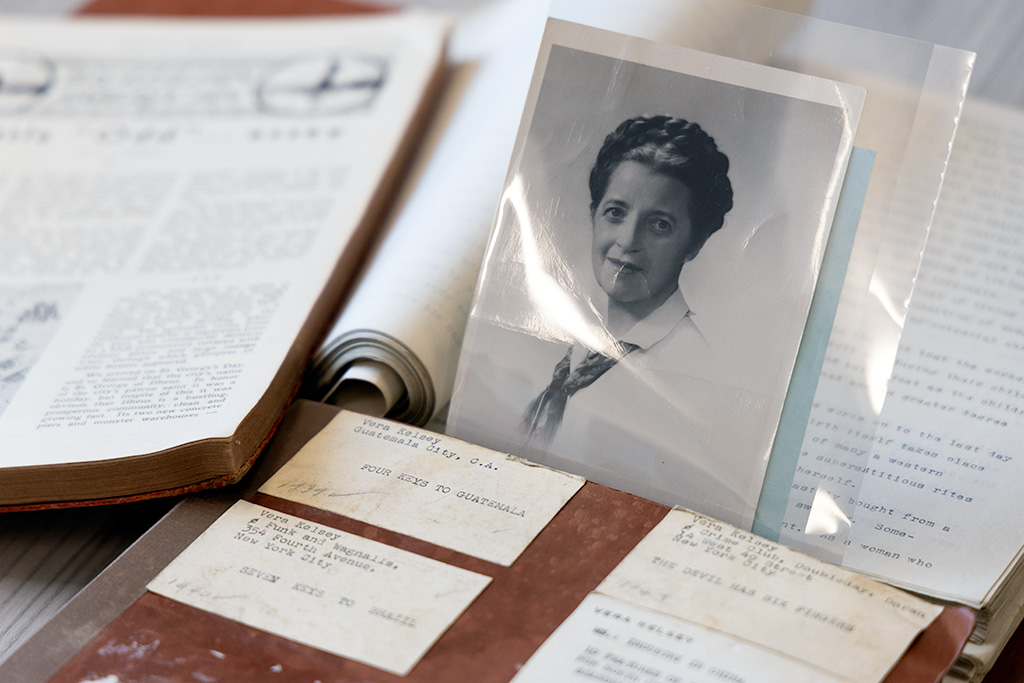
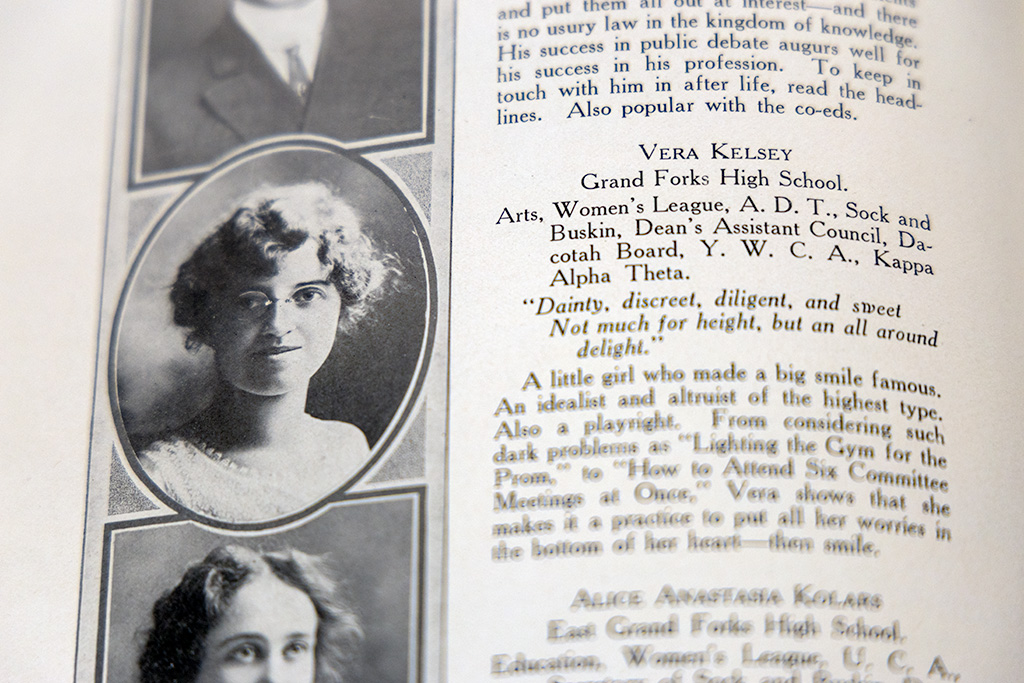
Vera Kelsey, a 1914 UND graduate, is one such person. Kelsey was an author, journalist and world traveler, a woman with a zest for life and an inquisitive soul. She allowed her curiosity to shape her craft and guide her through life.
A life of artistry forged in North Dakota
Born in Winnipeg, Man., Kelsey and her family moved to Grand Forks when she was 9 years old in 1900. Even as a child, she displayed remarkable artistic talents, particularly in sewing and embroidery. Her skills were recognized at the North Dakota State Fair in 1908, where she won first place for “Best Cross-Stitch Specimen” and “Best Embroidered Pillow.”
While studying Sociology at UND, Kelsey continued to expand her artistic abilities. She began refining her artistry by writing, directing and performing in various pageants, operettas and farces with her sorority, Kappa Alpha Theta. She also would serve as editor for multiple publications, including “The Dakotah,” a UND yearbook containing poems, stories and retrospectives.
After graduating from UND, Kelsey spent a year at Brown University before returning to Grand Forks to teach and take graduate courses in the English Department. Her time at UND as a student and educator helped shape her literary voice.
In 1917, she set out west after accepting a teaching position at the University of Washington.
Following her tenure in Washington, Kelsey embarked on another, more daring journey that would transform her life and career. In 1920, she traveled to China, which would prove to be a definitive moment for her.
Vera Kelsey, woman of the world
While in China, Kelsey turned her writing talent into a successful journalism career. From 1920 to 1925, she worked as a feature writer for the “North China Daily News,” where her sharp eye and detailed observations breathed life into the day-to-day routines of workers in the increasingly industrialized nation.
Kelsey’s ability to capture human experiences and nuances in China would earn her acclaim in China and the West, where several American and Canadian newspapers wrote about her work.
During her time in China, Kelsey also made history by writing the first industrial survey of central China. “Industry in China,” which has a manuscript preserved in the Elwyn B. Robinson Department of Special Collections, offers detailed descriptions of the burgeoning Chinese textile and manufacturing industries, and she documented Chinese laborers’ lives and working conditions with a keen eye.
Her experiences in the Far East left a lasting impression on her, and she often spoke fondly of China and Japan when she returned to America to live in New York and Minnesota.
“It seems very good to be home, but China won my heart completely, and I am looking forward to returning some day,” she wrote in a 1922 letter to her friend, Mildred Corliss.
As her literary career evolved, Kelsey continued to travel extensively and write about diverse cultures and societies. While traveling throughout South America, she wrote several travel books, including “Seven Keys to Brazil,” a work that was acclaimed for its detailed portrayal of Brazilian life.
“Nothing escapes the penetrating vision of Vera Kelsey, who sees, examines and inquires into everything with an honesty of observation,” wrote Brazilian scholar Angyone Costa in the Brazilian newspaper “A Gazeta.” “She has an acute sensitivity for observing customs and traditions, penetrating the very soul of the people on whom her sympathetic understanding falls.”
In addition to the numerous travel books she wrote as she traveled through South America, Kelsey also wrote a children’s book, “Maria Rosa: Everyday Fun and Carnival Frolic with Children in Brazil,” which featured illustrations by celebrated Brazilian painter Candido Portinari.
‘An awful lot of living’
Kelsey was not one to stay in one place for long. Even when she moved back to the States, she split her time between Minneapolis, New York and North Dakota and continued her international travels. Eventually, she turned her sights back home when she wrote her historical exploration of the Red River, “Red River Runs North!”
The book, a sweeping examination of the events and people that shaped the Red River Valley, is often regarded as Kelsey’s crowning achievement.
“There’s a bit of everything — history, biography, adventure — fascinating real Western material for the addicts,” noted a 1951 Kirkus Reviews assessment.
The people and places Kelsey encountered in her travels almost always informed her work. Her mystery novel, “Satan Has Six Fingers,” centered on a young American woman in Rio de Janeiro, while another mystery, “Whisper Murder,” was set in a fictional Minnesota town.
Despite her prolific writing career, Kelsey confessed to struggling with writer’s block in letters to friends. A letter written while traveling in Japan suggests that the openness and curiosity that made her travel writing so compelling also created challenges.
“My brain just shuts the door and walks away like a shiftless housekeeper when I even think of writing a letter,” she wrote to a friend in Minnesota. “For my mind is so cluttered with impressions and sensations and ideas and details that putting it in order for a letter, especially when the mail closes at 9 tomorrow, seems hopeless.”
Still, Kelsey’s fearless approach inspired other young women writers, particularly at a time when an American woman traveling alone to foreign lands was most unusual.
In a 1957 article for the “Vancouver News-Herald,” journalist Helen McGrath suggested that Kelsey’s career serves as inspiration for writers looking to carve out their own place in the industry.
“If ambitious young writers studied Miss Kelsey’s fabulous career in search of the clue to success, they might find it lies in following one’s impulses, no matter how ridiculous they seem.”
In the same article, Kelsey offered insight into how her life and experiences influenced her work.
“It is your ideas, your depth of perception and experience that the publisher looks for above all. You must have done an awful lot of living to write about it, and you must have a mature compassion for and understanding of people to write about them.”
Visit the Elwyn B. Robinson Department of Special Collections in the Chester Fritz Library to explore more about Kelsey’s legacy, including letters, manuscripts and reference materials. Even in her correspondence, Kelsey was eloquent, and her letters and manuscripts offer more than a glimpse of this talented, worldly woman’s work and life.
>> Do you want to read more UND Today stories? Just hit the link or go to our home page to subscribe to our twice-weekly newsletter.