Art, tech, community fluoresce at 56th UND Writers Conference
UND Writers Conference explores ways in which technology, literature, art can commingle, strengthen communities

“With great power comes great responsibility,” said Assistant Professor of English Patrick Henry, quoting the 2002 silver screen adaption of “Spider-Man” with a laugh.
Henry was reflecting on his first year as the sole director of the UND Writers Conference — an event with a storied history and national reputation for bringing acclaimed authors, artists and thinkers to Grand Forks each spring.
“I wouldn’t say running a literary festival is great power,” he continued, “but I do feel a tremendous responsibility to our campus community, the history of the Writers Conference and to the example of previous directors such as Crystal Alberts. It’s been an immense honor to see these events unfold and to hear from our students and alumni how much the conference has shaped their experiences.”
The theme for the conference’s 56th year, “Makers & Machines,” explored the intersections of technology and artmaking, while maintaining the focus on literary excellence that long has defined the event.
“I wrote the theme back in the summer of 2023,” Henry said. “My original inspiration came from the maker movement of the 2000s and 2010s — 3D printers, inexpensive Raspberry Pi computers — tools that made DIY tech and art more accessible. The idea of a maker space is rooted in access and community. That was the initial catalyst.”
Henry said the theme began to click into place after reading “Memory Piece,” a novel by 2025 visiting author Lisa Ko. The book follows three women — an artist, a coder and a community organizer — over several decades, from the rise of the internet in the 1980s to a dystopian future in the 2040s.
“That novel became a kind of North Star,” Henry said. “It helped me see how art and technology shape community — and how stories help us navigate that relationship.”

Art, tech and community collide
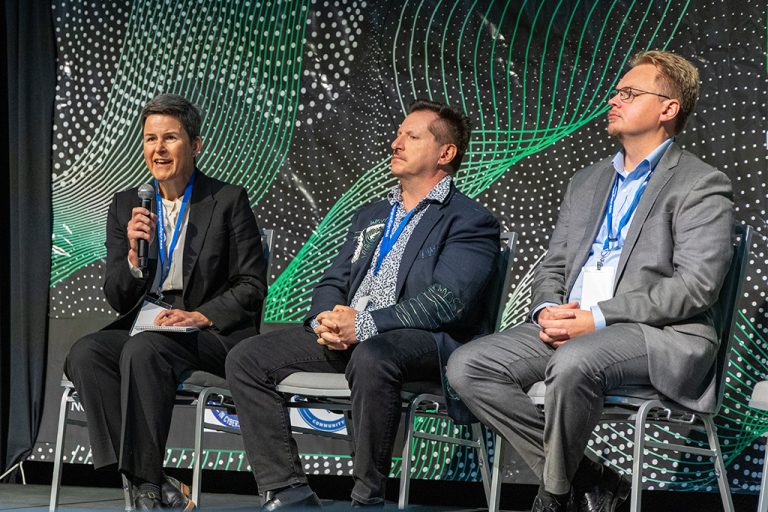
That relationship was front and center during the conference’s Friday afternoon panel, which featured poet and technologist Kenzie Allen, experimental novelist Eugene Lim and multimedia artist KT Duffy. The discussion, moderated by UND Associate Professor of Philosophy Lucian Stone, explored how creative practices can be both personal and collective — even in an increasingly digital world.
“I think about how our digital creations actually embody in the land and in the world,” said Duffy, who works with open-source tools and web platforms such as glitch.com to make collaborative art. “It’s a communal space where everyone is welcome.”
Duffy also added that technology has created new avenues for human connection.
“We’re developing other ways of languaging,” Duffy said. “We’re developing other ways of connecting.”
Similarly, Allen, a Haudenosaunee poet and artist, reflected on how Indigenous populations long have used technology to connect with their communities. Allen pointed to Wampum, the Indigenous practice of weaving purple and white beads into belts or strings to record historical events or tell stories, as an example of how technology can be central to telling stories.
“Wampum is the original digital literature,” she said. “You make it with your digits. It’s purple and white, like binary code. And each symbol leads to another part of the story. It’s both technology and narrative.”
Lim, whose most recent novel, “Search History,” features AI in its plot and themes, added that the importance of fiction in a technological world lies in its ability to cultivate empathy. He affirmed that, in an industry increasingly concerned with how technology diminishes the value of art and artists, human-made works and shared stories remain important.
“Fiction survives by offering interiority,” he said. “That’s something visual media and tech spectacles can’t do in the same way. Language gives us access to thought. That’s where fiction finds its staying power.”
Lim, like Allen and Duffy, also pointed to literature as a tool for finding connection and community.
“I can’t necessarily fight the system,” he said, reflecting on community change. “But I can be within it and try to signal to others — other like-minded people — ‘Here I am. Maybe you’re there, too.’ And through that, we can persist.”
Alongside panels and readings, the conference included community writing workshops, open mics and tours and evening mixers at the North Dakota Museum of Art, all of which continue the trend of public engagement that has given the annual event its staying power.
“People want to make art together, which doesn’t surprise me,” said Henry. “But, we held extra sessions this year during the 2 p.m. block, and it was nice to see that they were all very well attended.”

A conference for everybody
The conference also attracted attendees from beyond the College of Arts & Sciences. Law student Abby Peterson and pre-medical student Edward Tortorelli said they found value in hearing from artists and writers.
“Taking into consideration perspectives and humanities is something that is overlooked very often,” Tortorelli said. “But it’s very important, because you’re dealing with people pretty much all the time in fields like mine.”
Peterson said that, despite their busy midsemester schedules, they tried to attend as many panels as they could. Peterson writes between classes and studying and said that, though she was disappointed to miss out on the community sessions, she found value in listening to authors and artists speak on panels.
“It’s nice to hear somebody be like, ‘It’s OK to just keep pushing the boundaries, keep trying things,’” Peterson said. Peterson and Tortorelli agreed that, though their coursework isn’t focused on art, learning from and about artists can help them in their fields.
Casey Fuller, a poet and doctoral student in the UND English Department, has been involved in the Writers Conference since arriving at UND five years ago and has helped instruct community sessions, moderate panels and facilitate community open mic nights. Fuller was heartened to see and hear that so many members of the community have an interest in reading, writing and exploring art.
Fuller also mentioned that the Writers Conference was one of the things that drew him to UND in the first place, and that its legacy remains impressive after 56 standout years.
“When you look through the UND archive of past conferences, you can get a sense of the larger sweep of literary history and how it changes over time,” Fuller said. “One of the things that draws me to the conference is that it’s a place for a lot of people to sort of join together and talk about people who are doing writing and making art at this moment.”
For Henry, the sense of connection that Fuller mentioned was one of the most important aspects to maintain as he stepped into his role as director.
“The Writers Conference is for everybody,” he said. “Stories help us understand each other. That’s what this event is really about — creating a space for empathy, for discovery and for community.”
Recordings of panels and readings from this year’s UND Writers Conference will be available to view on the UND Scholarly Commons webpage soon. For now, readers are invited to look at the Scholarly Commons archives of past conferences to learn more about their panels, readings and visiting authors.