Education research: Posters on the leading edge
Sum total of human knowledge goes up by 87 as College of Education & Human Development researchers present
If you didn’t know the reason for the UND College of Education & Human Development recently breaking into the National Science Foundation’s Higher Education Research & Development survey’s Top 100, it became strikingly obvious Thursday at the CHED Research Conference.
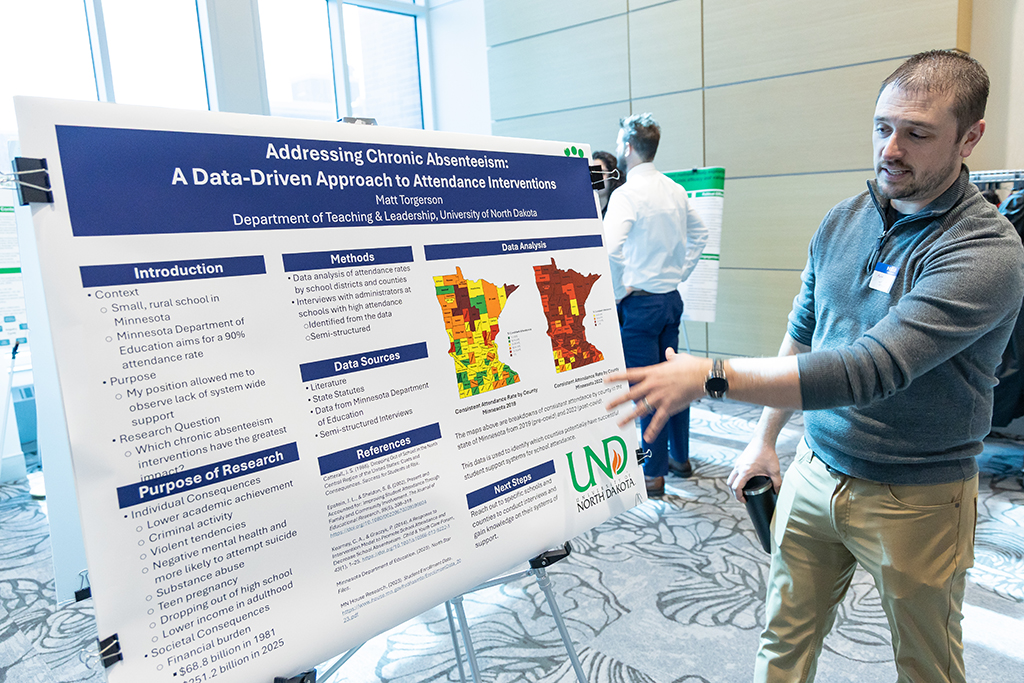
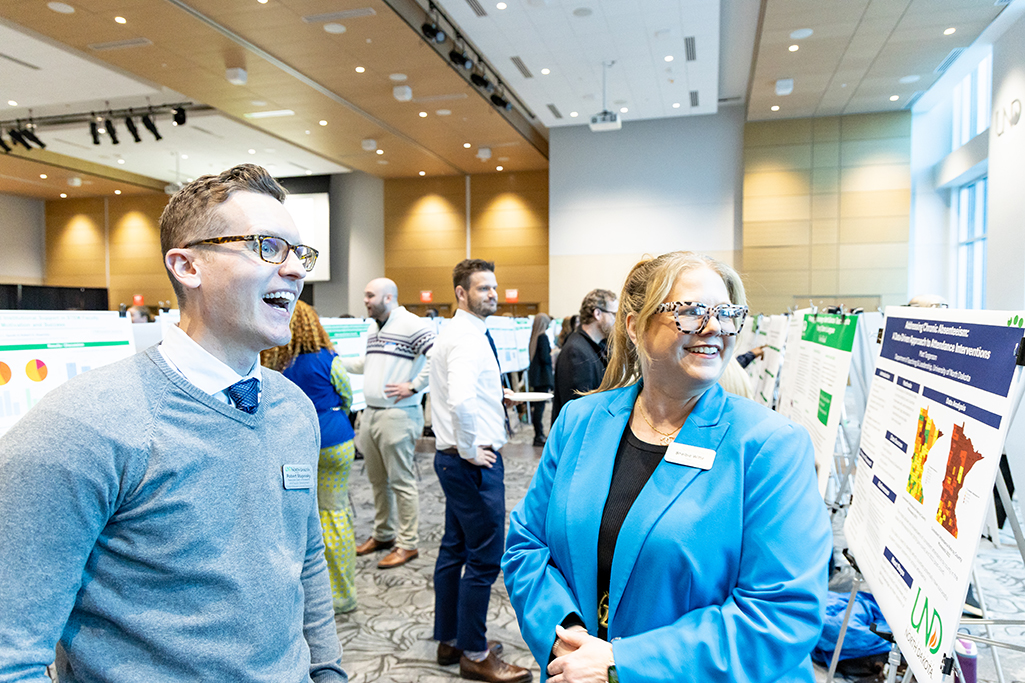
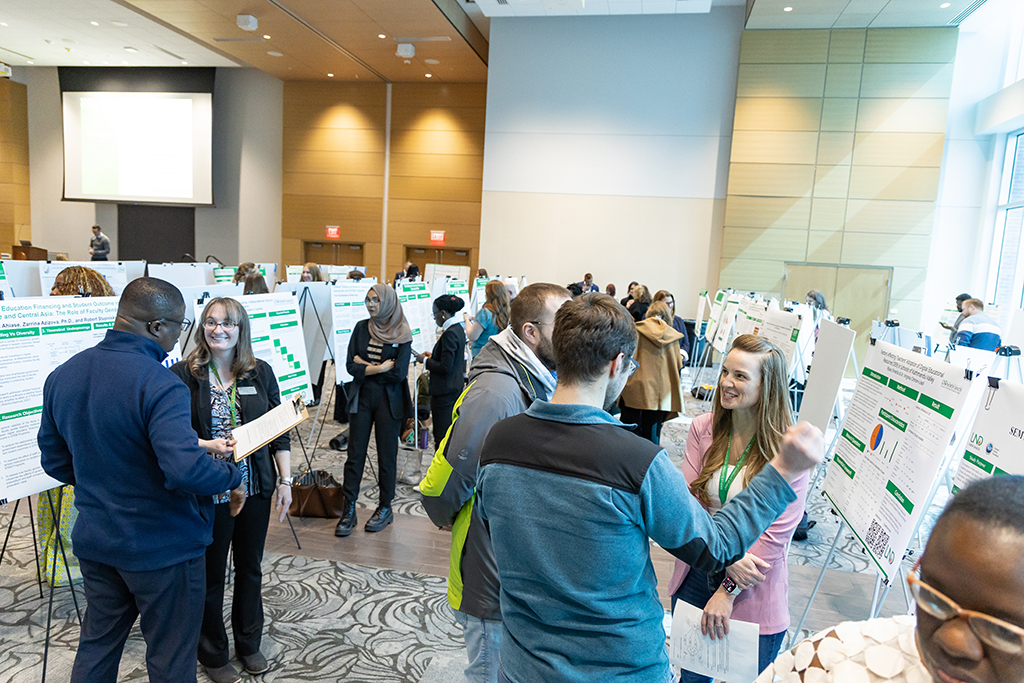
Graduate students and faculty had it GOING ON inside the Memorial Union Ballroom with 87 posters showcasing their research.
Dean Shelbie Witte said hundreds of people filtered in and out of the ballroom all day to take in the poster presentations, along with 12 formal on-campus research talks, seven online talks and three research award presentations.
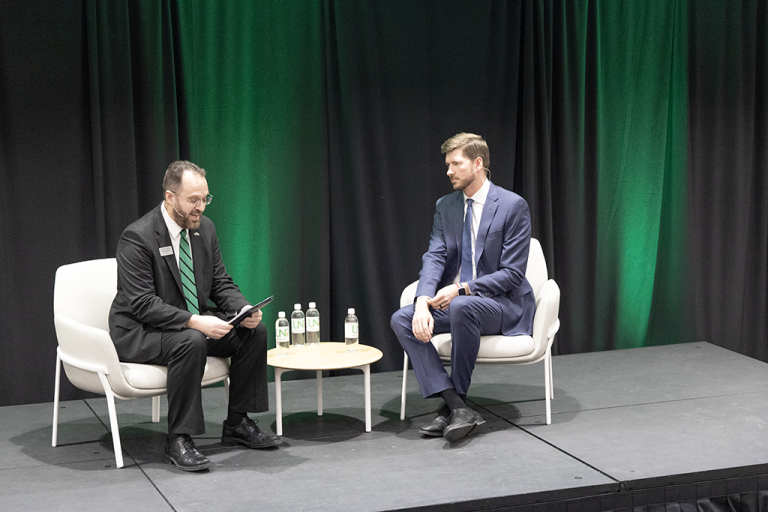
“This is a world-class event right here in Grand Forks,” Witte said. “It’s tremendous, not only in the size and scope of participants, but as well as the folks who have come from across campus to join in community to discuss research and to really emphasize the importance of research both in our college and at UND. It’s super exciting.”
A community of education researchers
Witte went on to say that so much of the important work that researchers do can feel like it’s taking place in a silo.
“But when you’re able to present to a larger audience, you get the opportunity to unpack all of that and talk about the impact the research makes on North Dakota and the wider communities throughout the nation and the world,” Witte said. “The screenshot on the College of Education & Human Development is preparing professionals to nurture stronger minds, bodies and hearts — and we mean that in all aspects of physical fitness, mental fitness, intelligence, kindness and what it means to be compassionate.
“If you look at the full program of today’s research conference, you will see that the tangible, living research that’s happening fits that vision.”
CEHD Associate Dean of Research & Faculty Development Rob Stupnisky seconded that sentiment.
“There’s this stereotype of the lone wolf researcher, and a lot of times I’ve heard colleagues talk about students or other faculty members and say, ‘I didn’t know you did research on this or that.’ Well, here’s a chance where we can come together and learn a lot about what each other is doing,” Stupnisky said. “This fosters collaboration in the building and even generates new ideas for future projects and future grants. It’s also really important to see so many graduate students presenting today. The more similar we can make this conference to what it feels like to be at a national or international conference, the better prepared they’re going to be when they go out to present elsewhere.”
Peers select standout education researchers
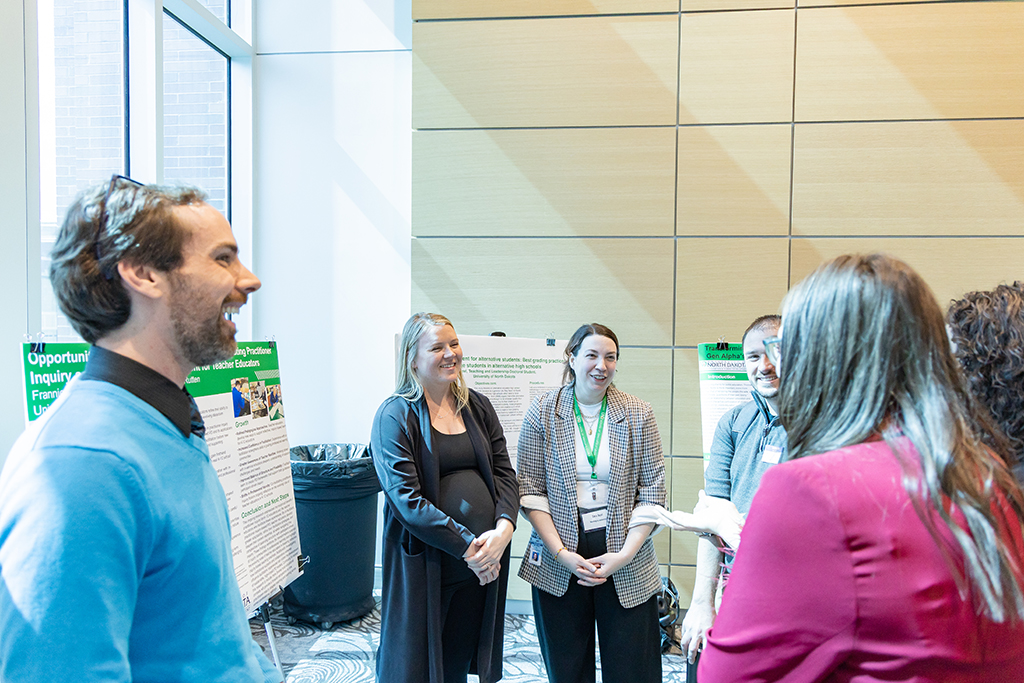
Stupnisky easily could have been talking about this year’s peer-selected research award winners.
Muhammad Salahuddin of the Education Foundations & Research doctoral program and Logan Rutten of Teaching, Leadership & Professional Practice were selected as winners of the Inspire Graduate Student Research Excellence Award and Aspire Early Career Award for Excellence in Research, respectively. Lee Ann Williams in Education, Health & Behavior Studies was chosen as the winner of the Excellence in Research & Scholarship Award.
UND Today ran into Salahuddin and Rutten at Thursday’s conference.
Rutten, a second-year assistant professor, said he was honored to receive the award.
“For me, it fuels the drive to continue this work with communities and in service to the public schools of our state,” Rutten said. “To be publicly recognized for that work among colleagues, students and community members is affirming, and it fuels the work and the desire to grow it and deepen in partnership with the people of North Dakota. It means a great deal to be recognized — not just for research quality but for research impact — and that’s something we do together by collaborating with folks throughout our state. I’m truly grateful to be honored in that way.”
During the conference, Rutten shared with the crowd how he was inspired to pursue a research career focused on partnering with schools and communities in “improvement efforts that matter most to them locally.”
In particular, one project involved support and collaboration that led to significant impacts for students’ sense of belonging. A second involves a partnership between UND, Pennsylvania State University and the Navajo Nation to create a culturally sustaining curriculum for students.
Supporting faculty research motivation
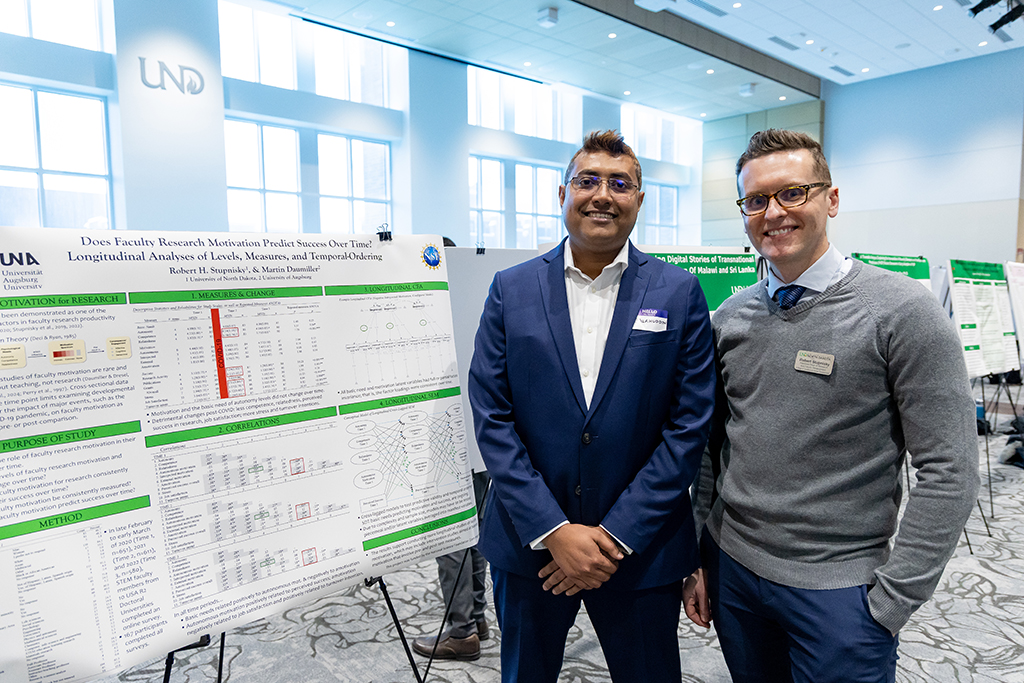
Salahuddin, a native of Bangladesh who has earned 19 academic awards since arriving at UND in 2021, has been working with Stupnisky on faculty motivation research.
Salahuddin created a test that measures research knowledge and skill. He believes how competent faculty are in their research skills is an important part of their motivation, and in turn, their productivity. However, in past studies, faculty only self-reported how competent they believed they were in research, and such self-reporting can contain bias. Minimizing such bias will have important implications for faculty professional development.
Salahuddin plans to finish his dissertation and graduate with his doctorate this summer.
“I feel that this recognition is a really, really great moment for me because it’s acknowledgement of my hard work, my motivation and my inspiration to do something better,” Salahuddin said.