Erica Thunder, ’11, ’14, on tribal sovereignty, making connections
North Dakota’s first Native American labor commissioner talks about tribal law, finding purpose — and cybersecurity
Editor’s note: In the UND LEADS Strategic Plan, the Equity core value calls on the University to “work to meet the changing needs of our students and employees with a commitment to access and inclusion.” This story reports on a UND alumna who built her career on those values and is happy to help today’s students do the same.
####
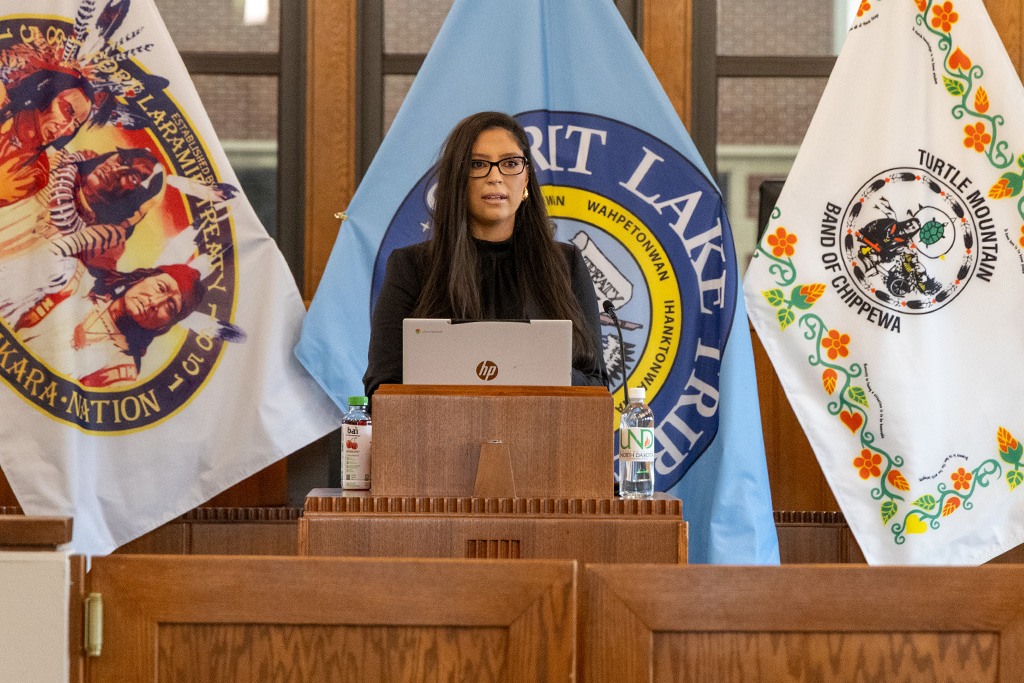
For UND and UND School of Law alumna Erica Thunder, the years since graduation have been shaped by service to tribal nations and state government. USA Today’s 2022 North Dakota Woman of the Year and, from 2019 to 2022, North Dakota’s first Native American labor commissioner, Thunder returned to campus to speak with law students about the importance of finding purpose and making connections.
Thunder, a citizen of the Mandan, Hidatsa and Arikara Nation (MHA), served as this year’s Distinguished Indian Law Speaker at the School of Law’s Vandewalle Courtroom on Thursday, April 17. During her talk, she recounted her path, which began at the UND law school and led her to roles as a tribal attorney, state labor commissioner and advocate for modern tribal governance.
Finding a purpose in law school
“This is where I found my grounding, my purpose,” Thunder said of the School of Law as she opened her hourlong talk. “Without my time at the Tribal Judicial Institute, I wouldn’t have worked with so many different tribes. It was an incredible experience.”
Thunder also credited UND’s Northern Plains Indian Law Center and the mentors she found there for setting her on a path that brought her into fields such as child welfare, labor rights and tribal-state relations.
Mind you, this wasn’t always her plan. Early in her education, Thunder explained, she anticipated a career in contract and regulatory law before being drawn to child welfare work through her experiences at UND.
“I really didn’t ever think that I would work in child welfare, even though I studied it here and appreciated everyone who was in it,” Thunder explained. “I always felt like it was going to hit too close to home.”
But through her time at UND, she found a calling in the field. She described her shift in perspective as a positive one as well as something that gave meaning to her work in the legal field.
“Going into child welfare law was the best thing that happened to me,” Thunder explained. “I was able to flip the script, not just for myself, but for the children and families whom I’ve served.”
From her first role as an attorney for the MHA Nation to leading the North Dakota Indian Affairs Commission, Thunder’s work has been marked by her ability to serve and build bridges between governments and communities.
Partnerships crucial to tribal, government relations
Thunder centered much of her talk on the importance of partnerships between governments, communities and people. Tribal nations and the federal government alike benefit greatly through shared interests and partnerships.
“Partnership has always been central to our survival as tribal nations,” Thunder explained. “It helps so much to have places that have supported us, have places that have really gone out on a limb to get behind us. We’ve not only been able to keep pushing forward; we’ve been able to thrive.”
Thunder added that memorandums of understanding — agreements between tribal, state and local entities — have helped overcome jurisdictional gaps, particularly in public safety and child protection. More important, she said, these agreements reflect a shift toward collaboration and trust. From youth support to public safety efforts, the positive impact they can have on tribal communities is unmistakable, she said.
“It turned out to be a win-win-win for everyone,” Thunder said of a specific, cross-jurisdictional agreement with the MHA Nation that focused on coordinating emergency response efforts between tribal- and county-level authorities. “There was just a huge sigh of relief from everyone involved. We were able to directly work with families and not have them be left out to wonder what’s going on.”
The initial gaps that Thunder helped bridge between tribal communities and state entities were often wide, especially when trust had been lost. Even so, she said, the outcomes often were positive and had meaningful impacts on tribal communities.
Modern sovereignty and the digital landscape
A particularly interesting component of Thunder’s talk was her emphasis on the evolving relationship between cybersecurity and law.
Looking to the future, Thunder urged students in attendance to expand their understanding of tribal sovereignty beyond land, treaties and governance structures. In today’s world, she said, the concept of sovereignty must also include digital infrastructure, data governance and cybersecurity.
“We can’t talk about modern governance without understanding that protecting our networks, our digital footprints, is just as critical as protecting our land and our people,” she said.
Thunder, who now works as a senior associate at the firm K.L. Scott and Associates, an IT consulting firm, explained that many tribal governments are now confronting serious threats to data privacy and cybersecurity, often without precedent or adequate support.
“Protecting our digital footprints is just as critical as protecting our land,” she said. “We should be protecting our data in the same way because human lives are at stake, and cyber threats can be so invasive to our tribal nations. So, I encourage you to view your future clients, friends and neighbors in a way that extends beyond the physical line.”
Additionally, she added that data infrastructure — including tribal enrollment and law enforcement records — is large component of the assets that need protecting.
“This isn’t just a tech issue. It’s about protecting sovereignty,” she added, asserting that the future, legal professionals will play a crucial role in bolstering these protections.
Law students key to sustained success
Thunder encouraged UND students in attendance to pursue their careers with authenticity and courage, even when their path forward seems uncertain.
“You’re not here to mold yourselves into someone else’s expectations,” she said. “Walk your own roads well — with each other, and with all of us.”
Thunder closed by affirming the importance of students’ future contributions in Indian law, public service, policy making and beyond. Sovereignty, she reminded them, is not a relic of the past. It is an active, ongoing responsibility.
“None of this is a cultural artifact,” Thunder said. “This is a governance strategy which I’ve seen be extremely effective time and time again. Judges, policy makers, attorneys and governments recognize that working with tribal nations isn’t just supplemental; it’s essential to good law.
“We’re essential, and whether you’re tribal or non-tribal, you’ll be essential, too.”
####
>> Questions or comments about the UND LEADS Strategic Plan? Your thoughts are welcome! Please contact Mike Wozniak, coordinator of Leadership & Programming, and/or Ryan Zerr, associate vice president for Strategy & Implementation, the co-chairs of the UND LEADS Implementation Committee. You also may offer your thoughts by visiting the UND LEADS Strategic Plan home page and clicking on the “Provide your feedback” link.
Thank you for your support of the UND LEADS Strategic Plan!