Flight-ready again: Vital aviation-medical service returns to campus
FAA program helps pilots who have struggled with substance abuse or mental health issues regain ability to fly
By Madison Dame
At the Odegard School of Aerospace Sciences on UND’s western edge, all roads lead to an aviation career. But first, the students on those roads must pass through a vital checkpoint on the other side of campus.
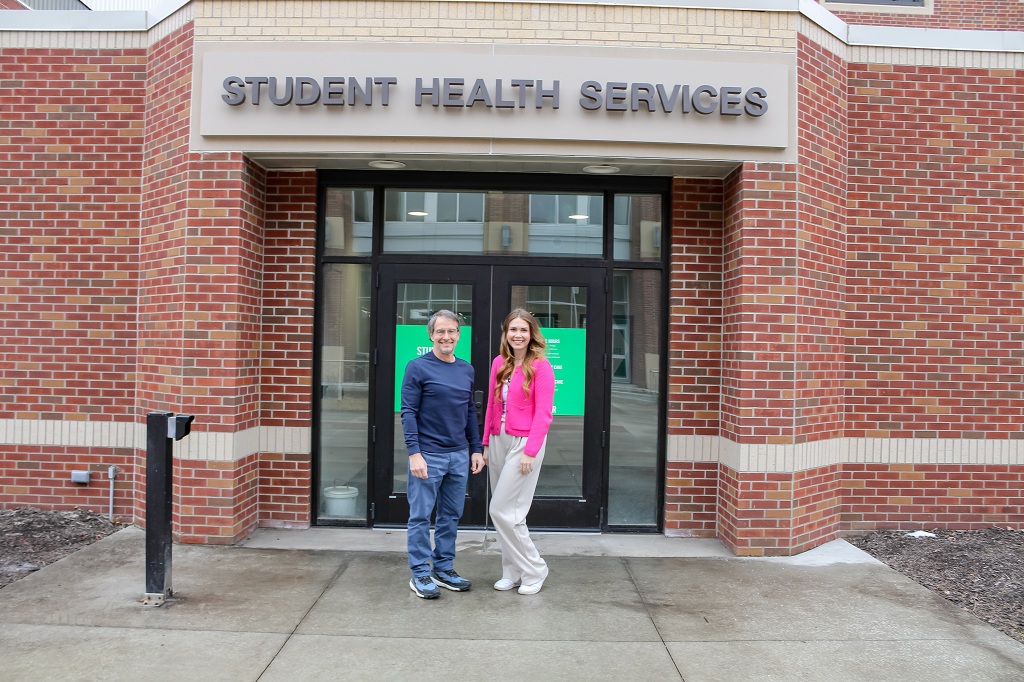
That would be the Student Health Services clinic, the home of UND Aerospace Medicine, and the physicians who are the gatekeepers of flight safety.
Aviation medical examiners are physicians who have been trained and certified by the FAA to conduct physical exams and issue medical certificates to pilots and air traffic controllers. Passing the physical is a requirement to work in those fields.
At UND, prospective pilots and controllers can get their medical certificates from the aviation medical examiners on campus. In addition, and as a public service, UND’s aviation medical examiners also conduct flight physicals for commercial and other pilots from around the region.
And in a new development, UND is bringing back a service that helps pilots who have a history of drug and/or alcohol use to get the treatment and training they need to regain their FAA medical certification. Dr. Warren Jensen previously had conducted this service on campus.
This service, part of the FAA’s HIMS or Human Interventional Motivational Study program, calls for UND’s HIMS aviation medical examiner to evaluate the pilot’s condition and then supervise their road to recovery and recertification.
What is aviation medicine?
Every pilot needs to get medical certification to be able to fly. There are three medical certification classes, one for each of the various levels of flying.
Most UND students will need a second-class certificate, but anyone who wants to fly as an airline transport pilot will need a first-class certificate.
These certifications come from AMEs, who evaluate student pilots based on the checklist provided by the FAA. The AMEs at UND are not here to deny medical certifications, they say. Instead, they’re here to help pilots get certified or to defer them to the FAA for a closer look at any discrepancies.
“We never deny anyone a certificate,” said Dr. Laura Morgan, UND HIMS aviation medical examiner. “We always defer to the FAA for the agency to look over.”
In other words, aviation medicine at UND is meant to get pilots flying and find ways to keep them flying safely.
Aviation physical vs. normal physical
Aviation physical examinations are like normal physical exams. The health practitioners check for blood pressure, pulse and other health indicators.
But aviation physicals are meant to determine whether pilots, according to the FAA’s standards, are safe to fly. For example, blood pressure needs to be maintained below 155/95 mm Hg, because hypertension boosts the odds of a pilot suffering a heart attack or stroke.
Such tests are important for determining whether a pilot is stable enough to be safely flying. Should red flags arise in this area, the pilot’s medical certification gets deferred to the FAA.
And when that happens, the FAA may refer the pilot to a HIMS AME to get personalized care — a step that may let the pilot get certified sometime in the future.

HIMS AME
The HIMS AME program is returning after about five or six years of not being on campus since the last HIMS AME retired, according to Dr. Mark Christenson, a UND AME.
This absence meant pilots both at UND and from surrounding areas had to seek HIMS treatment elsewhere, sometimes in distant states. Given that the HIMS program already is expensive and time-consuming, having to go elsewhere for treatment was a big challenge for local pilots.
With the return of the program, Morgan can see anyone in the area who is referred to an HIMS AME by the FAA.
This service is something that the FAA requires that pilots go through when they are thought to have a substance abuse or mental health issue. When this happens, the pilot is faced with the choice to commit to the program or accept that their flying days are over.
“If you have any kind of mental health issues, this is a path that the FAA wants you to try, in order to get as many people to fly who can do so safely,” said Christenson. “They’re just trying to make available a pathway for pilots to seek out treatment, see a counselor, potentially be on medication and still be able to fly.”
When pilots choose to go through the program, Morgan submits reports to the FAA, telling the agency whether she thinks the pilot has made sufficient progress to return to flying. The program usually takes about five or six years to complete and for the pilot to return to flying, she said.
“I never think it’s a bad thing to seek treatment,” said Morgan. “Yes, it’s going to go on [the pilot’s] record, but it is in their best interest to take care of their health; and as long as it’s stable, then, typically, we can get most people back to flying.”
This program will give support to the whole community and help pilots stay in the Midwest and not have to travel to find the support they need. This is increasingly important as people are coming forward more and saying they need help.
AME certification
For people who are interested in both medicine and aviation, becoming an AME is a great way to experience both worlds.
As noted above, AMEs focus on conducting medical examinations for pilots. They use the FAA checklist to determine if a pilot is safe to fly or should be deferred to the FAA for a closer examination.
Physicians who want to become AMEs can apply to the FAA on the agency’s website and complete the required training. The FAA Aviation Medical Examiner (AME) Training page and Information for AMEs page are great resources to get started.
If anyone has any questions or just wants to talk to an AME, Morgan noted that they also offer consultations.
Everyone in Student Health Services, the nurses, the doctors, administrators, all just want to help pilots get what they need to be successful. “We’re here to help,” said Morgan.