From UND to Emergency Medicine chair at Minnesota’s busiest trauma center
‘Empowered by Our Past’ brings to campus Dr. Tom Wyatt, a UND medical school and INMED program graduate

On April 14, UND’s Hilyard Center hosted its second Empowered by Our Past celebration, building on the foundation laid by last year’s inaugural event honoring the University’s Noble Nine — the first graduates of color in UND’s history. This year, the program expanded its scope to recognize present-day changemakers while continuing to uplift voices rooted in heritage, service and community.
As Associate Vice President and Advisor to the President for Community and Belonging Tamba-Kuii Bailey said, “This experience tells us who we are and allows us to honor their legacy and the history of this institution.”
The evening’s keynote was a conversation between Stacey Borboa-Peterson, director of UND’s Hilyard Center, and Dr. Tom Wyatt, a graduate of the UND School of Medicine & Health Sciences and its Indians into Medicine (INMED) program. The former EMT and paramedic returned to UND to reflect on his path toward medicine and the support systems, such as Indians into Medicine (INMED), that helped him navigate it.
Wyatt now chairs the Department of Emergency Medicine at Hennepin Healthcare. Among its other services, Hennepin Healthcare operates the Hennepin County Medical Center in Minneapolis, a Level 1 trauma center that is Minnesota’s largest and busiest emergency department.
‘Learning to live in two different worlds’
Wyatt began by recounting his upbringing in a suburb outside Oklahoma City, where he navigated life between his father’s white community and the deep cultural traditions of his mother, a member of the Shawnee and Quapaw tribes.
“My time in Oklahoma is really a story of me learning to live in two different worlds — kind of the code-switching that so many people talk about,” he said.
As a child, he danced at powwows and participated in tribal ceremonies as a war drum dancer, experiences he continues to pass on to his own children.
“I still go to our annual tribal powwow every Fourth of July back in Oklahoma, with my three children, who all dance as well.”
Education was a cornerstone in his family’s values.
“I had a relatively safe upbringing and parents who really wanted me to succeed. I was the first person in my family to attend a four-year college and graduate.”
However, Wyatt’s journey to medicine wasn’t his initial plan. It wasn’t until he met psychology professor Jack Cannon — a mentor who encouraged him to consider graduate studies — that Wyatt began thinking seriously about medical school.
“It wasn’t like this ‘aha moment’ that so many physicians talk about,” Wyatt said. “I wasn’t really sure what I wanted to do. Dr. Cannon took a real interest in me; I’m not sure why, but he guided me through it.”
That guidance led him to apply to the INMED program at UND, where Wyatt recalled finding a supportive environment committed to his success.
Wyatt said that his first years in medical school were a humbling experience. Though his paramedic background had given him field experience, adapting to the academic demands of medicine was a challenge.
“The first year, I actually was struggling,” he said. “I was studying a lot, had a lot of extra time in the labs and was just barely making it.”
What helped him through, he said, was the support he found within INMED — from peers who had walked the same path to faculty who understood the weight of being one of the few Native students in medical education.
“Through talking with different people — students who were a year or two ahead of me, as well as my advisors — I really overcame that.”
By his third year, Wyatt found his stride during clinical rotations, where his EMT and paramedic experience came in handy.
“I was used to seeing patients who were sick,” he said. “I was used to sticking sharp objects into people — a lot of things my classmates weren’t used to at that point.”
He also credited the INMED program not only for its academic support but also for fostering a sense of belonging.
“From the moment I got here, I felt like I really was well supported,” he said. “People like me had some of the same lived experiences I did, and that was something that was incredibly important.”
Mentorship, community and giving back
Throughout the conversation, Wyatt highlighted the importance of mentorship — particularly for Indigenous students navigating higher education and medicine.
“Take your mentors where you can get them,” he said. “Most of the mentors in my career have been elderly, white male professors — people who really took an interest in me.”
Those mentors helped him secure a clinical rotation at Hennepin Healthcare in Minneapolis, where he would later complete his residency and, eventually, become chair of the Emergency Medicine department.
At Hennepin, Wyatt has worked to advance representation through policy changes. He helped implement a Traditional Medicine Policy, which helps to bridge the gap between standard American medical practices and traditional Native American medicine by allowing practices such as smudging within hospital settings.
“If families want to perform a ceremony in the hospital, they should be able to do that — including in the emergency department,” Wyatt said.
He also spoke candidly about the persistent health inequities affecting Native communities.
“American Indians have huge disease burden in their communities,” he said, referencing high rates of chronic illness and addiction and lower-than-average rates of organ donation, which may be partially attributed to the lack of Native American health care professionals in the country.
Part of the solution, Wyatt says, is to introduce Native students to the profession early. And, through American Indian Youth with Stethoscopes — an organization that exposes students ages 12 to 18 to health care careers — he hopes to do just that.
“We had about 100 American Indian youth from Minnesota and the Dakotas, with about 30 different tribal affiliations,” he said. “We’re really invested in trying to reach as many American Indians as we can.”
In his final moments on stage, Wyatt left students with a message of resilience and purpose.
“Don’t be afraid to be authentic,” he said. “Don’t ever forget where you come from. Work harder than everyone else around you. And really think about the roles of mentors in your careers — and pay that forward for future generations.”
Introducing the Paul Pitts Community Impact Award
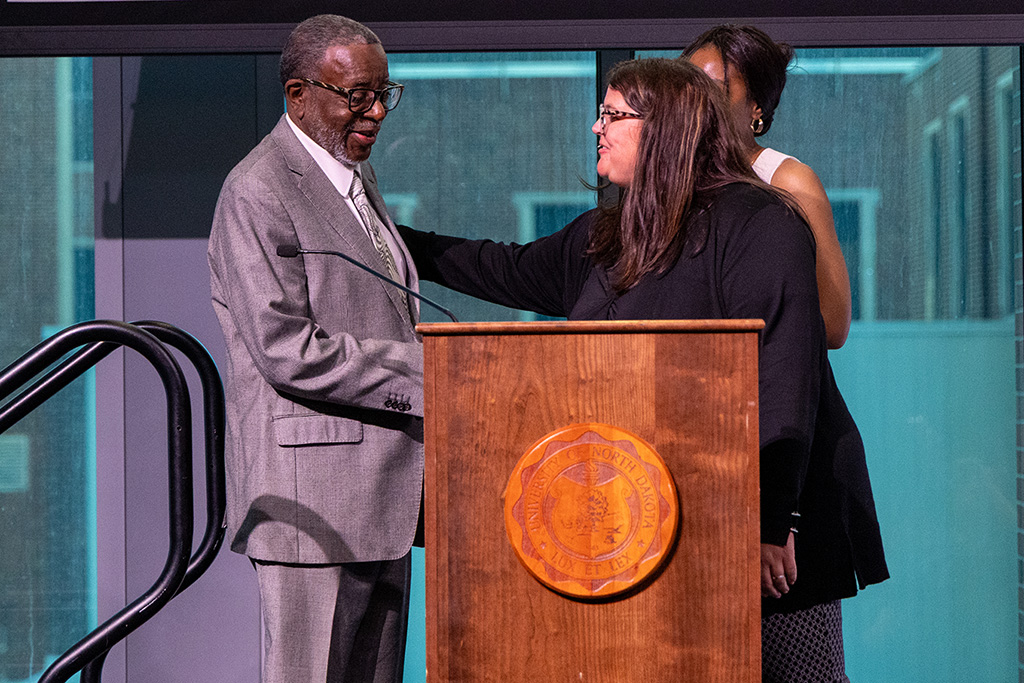
The evening also introduced the Paul Pitts Community Impact Award, named for UND’s first Black student body president who visited UND’s campus earlier this year for Martin Luther King Jr. Day.
Awards were presented to Wyatt and 2019 UND alumna Kaly Miaso, a health care worker specializing in substance abuse harm reduction and community outreach. But the inaugural award went to Pitts himself, who offered a message of forward momentum to students in the audience who, one day, may be honored at the ceremony themselves.
“We’re not passing the torch on to you — because I’m still here — but I have to move the torch on,” Pitts said.