Scholars shine at Faculty Scholarship & Creative Works Celebration
Event recognizes the 1,500-plus examples of scholarly and creative works by UND faculty members in 2024
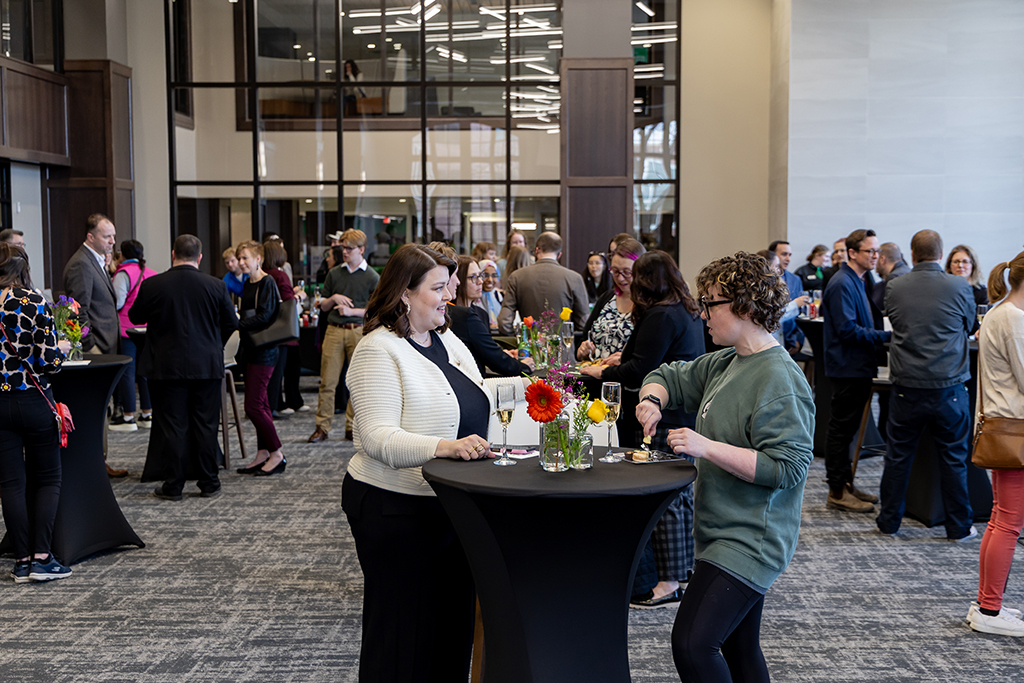
Scholarly articles written by UND faculty members, electronic displays showing published academic books and chapters of books and other works — plus the makings of a quirky science fiction novel — were all part of fun at the UND Faculty Scholarship & Creative Works Celebration on April 10.
The celebration, now in its second year, showcased all the scholarly and creative works produced by UND faculty members in the previous calendar year. In 2024, the output in various fields met and sometimes surpassed that of the year before, with articles in the independent media outlet The Conversation, for example, showing a marked increase.
The event was held in the reading room of the Chester Fritz Library, with all those works and accomplishments on display in the adjacent room (alongside a gorgeous spread of food and hors d’oeuvres prepared by UND Catering).
Rebecca Bichel, dean of Libraries, thanked the librarians and library staff members who helped set up the event, and also gave a shout-out to Randi Tanglen, vice provost of Faculty Affairs, for help with organizing it.
“The variety of creativity and scholarship that we have on display tonight is much good news for us to share,” Bichel said.
Indeed it was. In 2024, UND faculty members authored 886 journal and invited review articles, wrote 20 books and 20 chapters of books, received 506 grants and were awarded five patents. UND scholars also had 23 articles in The Conversation in 2024 (up from 11 in 2023), which together received more than 380,000 reads.
On the creative side, scholars lent their talents to several activities including films, theater productions, musical performances, acting, directing, ceramic art, crochet, mixed media collages, scenic and lighting design, letterpress printing, theater costumes and more.
More than 1,500 examples of scholarly and creative works by UND faculty members were honored at the celebration.
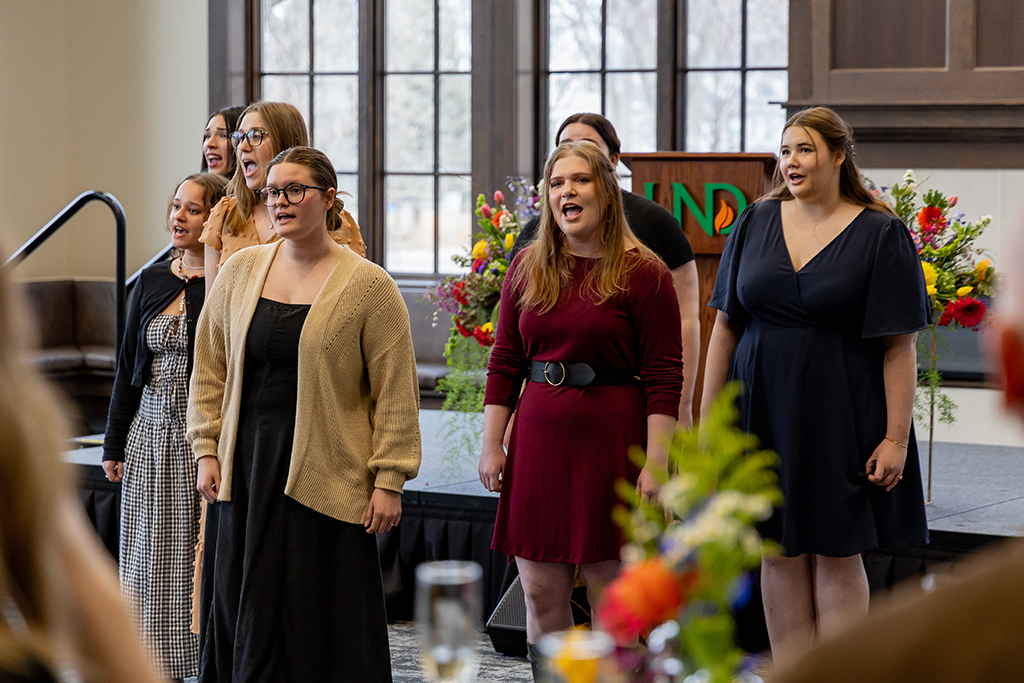
Following Bichel’s introductory remarks, celebration attendees listened to selections by the singing group Voices of Justice. The group came about, explained Justin Montigne, assistant professor of voice, through a collaboration between the Department of Music and the School of Law to explore, through singing, different concepts about law and justice. The group has performed in the Gerald W. VandeWalle Courtroom.
And after that, Provost Eric Link waxed philosophical when he invoked the first century Roman philosopher Seneca. Seneca’s writing in “Natural Selections” is about taking a scholarly approach to understanding the natural world.

Seneca laid out the idea that an individual can devote his or her entire life to studying a natural phenomenon and not uncover all of its secrets.
“‘The time will come when diligent research over very long periods, will bring to light things which now lie hidden,’” said Link, quoting Seneca. “‘A single lifetime, even though entirely devoted to the ‘sky,’ would not be enough for the investigation of so vast a subject. This knowledge will be unfolded only through long successive ages.’”
Link continued: “I would argue, standing before you tonight, that that same sentiment is as true now as it was when Seneca wrote it in the first century.”
And that’s when things got a little weird (but in a good way). Link said he’d wanted to deliver a quote from another book he was reading, but that day, he had forgotten that volume at home. So, using Google, he wrote a prompt to help him locate the text of the classic work, and thereby find the quote.
Well, he didn’t find the text, but he did find something even more entertaining. Because using Link’s prompt, Google’s artificial intelligence feature independently generated the opening text of a science fiction novel, one that was set in a laboratory in Grand Forks.
Link read the copy to much laughter, with his comic’s timing and pauses adding wonderfully to his delivery.
(Note: The full text of the AI-generated work can be read below)

If Link set them up, then President Andy Armacost knocked them down, when he delivered his toast to celebrate a years’ worth of academic and creative contributions.
After telling people to “charge their glasses,” Armacost said the event is not only a celebration of achievement, but a way to honor “the spirit of inquiry, imagination and dedication that defines our University’s heart and soul: our faculty.”
“Your research shapes the future,” he continued. “Your creative work captures the human experience, and your commitment fuels the minds of generations to come. Tonight, we raise our glasses to your curiosity, your courage and your brilliance.
“Thank you for showing us everything that is possible when passion meets purpose. And to each of you, let me raise my glass and offer this toast: May your work continue to shine, and your impact continue on this world. Here’s to you. Cheers.”
Provost Link’s unintentional sci-fi novel (best read in his mellifluous voice):
The hum of the cryogenic chamber was a constant, almost comforting presence, as Dr. Aris Thorne stared at the shimmering, almost translucent sample. It was a fragment, a mere sliver of what he hoped would be a breakthrough, a key to unlocking the secrets of temporal displacement.
Today, April 10, 2025, felt different.
The data, the years of research, the countless failed experiments — it all culminated in this moment. He ran a gloved hand over the control panel, his heart pounding a rhythm against his ribs. “Initiate sequence Alpha,” he murmured, the words echoing in the sterile, white room of the Grand Forks Temporal Dynamics Lab.
The chamber pulsed, the sample within it began to glow, and a faint, almost imperceptible shimmer rippled through the air, promising a discovery that could change everything…