Human nutrition degree opens new path to medical school
As nutrition takes on a larger role in medical education, UND graduate Anna Bernhardt is bringing a background in prevention, research and patient education to medical school
Nutrition is moving closer to the center of medical education, allowing pre health students a different path to careers in medicine.
In June, the U.S. Department of Health & Human Services announced new commitments from medical education and accreditation organizations to strengthen nutrition instruction throughout medical school, residency and professional training. Seventy-three medical schools have also pledged to provide at least 40 hours of nutrition education, or an equivalent competency, beginning in fall 2026.
The announcement is the result of the increasing awareness of the role nutrition can play in preventing and managing chronic disease — and the need for physicians who can turn that knowledge into practical guidance for patients.
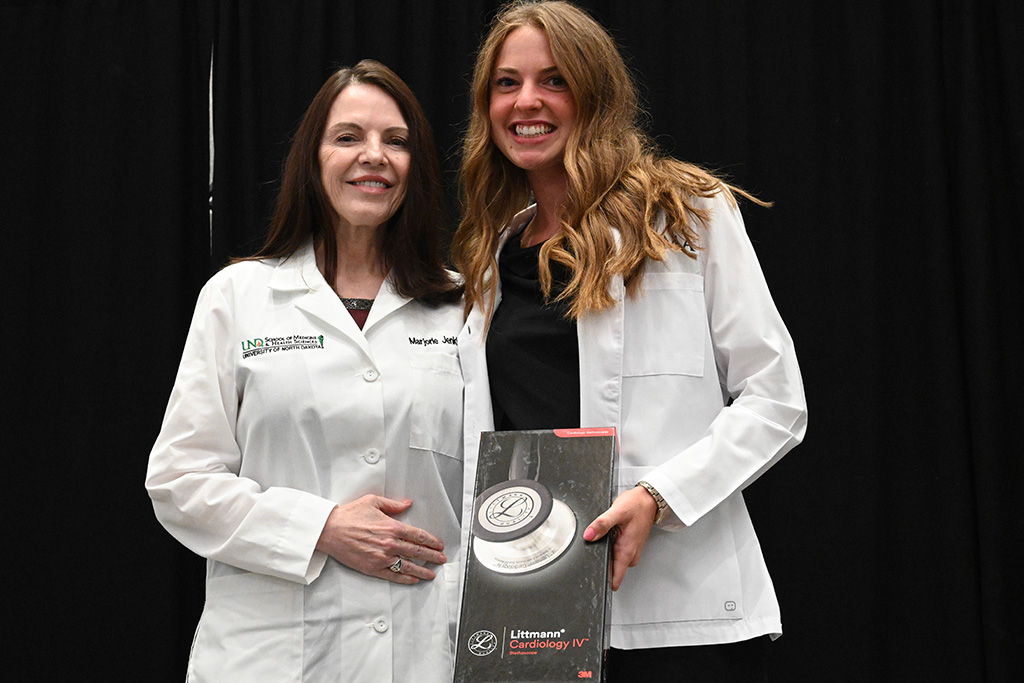
Anna Bernhardt entered the UND School of Medicine & Health Sciences this summer with four years of preparation in those areas.
Bernhardt graduated from UND’s College of Nursing & Professional Disciplines in spring 2026 with a bachelor’s degree in human nutrition. Her path illustrates how a nutrition degree can offer an alternative to the biology and chemistry majors often associated with medical school.
“I wanted a diverse major that I could use in a research field or as a dietitian, but that ultimately would also get me to medical school,” Bernhardt said.
Science with a broader perspective
Bernhardt’s interest in nutrition started long before she arrived at UND.
As a distance runner, Bernhardt developed an interest in exploring the relationship between nutrition and her performance on the track as early as middle school. Her grandmother, a dietitian who earned her degree from UND, also served as a mentor during this period.
Bernhardt arrived at UND interested in medicine but not entirely certain where she would start. The Human Nutrition program conveniently allowed her to complete the prerequisite courses for medical school while studying a subject that she was interested in.
Her favorite course? Nutritional biochemistry, where she studied nutrient metabolism and the ways vitamins, minerals and other nutrients interact with the body. She cited this, and classes like it, with shaping her approach to medicine.
“It has set me up to look at health through a scientific lens, but also with a nutrition focused, holistic perspective,” Bernhardt said, emphasizing the importance that diet and exercise plan in health.
Brenna Swanson, clinical assistant professor and director of UND’s Human Nutrition program, said the degree can be tailored for pre health majors, students pursuing physician assistant programs or other health professions.
The curriculum is grounded in chemistry, biology and other sciences, she said, but it also asks students to consider how that knowledge can apply to life.
“The Human Nutrition degree is really heavy in the sciences, but the benefit is that it also adds a lot of application toward chronic disease prevention,” Swanson said. “It helps bridge that gap between science and everyday choices.”
Students may understand cell biology, genetics and nutrient metabolism, Swanson said, but health professionals must also be able to explain what that science means when someone is shopping for groceries, preparing a meal or trying to change a long-standing habit.
“You can make the best menu and have all the carbohydrates, fat and protein figured out perfectly,” she said. “But if you are unable to communicate with the patient and show how it works in their life, it is just a list on paper.”
Research beyond the classroom
Bernhardt also gained valuable experience in research, when she studied how access to nutritious food can affect health.
Working with Nathaniel Johnson, assistant professor of Nutrition & Dietetics, she contributed to research examining carotenoids — precursors to vitamin A found in fruits and vegetables — and their relationship to food insecurity and food access.
The project studied how barriers such as cost and transportation can affect the food people are able to obtain and, in turn, the levels of carotenoids detected in their skin.
Bernhardt said the work helped her consider nutrition from a population health perspective, including the challenges faced by people who cannot easily afford or access nutritious food.
UND Human Nutrition students take research coursework and can complete supervised experiences in research, community nutrition, public health and other settings. Faculty members and students also collaborate with researchers at one of only six USDA Human Nutrition Research Centers in the country.
Swanson said those are among some of the most valuable opportunities help students connect classroom learning to the health needs of real people and communities.
Bringing nutrition into medicine
Bernhardt began medical school at the end of June. She’s not yet set on a specialty, but hopes to work in an area in which she could incorporate nutrition education and preventive care into her work.
She said experience in the Human Nutrition program taught her to step back and consider the whole person rather than focusing only on an individual symptom, organ or diagnosis.
“You might think there is one specific cause, but if you look at the bigger picture, you might see more of what is going on,” Bernhardt said. “That whole-person and whole-body perspective is something the program really emphasizes.”
She hopes that perspective will help her offer patients practical options, including lifestyle changes that may improve their health or help prevent a condition from progressing.
For students considering medical school, Bernhardt said pre health majors need not limit themselves to a traditional pre-medical field. Students can complete the required science courses while choosing a field that genuinely interests them.
“The medical field is so diverse, and there are so many different aspects of it, and it’s an area where it’s great to have teams of people with different strengths and backgrounds,” she said. “I don’t regret pursuing a slightly nontraditional route. Exploring the different majors you can pursue while still moving toward a career in medicine is a really cool opportunity.”