Teaming up for success in health care
More than 350 pharmacy, therapy, medical and other students take part in UND’s first Interprofessional Healthcare Day

Editor’s note: This story first appeared in the spring 2025 issue of North Dakota Medicine, the quarterly print publication of the UND School of Medicine & Health Sciences.
* * *
It was a great problem to have.
“We had to cap it,” explained Fargo native Morgan Mastrud of attendance at the inaugural UND School of Medicine & Health Sciences Interprofessional Healthcare Day, held at the School last fall. “We had so much interest, but the Simulation Center is only so big, and you can only get so many students in and out at once.”
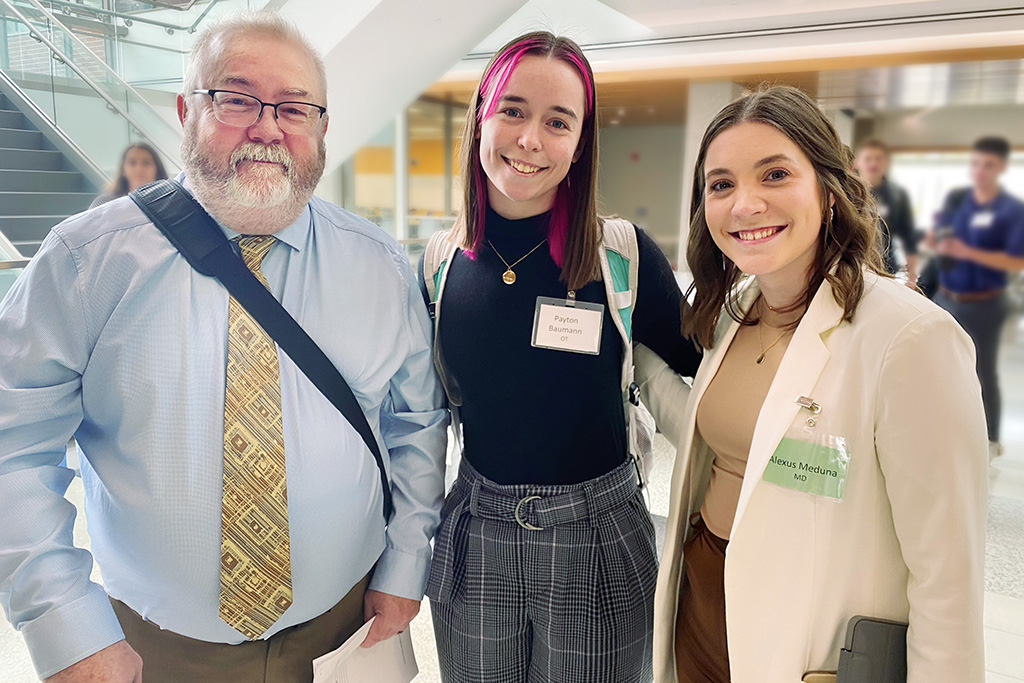
Nodding her head, Mastrud’s co-organizer Alexus Meduna, who hails from Dickinson, N.D., found the student response almost overwhelming.
“We had two different classes of nursing students and two classes of med students involved, so we need to narrow down how many people from each program register next time,” smiled the second-year medical student, noting also how students from the North Dakota State University School of Pharmacy in Fargo drove up to Grand Forks to participate.
“Our thought is we’ll have only second-year students in the future, so that way we can accommodate more medical lab science or social work students, for example.”
Interprofessional health care across UND
Taking inspiration from the School’s Interprofessional Education course on health care, the two second-year medical students found themselves co-presidents of UND’s relatively new Interprofessional Healthcare Organization about a year ago. On the organization’s to-do list almost immediately, said Mastrud and Meduna, was coordinating a new extracurricular day of interprofessional training for UND students across the University.
The point of such a day is to give students of multiple health professions an extra opportunity to put into practice the interprofessional training most already receive in their various classrooms.
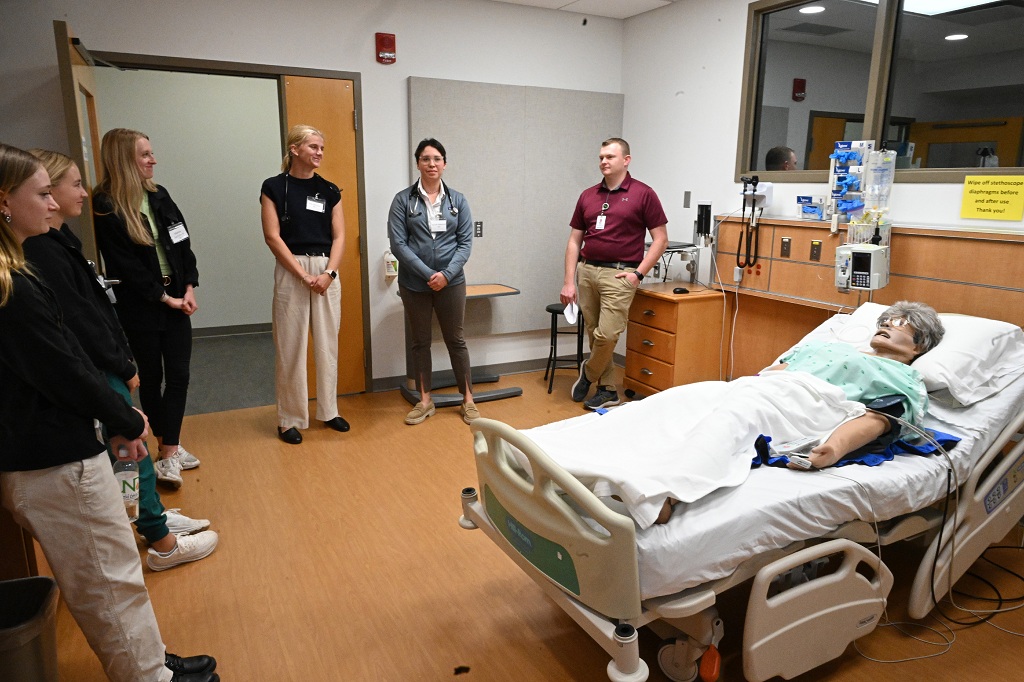
The day featured not only interprofessional medical simulation scenarios for participants, but a case competition, a Q&A with an interprofessional panel of health providers, and a keynote speaker.
“When we started as co-presidents, we thought that a daylong event was a really good idea,” Meduna added. “We brought the idea to Eric Johnson and Michelle Montgomery, and they said that it was something that they’d considered, too. So we kind of just ended up spearheading it.”
Meduna is referring to Dr. Eric Johnson, professor in the School’s Department of Family & Community Medicine, and Michelle Montgomery, wellness advocate for SMHS. Both are at the core of the SMHS Office of Interprofessional Education and as such coordinate the office’s Interprofessional Education course.
This one-credit, pass-fail course, which is offered four times each academic year, assembles students studying Nursing, Medicine, Communication Sciences & Disorders, Counseling Psychology, Nutrition & Dietetics, Occupational Therapy, Physical Therapy and Social Work to discuss collaboration in patient care and engage in small group activities to promote team building and communication among the health professions.
Calling the course an “entry level” learning experience, Johnson explained that he and Montgomery had been “steadily developing advanced IPE learning over the past several years” to include more clinical experiences and interaction with the pharmacy program at NDSU.
The Interprofessional Healthcare Day was a natural extension of that idea.
“What makes IPE at SMHS successful is that there is no hierarchical approach here,” said Johnson. “The School itself fosters a culture of collaboration and equity between professions, which our graduates then take with them into their care environments.”
To that end, added Montgomery, IPE helps providers of all types better understand what others’ roles are in the health system and better communicate with each other.
“The planning of this event by students from a variety of UND health programs was key,” she said. “They were able to combine elements from each of their professions, ensuring that attendees came away with a truly collaborative experience that fostered greater understanding of each discipline.”
Why IPE?
Why are such experiences important? As Johnson and Montgomery put it, the literature on the benefit of interprofessional education in health care is clear: More and better IPE means, at the very least, increased collaboration, retention and cooperation in the health care systems that promote interprofessional training.
Some studies even suggest that more and better IPE increases the potential for fewer medical errors and thus improved patient outcomes.
Enter Sclinda Janssen, professor in UND’s Department of Occupational Therapy.
Noting how the primary goals of IPE address team values and ethics, responsibility, communication and teamwork, Janssen said that some programs also emphasize helping students identify barriers to the coordination of care, increase their clinical reasoning skills and improve patient access to health care resources.
“The momentum for IPE right now is profound among students, staff and faculty at UND and NDSU as they pioneer innovative and authentic IPE approaches that go beyond just traditional didactic experiences,” said Janssen, who shared one anonymous student survey response about an IPE simulation with telehealth indicating that the experience “was literally the most valuable learning experience” in which the student had participated.
“The SMHS building provides a wonderful infrastructure that promotes IPE collaborative practice,” Janssen added. “During the student-led event last fall, the building was literally bursting with energy from the interactions between more than 350 enthusiastic students from nine professions. The IPE momentum is here!”
Lauding the move to more IPE across the university, the dean of UND’s College of Nursing and Professional Disciplines, Maridee Shogren, noted that modeling best practices such as IPE across the university will very likely help improve health care for everyone.
“All three disciplines from our college – Nutrition & Dietetics, Nursing and Social Work – value and include interprofessional education in their respective curricula,” said Shogren, whose college sponsored the IPE day alongside the SMHS Office of the Dean and the federally funded Dakota Geriatrics Workforce Enhancement Program.
“Any time we can give health care students at UND an opportunity to meet, learn about each other’s roles and work together through educational activities like simulation, we are planting the seeds for collaboration once they are licensed health care providers.”
To Shogren’s point, Meduna and Mastrud added that in their experience students of all backgrounds are clamoring for more interprofessional training.
“Everybody has different curricula and our schedules and lives look very different,” Meduna said. “So it’s nice to have another way of more casually coming together as future providers. It’s a student-run thing, so I feel like people come into it with less anxiety.
“We all know that once we get to the clinics and hospitals, we’re working in teams constantly. In our training programs, though, we often isolate or just stick to our own people that we know. So this event is a nice way of bringing people together to learn about what everybody else does.”
“The IPH course is great, but it’s more discussion-based,” said Mastrud. “Actually being able to implement experiences in person and learn from each other in a professional simulation experience is huge. It’s good for us med students to see medical laboratory science students in a patient room and run through the lab tests that patients need.
“It’s a good reminder that all students are valuable assets and that we need to rely on each of our colleagues in the future.”