The SIM vans are coming
New mobile simulation vans will let UND continue its outreach medical training in more efficient ways
Editor’s note: This story first appeared in the spring 2025 issue of North Dakota Medicine, the quarterly print publication of the UND School of Medicine & Health Sciences.
* * *
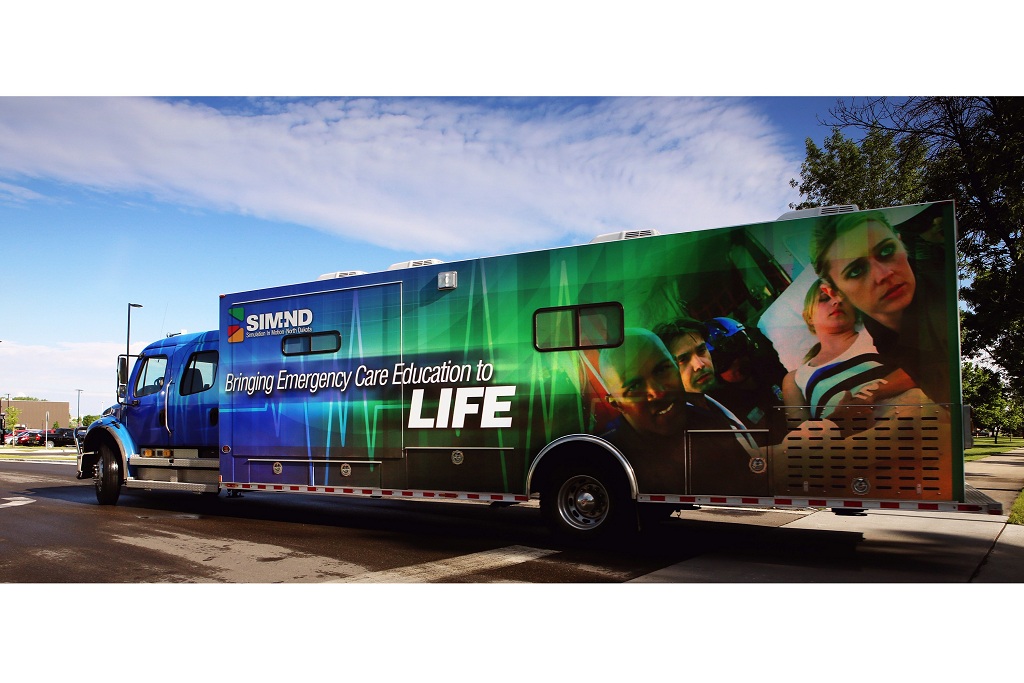
Describing one of the four gargantuan hospitals-on-wheels managed by her Simulation In Motion – North Dakota program, SIM-ND Coordinator Tawni Harvala acknowledged that as amazing as her 44-foot semis are, they can’t do everything.
“They’re too high,” Harvala said of the trucks, explaining how current and future physicians, nurses and first responders can’t practice loading and unloading patients with the trucks. “And because these are massive trucks, we’re dependent on drivers who need a commercial driver’s license (CDL) to use them.”
All of that is about the change.
In December, the SIM-ND program, an extension of the UND School of Medicine & Health Sciences Simulation Center, was awarded $1.3 million grant by the Economic Development Administration.
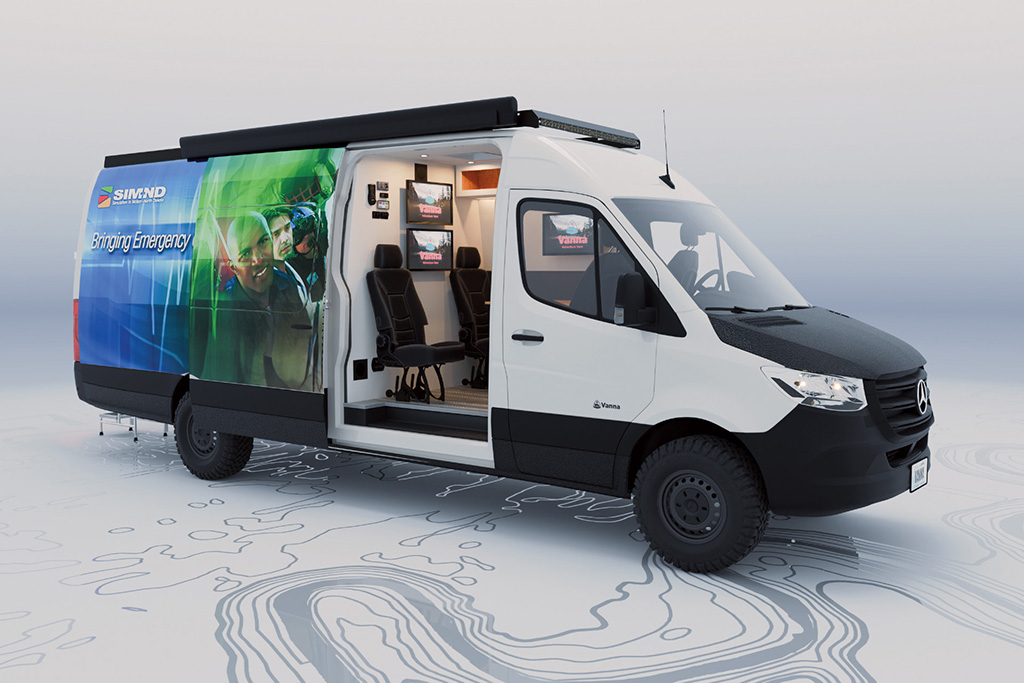
The award will help SIM-ND procure four new mobile simulation vans, Harvala said. This will let SMHS continue its outreach medical training efforts across North Dakota in a more efficient and comprehensive way.
“The vans will be a great addition to our fleet,” Harvala explained, emphasizing that the semis are not being retired and still will be used often. “They will offer additional simulation space and are better equipped to handle our extreme North Dakota weather. Additionally, the grant will allow SIM-ND to purchase updated simulation equipment, including new state-of-the-art infant simulators, simulated ventilators and simulated defibrillators.”
Dr. Kara Eickman, medical director of the SMHS Simulation Center, agreed.
Explaining how there are parts of North Dakota that the semis simply can’t access — due to underbuilt infrastructure, for example — Eickman noted how the new vans will be “amazing” and will allow Harvala’s team to do more and better health simulation training across the state.
“There are a lot of rural communities that really could benefit from our services, but we just haven’t been able to get in there,” she said. “These vans are going to expand our reach and capabilities.”
Simulation across North Dakota
Since 2013, SIM-ND has been bringing hands-on training to health care workers throughout North Dakota, from rural paramedics and firefighters to National Guardsmen, medical residents and physicians. The program has done so to date using the mobile simulation trucks that offer two separate simulation spaces and provide versatile and unique learning opportunities.
With the help of high-fidelity human simulators — or “manikins” — SIM-ND can immerse learners in a safe, but realistic, learning environment.
Its massive semis and CDL restrictions notwithstanding, then, part of the reason SIM-ND hasn’t been able to reach as many communities in North Dakota as it could is because it began its life outside of the SMHS umbrella.
Initially funded by a grant from the Leona M. and Harry B. Helmsley Charitable Trust, SIM-ND began as a partnership between UND; North Dakota’s six tertiary hospitals in Bismarck, Fargo, Grand Forks and Minot; and the North Dakota Department of Health & Human Services. For a number of financial and logistical reasons, though, a handful of the program’s original sponsors have had to withdraw their support of late.
That’s why it is time, said Eickman, to bring SIM-ND more officially “into the fold” of the SMHS Simulation Center.
“I want SIM-ND to be fully under our umbrella,” Eickman said. “The same goes for the new medical simulation space coming online at our Southeast Campus building in Fargo. We hope to take ownership of all of the various moving parts of UND-based simulation in the region, so all of it is part of the SMHS Simulation Center.”
Harvala added that since the program’s inception, SIM-ND has helped train more than 30,000 individual health care learners via its medical simulation activities in communities across North Dakota.
“We’re excited about all the ways this award allows us to continue to expand and fulfill our mission while enhancing North Dakota’s health care workforce and building resiliency in the health care professionals throughout North Dakota,” Harvala said.
“Ultimately, this work will mean improved patient care and outcomes in our state.”
Coming home
A 2004 graduate of the SMHS, Eickman, a neurologist by training, assumed the role of Simulation Center Medical Director when the former director, Dr. Jon Allen, retired last June.
Eickman long had worked alongside Allen, making her a natural next leader for the center.
“Jon trained me when I was a student,” she said. “He had just started building up the doctoring skills simulation program back then, and it made a lot of sense for us to work together again when I came back to North Dakota after residency. I started teaching through our patient-centered learning facilitation and then got pulled into more of the simulation training in 2020.”
As Eickman noted, her former position with Sanford Health in Fargo saw her working directly with not only other physicians but also physical, occupational and speech therapists, nurses and even social workers. Such interprofessionalism is exactly how the Simulation Center manages its various scenarios, she said.
“Our interprofessional team at Sanford’s muscular dystrophy clinic also collaborated with cardiologists, pulmonologists, sleep medicine doctors and lots of other medical fields to care for our patients,” Eickman added. “Working here in the Sim Center allows me to continue to educate all of those students who are very important parts of the health care team that I worked with in the clinic. So it fits nicely with the mission I adopted when taking care of my neurology patients.”
And now, Eickman, said, it’s time for the Simulation Center to find new ways to build on Allen’s model and expand its reach across the state.
“There are lots of opportunities for growth,” she concluded. “There are many students in all these areas of health care who would benefit from simulation. What we’re really trying to do is make our space accessible to learners from various health care programs and support their instructors’ efforts in using simulation to educate their students.”