UND hires new national security consultant
Former Grand Forks Air Force Base commander will work to establish partnerships in Washington and beyond
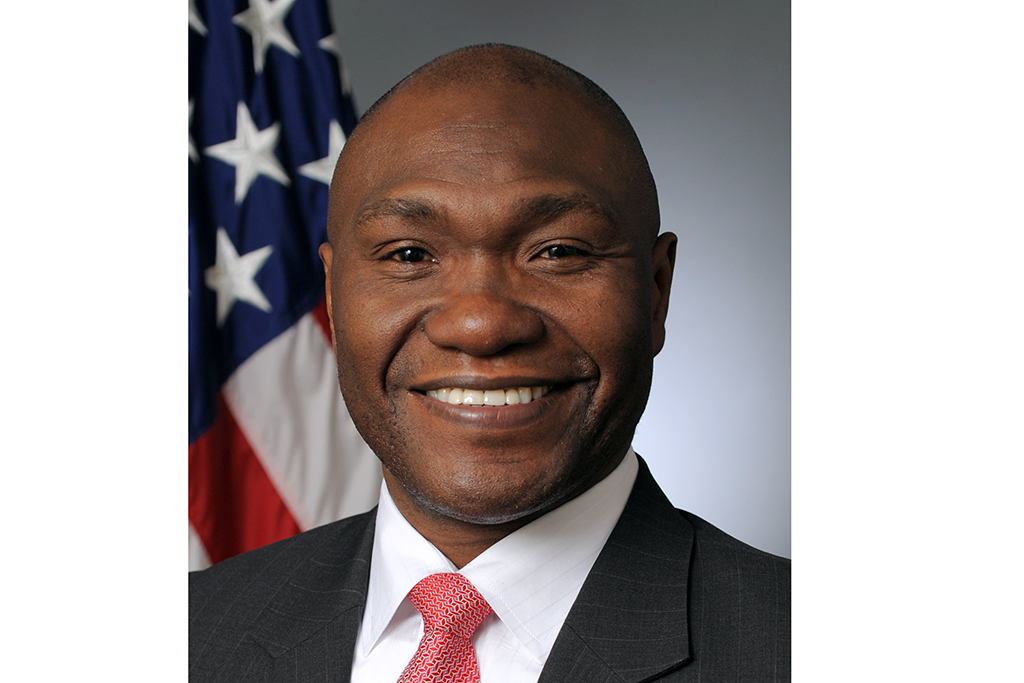
Last month, UND welcomed a distinguished military leader with more than three decades of service to advise the University on one of its grand challenges.
Maj. Gen. Rodney Lewis — now retired from the Air Force — will serve as UND’s consultant to assist national security research development in a civilian capacity.
Lewis, who served as commander of the 319th Reconnaissance Wing at Grand Force Air Base from 2015 to 2017, expressed excitement about returning to campus. In addition to his new role, Lewis is a UND graduate, having earned a doctoral degree in higher education.
“When I was here before, I felt like UND was home — because it was,” Lewis said. “I built some great relationships with the community and with the University.”
Lewis said he’ll bring his experience working in high-level strategy and defense budget planning roles at the Pentagon to UND. This experience, he said — in addition to leveraging connections in the nation’s capital — will be invaluable.
“The ecosystem in D.C. is rapidly changing, but I look at change as opportunity,” he said. “If you have your stuff together, and know where you want to go, you can create some really great opportunities.”
Lewis added that national security is a bipartisan initiative — one that UND is well poised to lead.
“Regardless of which side of the aisle you’re on, national security is paramount,” Lewis said. “I think everyone in Washington who knows about UND is singing its praises, because it is a fantastic university. The issue is introducing folks to UND who don’t already know about it.”
During his visit to campus, Lewis met with UND administrators and deans for a roundtable discussion focused on national security. Those in attendance included Scott Snyder, vice president of Research & Economic Development; Ryan Adams, interim dean of the College of Engineering & Mines; and Mark Askelson, associate vice president of national security.
Discussion topics ranged from UND’s leading role in the fields of counter UAS and satellite testing and design to expanding partnerships with agencies representing the departments of Homeland Security and Defense.
Lewis also toured UND’s Energy and Environmental Research Center, newly constructed nanofoundry and the Northern Plains UAS Test Site — campus elements that are vital to the University’s national security mission.
In welcoming Lewis to campus, Snyder praised his skill set, calling Lewis a “great fit” for his new role.
“I am so excited about having Rod in this position,” Snyder said. “His experience, strategic thinking, connections and passion for UND can really help move us forward.”
Examples of UND’s forward momentum in national security-related research and partnerships abound.
Robert Kraus, dean of the John D. Odegard School of Aerospace Sciences, told Lewis that UND’s first-in-the-nation bachelor’s degree in UAS has paved the way for partnerships with the Federal Aviation Administration and Homeland Security — specifically, Kraus said, in the areas of border surveillance and membership in the FAA’s Assure Program.
Assure, headquartered at Mississippi State University, is a network of 30 universities spanning the globe, committed to excellence in UAS research. Kraus called UND “the No. 1 contributor of research activity to the program.”
In the field of satellite testing and design, Kraus added that UND recently has joined the High Altitude Platform Stations alliance — a consortium of industry and academic partners working to standardize and commercialize the technology.
Brad Rundquist, dean of the College of Arts & Sciences, opined that in undertaking its national security mission, UND’s research profile has grown more robust — evidenced by hiring more postdoctoral scholars, and the University’s recent designation as a Carnegie R1 Institution.
“It’s been an interesting transition period over the past five or six years,” he said. “UND was a very teaching-oriented university for a long time, and it’s been shifting toward a more research, Grand-Challenges-related focus. Things are moving fast, but in a great direction — and that’s going to help us recruit faculty.”