Lessons from life in the journalism trenches
From the Dakota Student to the Pioneer Press, Hagerty Lecturer Mike Burbach, ’82, says he has learned mostly this: Gratitude
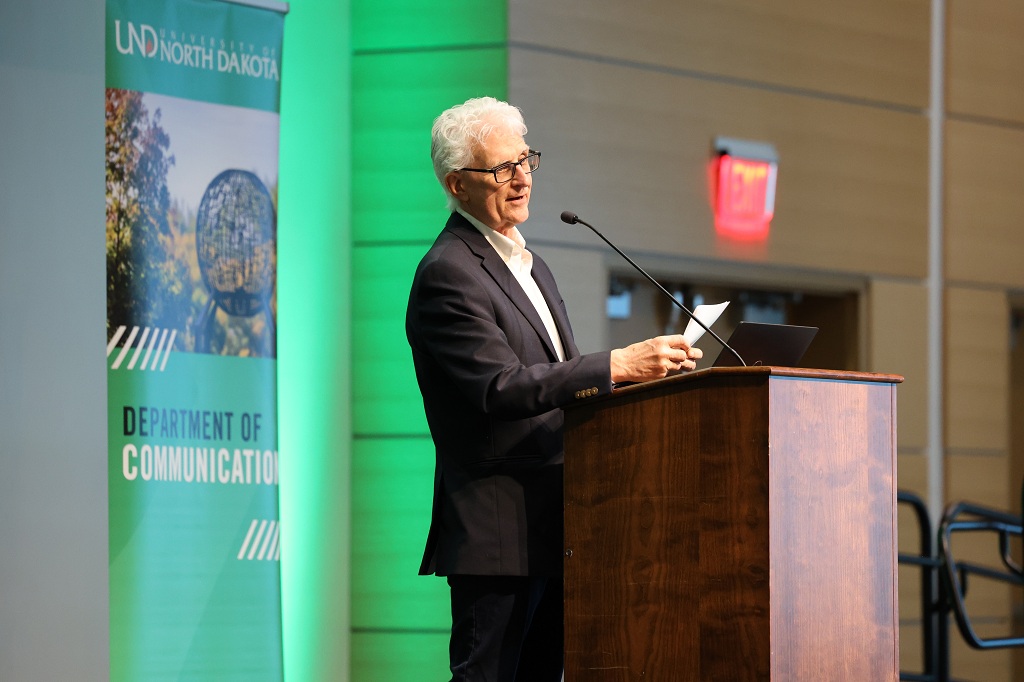
Mike Burbach, editor of the St. Paul Pioneer Press, was feeling pretty good about himself that day back in 2018.
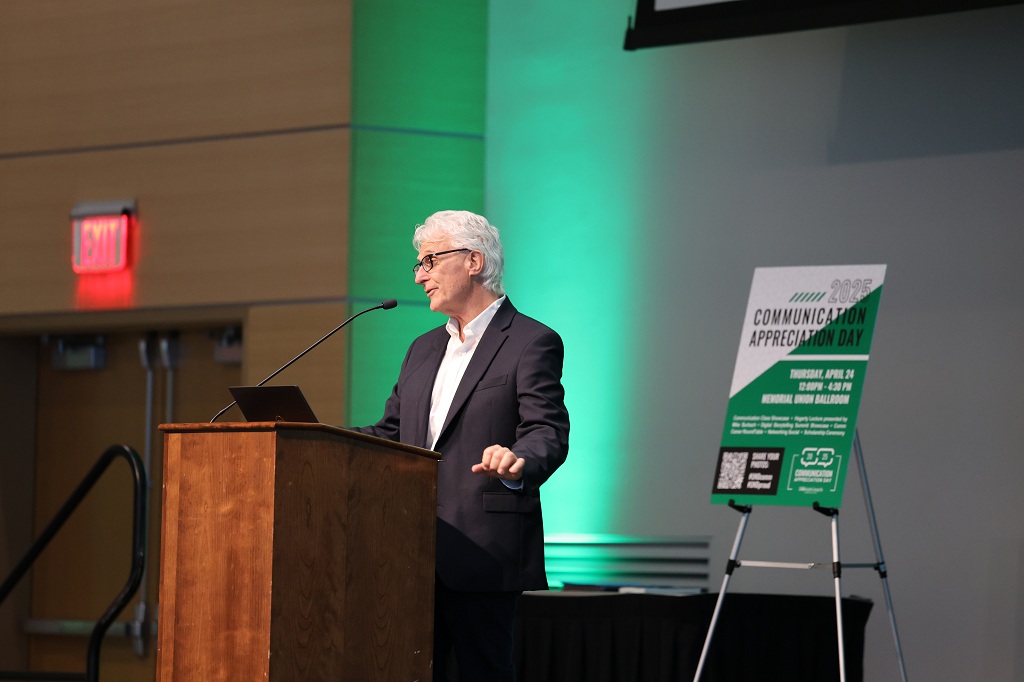
“After having not managed work and worry optimally, I had decided to get healthy again,” Burbach said during his Hagerty Lecture at UND on April 24.
“It was going well. I was losing weight, eating better, drinking less, a regular at the gym.
“Then one Saturday, after a nice, long workout, I thought, ‘Shoot. I’m going to live to 90, just like my dad and his dad.’”
A moment that concentrates the mind
But events, as often happens, intervened. And in the course of his lecture, Burbach offered a number of key lessons that apply to both life and journalism – lessons that, he said, drew upon “the immense gratitude” he was left with after that day in 2018, when a near-death experience had left him peering into, and even teetering on the edge of, the abyss.
“So when I say I’m happy to be here today, I mean really happy,” he said during his talk. “And not just ‘here’ here, but here at all.”
The Hagerty Lecture Series, which was named for the late Jack Hagerty, longtime editor of the Grand Forks Herald, brings to UND distinguished journalists to talk about their careers and craft. Burbach qualifies. His decades-long career got its start at UND, where he was editor in chief of the Dakota Student. After graduating in 1982 with a double major in journalism and German, Burbach worked at the Grand Forks Herald, then became managing editor of the Aberdeen (S.D.) American News and editor, from 1992 to 1995, of the Minot (N.D.) Daily News.
Stints in newsroom leadership at the Detroit Free Press, Columbus (Ohio) Ledger-Enquirer and Akron (Ohio) Beacon Journal followed. Then in 2006, Burbach became editorial page editor of the St. Paul Pioneer Press. He was appointed the paper’s editor in 2011.
As mentioned, Burback was feeling limber and loose after that Saturday workout back in 2018. “Then the pain started,” he said.
“It wasn’t grab-your-chest pain like in the movies; I figured I had just pulled something. But it persisted. …
“The pain got worse, more enveloping, so I stopped at the neighborhood clinic just a few blocks from our home. I walked in, waited in line like a nice, polite Nodak.
“When it was my turn, I said, ‘I think I’m having a heart attack.’ The person at the front desk smiled and said, ‘May I see your insurance card?’”
A heart attack it was, and the hours that followed featured both an ambulance ride – complete with lights flashing and siren blaring – and emergency surgery.
“And it took some doing, but I got another chance,” he said. “That’s where I’m coming from today – at the tail end of a long career full of lessons that began right here at UND, under the influence of so many good people.”
‘For journalists, essential’
Lesson 1, Burbach said: Objectivity. Of course it’s a myth, and no journalist can hope to be perfectly objective.
But a funny thing happens over the course of decades, when a reporter sees people at their best and worst, and experiences journalism itself at times swinging between those extremes.
At such moments, the wisdom of certain old rules, born of hard-won maturity and the experience of centuries, can be seen to apply. And one of them is this: “Actual objectivity is a human impossibility. But the pursuit of it is useful – and for journalists, essential,” Burbach said.
“Which means we work hard to recognize our own biases and assumptions, and we work hard to account for them and counter them, because we need to figure things out.
“That takes shoe leather and, often enough, mind-bending effort.”
Second lesson: Compound interest is indeed a miracle – and not just for investors.
True enough, if you deposit money on a regular basis into an account that earns good interest, you’ll be looking after 30 or 40 years at an astounding sum. But here’s the thing, Burbach said: “Interest in the world around us also compounds.
“An original investment in learning something about, say, the Red River as it rises, earns interest as we then learn more about local geography, and why the Red River Valley has some of the best farmland in the world.
“And then about the inhabitants of the valley before it was farmland. Then about glacial Lake Agassiz. And then more about the recent Ice Age, and the wobble of the earth and solar cycles and other influences on climate.
“And then about plate tectonics, and the origins of life on Earth …
“Interest upon interest, delivering a stunning return on investment,” Burbach said. “I think of compound interest like that, one discovery leading to another and compounding into more understanding.”
‘Gratitude is magic’
Here’s another lesson, one with applications far beyond the newspaper world: For best results when launching or leading any project, first find the organizing principle.
Because “getting things done in a group, in a newsroom, at home, on a school board, in a university department, wherever, it requires a shared sense of purpose,” Burbach said. “And a sense of purpose requires an organizing principle, an idea to orient from and to.”
Case in point: Burbach’s own experience as head of the Parent Council at a school attended by one of his children. Along came the pandemic, “and all the upset and dissent that brought,” he said.
Amid this discord, the school’s leaders “had to make a lot of decisions, like all schools: whether to stay open, how to stay open, how to balance risks and competing priorities. … Behind the scenes, there was good faith, but also fear, anger and suspicion. Everybody wasn’t on the same page, which is almost always the case.”
As he looks back on that time, Burbach said, he thinks about what good organizing principle would have made things easier.
“This one would have: ‘Our aim is to keep kids in school,’” he said.
“If you’re organized around that, your decisions can flow from that. What should we do to mitigate risks? Do we have to wear masks if kids aren’t at risk? …
“Suddenly, the trade-offs make much more sense, because we’re organized around a good thing that we pretty much all can agree with.”
In closing, Burbach said after listing these and other lessons, “I want to pull these pieces together, and add one more thing that I’ve learned.”
That one thing is the sum of the others, in a sense. Because “when we develop the ability to look back and appreciate the moments of kindness, of grace, of encouragement, of benefit of the doubt that we’ve been given through the years by friends, family, strangers, teachers, adversaries, it’s almost overwhelming.
“So I’ve learned this. Gratitude is magic. Through the lens of gratitude, the world, with all its woes and trials, is a beautiful place.”
And wth gratitude in mind, Burbach quoted from a piece he’d contributed to the UND Department of Communication’s 100th anniversary celebration last year.
“From every single teacher, PhDs and practitioners alike, each with his and her own remarkable strengths, I learned so much,” he said. “Skills, yes; but more importantly, concepts and values and attitudes that enriched us then and enrich me yet now, more than 40 years later.
“The transcendent beauty of curiosity, the absolute value of constructive skepticism, the liberating joy of precision, the bounty of economy, the atomic power of a generous spirit.
These things I saw in our UND Communication faculty, as they instructed us, corrected us, guided us – and sent us on our way.”