UND leaders grateful for Legislature’s continued support of higher ed
New STEM complex, national security mission among areas robustly funded for 2025-27 biennium
As the North Dakota Legislature concluded its 2025 session, UND leaders expressed appreciation for the lawmakers’ steadfast support of higher education.
“Overall, I am very pleased with how North Dakota continues to recognize the importance of higher education,” said Karla Mongeon-Stewart, UND’s vice president of Finance & Operations.
In May, the Legislature passed Senate Bill 2003, which provides the North Dakota University System with its operating budget for the 2025-27 biennium. Although UND did not receive 100% of the funding it requested in its legislative priorities, campus leaders feel that the most important needs were met.
“We’re lucky to have legislators in both chambers who really do care about higher education, and understand its value to the state of North Dakota,” said Peter Johnson, director of Government Relations & Public Affairs at the UND Alumni Association & Foundation.
Meloney Linder, vice president of Marketing & Communications at UND, opined that such value is represented in workforce development – a topic that has concerned policymakers and business leaders across the state.
Johnson added that higher education plays an important role in diversifying North Dakota’s workforce and economy beyond traditional sectors such as energy and agriculture.
“There’s a recognition that as a state, we need to find a way beyond those sorts of things, and higher education is the best doorway for that,” he said.
Mongeon-Stewart believes a key reason for the Legislature’s continued support of higher education is an open channel of communication between legislators and campus leaders.
“The fact that we can meet with legislators in person multiple times per session to share our ‘why,’ is so important,” she said. “I think that’s a reason why they’ve invested in higher ed – they have a better understanding of it because they give us that time.”
Regarding compensation and benefits, Mongeon-Stewart said she feels reassured about the Legislature’s actions regarding the North Dakota Public Employee Retirement System (NDPERS) – the entity administering insurance and retirement benefits for the state’s public employees. Rather than passing them on to UND, the body appropriated $4.6 million and $1.39 million to offset costs associated with NDPERS retirement plan closures and insurance premium increases, respectively.
The Legislature also approved merit-based salary increases of 3% per annum of the biennium, meaning that employees with satisfactory evaluations on file are eligible for raises.
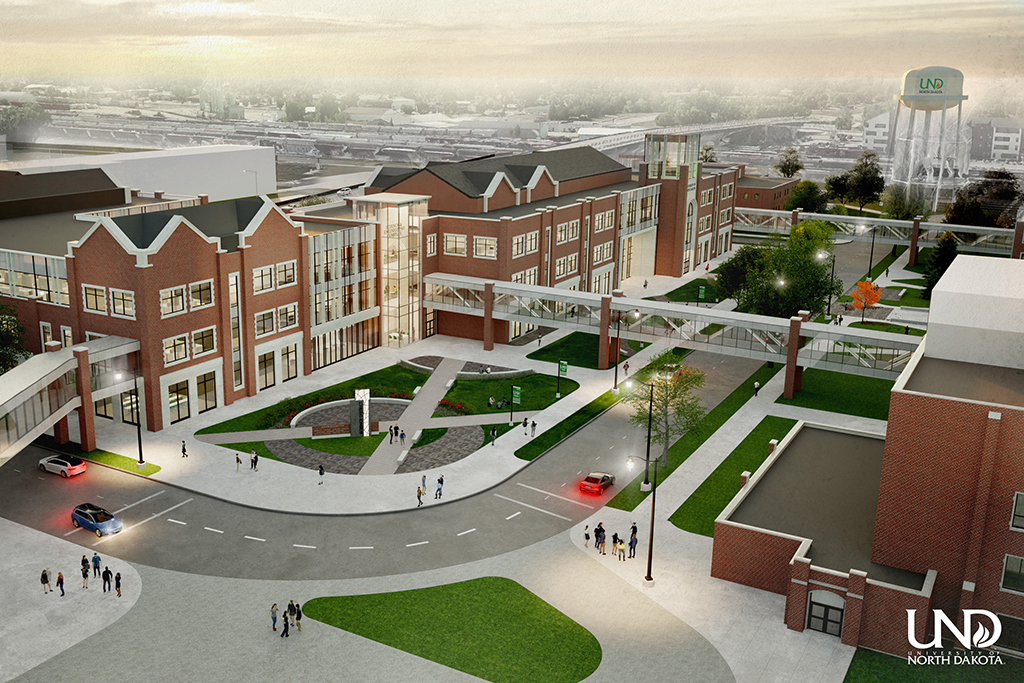
Senate Bill 2003 provides $55.6 million in funding for a new STEM complex, to be supplemented by up to $24 million in donor funding. UND leaders said the facility will benefit research activity and boost workforce development, through modernized lab space and collaboration across different colleges.
Other highlights of the bill include $24.75 million, appropriated to the state’s Challenge Grant – an increase of $4.75 million from the previous biennium. The fund, which helps grow philanthropic contributions to higher education, provides a 1:2 match for UND and North Dakota State University – meaning that the State Board of Higher Education will match one dollar for every two raised by the state’s research institutions.
“Legislators by and large really like the Challenge Grant concept,” Johnson said. “They understand that it’s an opportunity for all of the foundations to match dollars, so it brings in additional money, including from out of state.”
An additional $16 million was appropriated to help bolster UND’s national security mission, specifically in the fields of UAS and counter-UAS, cybersecurity and satellite testing and design. This brings total legislative appropriations over the previous two regular biennial sessions and a special session, to $39 million, according to Johnson.