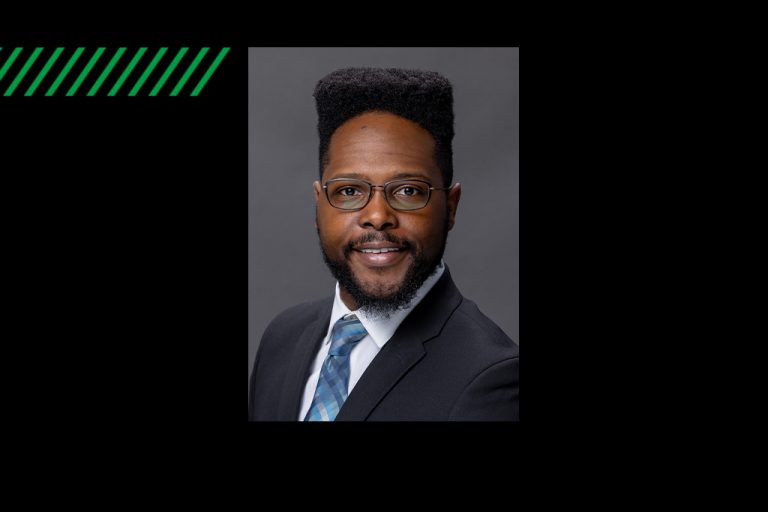
PHOTOS and VIDEO: UND Summer Commencement 2025
UND Math Professor and Commencement Speaker Ryan Zerr offers axioms for life, and more than 500 graduates cross the stage

“Though the day began with a thunderstorm and tornado warning in Grand Forks, students at the University of North Dakota were all smiles at the 2025 summer commencement,” as the Grand Forks Herald reported in its story about the ceremony.
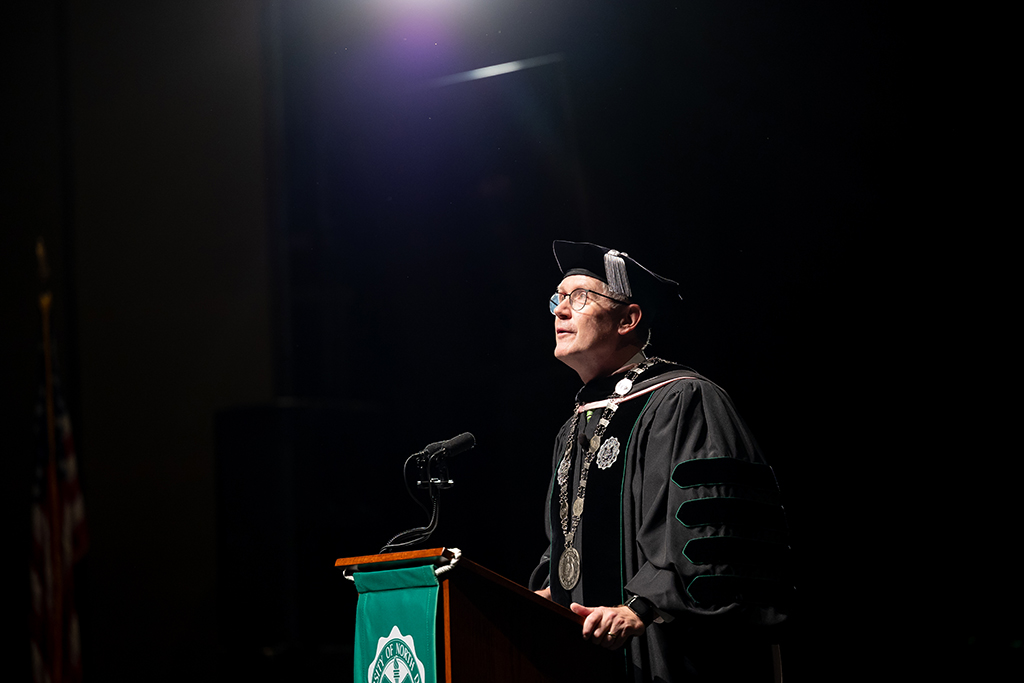
Some 534 undergraduate and graduate students were eligible to receive degrees in the ceremony, which was held on Aug. 8 at the Chester Fritz Performing Arts Center and served as UND’s 104th Summer Commencement.
“Before any could walk across, however, a posthumous degree was awarded,” the Herald reported.
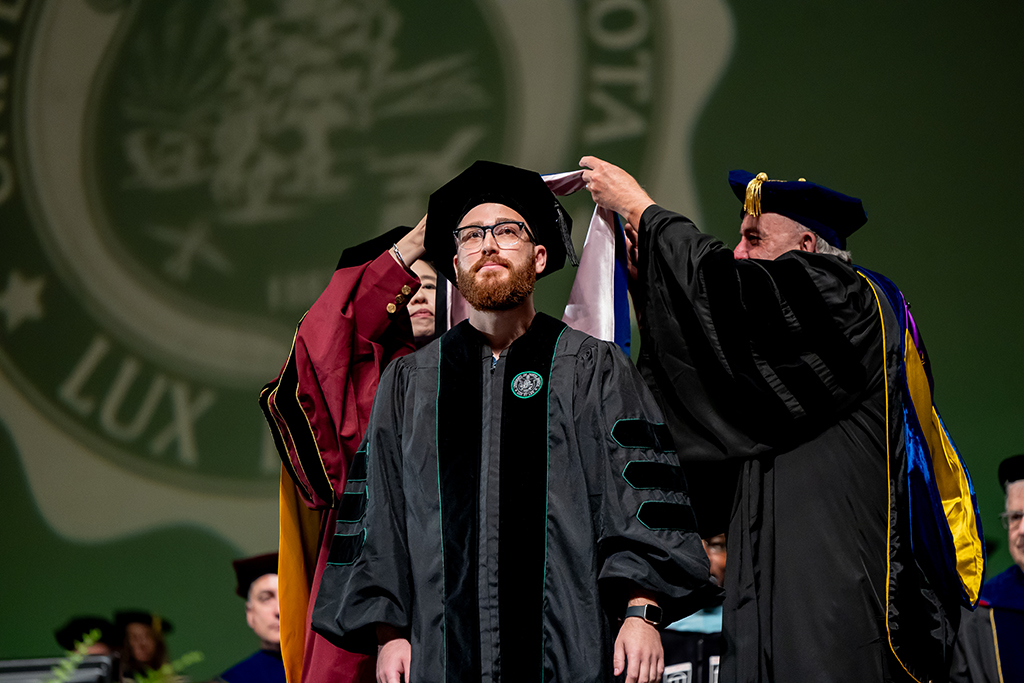
“Kalisi Uluave received a posthumous Doctor of Philosophy in Indigenous Health under adviser Brynne Luger. Uluave, who died July 25, 2024, was a member of the Department of Indigenous Health as opioid response tribal liaison and tribal tobacco control research and project coordinator. He also taught Master of Public Health courses focused on American Indian policy.
“ He began his doctoral program in 2021. His wife, Mariah Uluave; his mother, Sheila Taysom; and his stepfather, Steve Taysom, accepted his diploma and doctoral hood.”
The ceremonies were livestreamed at UND.edu and UND’s Facebook page. A video of the ceremony is below.
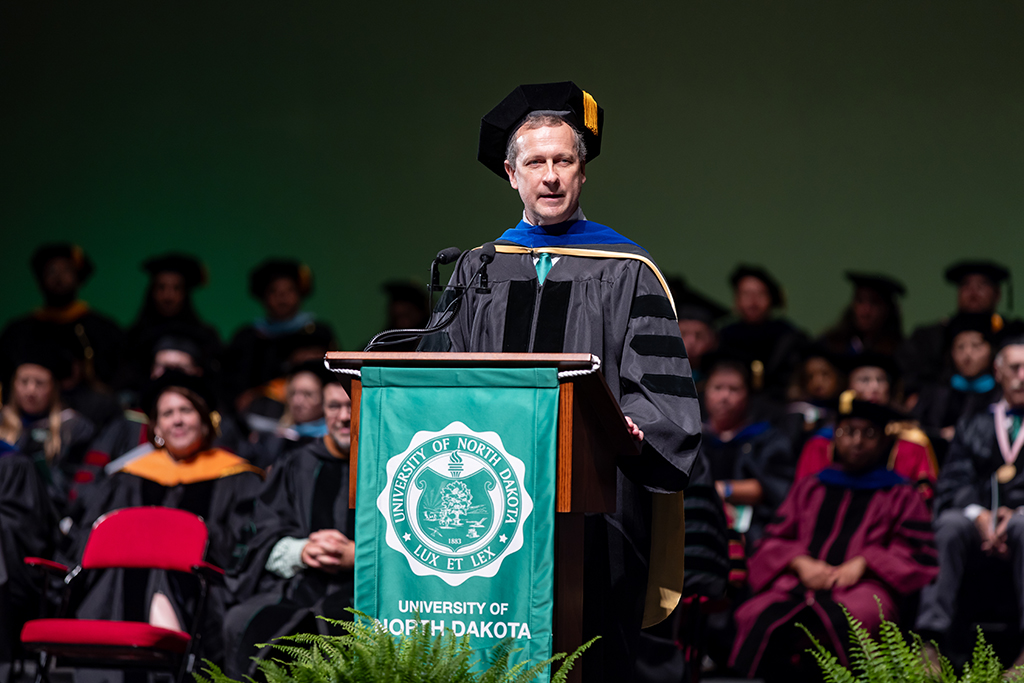
The following is the UND summer commencement address by keynote speaker Ryan Zerr, professor and chair of the Department of Mathematics & Statistics in the College of Arts & Sciences and associate vice president for Strategy & Implementation at UND. Zerr is also a two-time graduate of UND, earning a B.S. in Meteorological Studies and an M.S. in Mathematics in 1996 and 1998.
* * *
Graduates: Congratulations on reaching this milestone! You, and your family, friends and supporters, should be proud of what you’ve accomplished.
I’m honored to be here to say a few words to commemorate the occasion and to acknowledge your hard work and dedication in reaching this point. As a mathematician, it seems appropriate to note a few of the numbers that have defined your time as a UND student. For instance, one of you will receive the 169,000th degree granted by UND since its first commencement in 1889. On average, you’ve spent at least 96,000 minutes in class to obtain a four-year degree. And for those who have earned graduate degrees, the total is just that much greater.
Time spent studying? It varies, of course, but I’ve done the arithmetic, and thousands of hours seems a safe estimate.
And now here you are, with just a few minutes until you take your final steps as UND students. The steps that come after will be as UND graduates, and those next steps, as you descend from the stage to take your seat, will be the first as you commence the next stage in your life’s journey.

Uncertainty precedes plan
Some of you may know where these next steps will take you; others may be less certain.
When I was in your place, I wasn’t sure what would come next. Of course, in the sense that we don’t know what the future will hold, that’s true for all of us. What I mean is that I didn’t have a detailed plan, which is strange, because I thrive on having a plan. My family can attest to this. As everyone is getting ready for the day, I feel compelled to talk through the day’s game plan: Who has to be where by when? Logistics for making it happen? Dinner — prepared by whom and at what time? Menu? You get the point.
But that’s the me of today. It seems I was more relaxed when taking my first steps as a graduate.
Although that’s not quite true, either. The type of plan I just described would be more like a recipe or the turn-by-turn directions from my phone. “While staying in the left lane, in a quarter mile, turn left onto University Avenue.” These types of plans are comforting and reassuring — they’re a formula: Subtract 2 from both sides of the equation, divide by 5 and … there you have it, the answer.

Axioms for math and life
But there’s a different type of plan. One that I was following all along, and that I know each of you will be following as well. It’s the type of plan that focuses on the principles and values that define each of our characters, such as:
Do the right thing even when no one is looking.
Be kind and treat others with respect.
Act with honesty and integrity.
It’s a long list, and I know each of you has one that you use to guide your decision-making, even if not always consciously.
A mathematician would refer to “big picture” rules such as “do the right thing” and “act with integrity” as axioms. They’re the ground rules for approaching the topic at hand, whether geometry, algebra or calculus. They’re higher level, not quite so formula-like. But they’re key; the foundation for what you are trying to do.
Of course, two people’s lists of axioms are likely to differ. And each of our lists will naturally grow with time and experience — this is probably one way to think of what it means to acquire wisdom — your personal list of “rules to live by” has grown and been refined.
So, in addition to those I noted earlier, which axioms have found their way onto my list? More than we have time for today, and so for now, I’ll focus on three that may not have been entirely obvious to me as a new graduate: Consistency, adaptability and opportunity.
Consistency, adaptability and opportunity
The first of these, consistency, is not far removed from principles I mentioned earlier: honesty and integrity. It’s doing what you say you will do, following through when a commitment has been made.
But it’s also more than that. For instance, as you take your first steps in your career, things are likely to become difficult. Or perhaps ideas you have aren’t met with the enthusiasm you might hope. How will you react? If with determination, perseverance and diligence, then you have the right idea.
It means a consistent approach that isn’t subject to change when challenges arise. It’s an acknowledgment that throughout our lives, others will need to know what to expect from us — to be able to rely on us for things both professionally and personally.
The next item I mentioned was adaptability. But wait — be both consistent and adaptable? Yes: consistent in the face of difficulties and challenges, but adaptable enough to know when something isn’t working — when a change in approach may be necessary. It means adapting to new information or to new insights.
I see the tension between these two axioms when helping students think through problems, where it’s important to balance not giving up too soon against abandoning an approach that isn’t leading to results. It’s also present when working with those around us, navigating differences of opinion by balancing between principled stands, making compromises and finding common ground.
The great news is that the ability to navigate the interplay between consistency and adaptability is a hallmark of the degree you’ve just earned. Your UND degree means you know how to learn and how to analyze situations. That you know what to do as you encounter new circumstances, new discoveries and unexpected challenges.
The final item on my list concerns recognizing — and being open to — opportunities. Opportunities are what help us find our niche and open doors. I think of this as my “just say ‘yes’” axiom. It’s the idea that building a happy and fulfilling life and career is more than just following a basic formula.

Make most of opportunities
For instance, my undergraduate degree — which is not in mathematics — did not point in any obvious way to the trajectory my career has followed. As things have turned out, I’ve had the good fortune to pursue interests in various areas, and I spend as much of my time writing, planning and organizing as I do calculating and computing. Had I not said “yes” at a number of critical points, I would have missed opportunities for growth — opportunities that have helped define my career.
I predict the same will be true for you. Perhaps it already has begun with opportunities you are pursuing or that are on the horizon. And here, too — just as with consistency and adaptability — the degree you’ve earned demonstrates your ability to succeed when opportunities present themselves. You have the knowledge and skills to make the most of the situations that lie ahead — whether those situations look like your expected trajectory or represent a unique unfolding of opportunities.
To close, I’d like to return to some of the numbers that have defined your time as a UND student. These numbers are much more important than the ones I mentioned earlier, and only you will know what they are:
Number of friendships formed while at UND.
Number of teachers and mentors who have had an impact on your education.
Number of family and friends who have supported you.

You’re on your way!
So while you navigate the many other numbers that will be part of your life, don’t overlook those that define your network of support. People who are rooting for you, who will be there during life’s milestones. Those who provide consistency when you need it, and who help you adapt to whatever comes your way. Those who are mentors, who see your potential and offer guidance to ensure you recognize opportunities for growth and advancement.
And a final number: The number of doors opened by your UND education. This number will continue to grow in the months and years ahead as you are guided by your personal list of axioms for life.
Whatever it contains, know that the achievements that bring you here today mean your list is a plan that leads to success! You’ve done it! You are a graduate of the University of North Dakota! Know that we are proud of all you have accomplished, and we look forward to your future success.
Thank you.