From layoffs to ‘Leaders in Action’
With strategic budget cuts and a farsighted master plan, UND modernized its campus and built a new brand
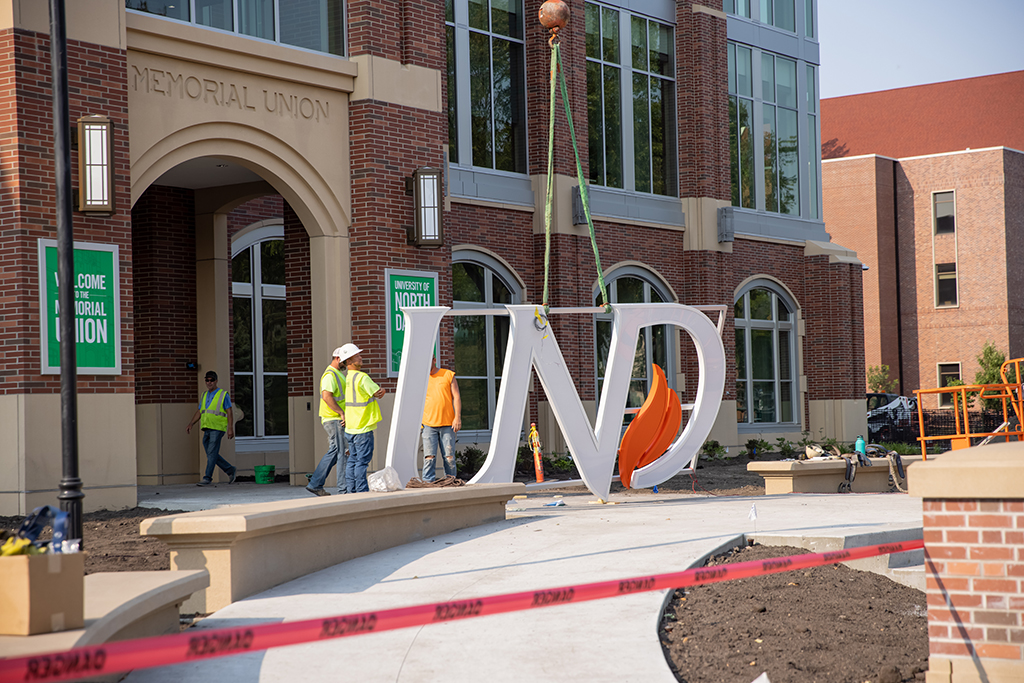
Connection, Momentum and Community. These three words — UND’s most recent “words of the year,” as proclaimed by President Andy Armacost in ascending order — are certainly apt descriptors of the University’s transformation over the past decade.
Binding together during tough times, a resilient campus community set forth a plan that led to unparalleled growth — spanning scholarship, strategic partnerships and its largest ever student body — with a nationally recognized brand to boot.
Making the tough calls
Driving down University Avenue — with its lushly landscaped median, sidewalks teeming with students and new buildings designed in the “collegiate gothic” style — it’s easy to forget the vastly different reality facing the state’s flagship university a decade earlier.
In 2016, North Dakota faced a $1 billion budgetary shortfall, driven largely by plummeting global crude oil prices – a commodity that provides the state with billions in tax revenue annually. That same year, the average price of a barrel of crude dipped to $43.67, down from a peak of $111.63 in 2012, according to Statista, a German data collection firm.
“A reality is that North Dakota’s primary economic base is agriculture and energy,” said Peter Johnson, director of government relations and public affairs for the UND Alumni Association & Foundation. “That happened to be a time when both sectors were down. The money rolling into the state’s coffers was much less than anticipated.”
Johnson – who has worked in communications and public relations at UND for over 30 years – said North Dakota’s institutions of higher education faced a grim reality. Former Governor Jack Dalrymple directed all state agencies to cut 4.05% from their general funds.
That meant cuts to academic programs, layoffs of faculty and staff, and the elimination of athletic teams – among other cost-saving measures.
“The mood was very pensive, people were wondering where things were going,” Johnson said.
However, Johnson opined that the initial cuts made by interim President Ed Schafer, continued under President Mark Kennedy, had the foresight to plan for the future.
“It’s kind of like pruning trees – you’re cutting in a way that you’ll have renewed growth,” Johnson said.
Johnson added that the optimism surrounding UND’s direction is palpable across campus.
“Most of the people I interact with now are very happy with where UND is at,” he said. “There’s more of a sense of family, a sense of ‘we’re all in this together.’ We have a leader who cares about students, faculty and staff, and is always trying to do the right thing.”
Budgeting today for the needs of tomorrow
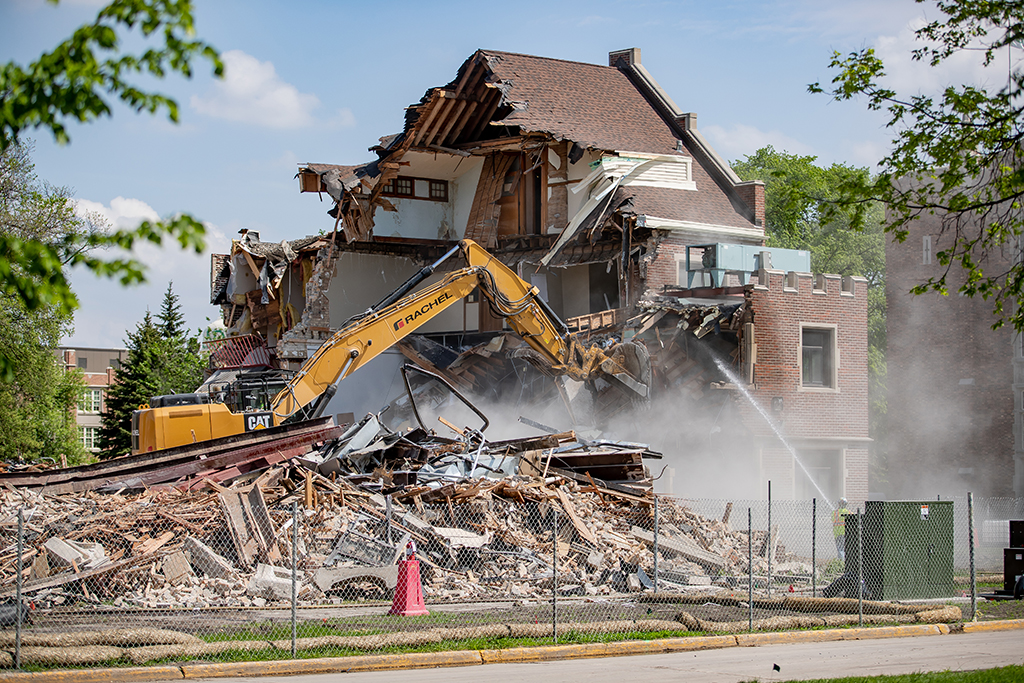
Before UND’s newest buildings could be constructed, several outdated ones had to be demolished.
Around the time of Dalrymple’s budget cuts, UND began prioritizing deferred maintenance – an area that had been neglected in years past. Part of this process required University leadership to do a cost-benefit analysis on the merits of keeping aging buildings.
The result was UND eliminating a net 346,207 square feet of building space as of that fiscal year – down from a net positive of 690,446 square feet in fiscal year 2015-16. Although demolishing certain buildings on campus proved controversial, the decision left the University in better fiscal health, said Vice President of Finance & Operations Karla Mongeon-Stewart.
UND also began allocating 1 percent of total tuition revenue toward deferred maintenance each fiscal year. This cumulative investment has paid dividends, Mongeon-Stewart said.
“Now, we have $10 million we can use to match the state’s funds to do twice as much work as we could if we only relied on the state,” she said. “That was a conscious decision we made.”
Mongeon-Stewart added that UND’s Facilities team compiles a list of maintenance priorities that it regularly presents to the president’s Executive Council.
“We’ve improved every year,” she said. “In the past, Facilities had the ‘go fix what you can’ mindset. Now, as we’ve received more money, I think it’s been far more coordinated with leadership.”
Brian Larson, director of construction management at UND, said being responsible stewards of the deferred maintenance budget let the University focus on the historic core of campus.
“I think Merrifield is a great example of using those dollars responsibly to address maintenance in a building we’re going to keep forever,” he said. “We did the same with the Chester Fritz Library.”
Mongeon-Stewart added that using a diverse mix of funding sources for capital projects — including bonding, philanthropy, reallocation of campus resources and public/private partnerships — insulates UND from potential financial shocks.
Nearing the end of its current campus master plan, UND continues to look ahead – in fact, over 30 years ahead. With projects underway such as the new flight operations building, and a STEM complex located on the former site of the Hyslop Sports Center, University leaders will have important decisions to make about optimizing square footage on campus.
Larson and Mongeon-Stewart agreed that a major factor in the success of UND’s recent capital projects is a steadfast commitment to the campus master plan, no matter how difficult it seemed at the time.
“We’ve been lucky, because every president has embraced the idea of living to the model,” Mongeon-Stewart said. “They’ve allowed us to move forward and keep moving forward. Ed Schafer really set the stage for cutting more than you need today, so you can invest in what you need tomorrow.”
Telling the story of UND
Here’s another, often-overlooked component that has added significantly to UND’s success, especially when it comes to recruiting students: the University’ extensive efforts at marketing and communications.
On the far western edge of campus, a team of writers, marketing professionals, photographers, videographers, web designers and event planners is hard at work telling the University’s story and touting its brand.
Since its creation in 2017, UND’s Division of Marketing & Communications has been keeping state lawmakers, alumni, faculty and students apprised of developments on campus through its publication, UND Today, along with promotional campaigns to boost student recruitment and retention.
At the division’s helm since 2018 is Meloney Linder, UND’s vice president of Marketing & Communications. She said the division’s creation the year before coincided with the launch of the University’s brand: “Leaders in Action.”
Before establishing the division and brand, Linder said, UND lacked a unified marketing and communications strategy.
“It was really the Wild West — every school or college would have its own website,” she said. “Everything was really decentralized. When things are decentralized, it’s hard to have that cohesive message.”
Now, the division’s staff coordinates closely with the University’s colleges — and entities including athletics and the Alumni Association & Foundation – to ensure unified messaging and branding. This creates what Linder dubs a “halo effect” – an image of positivity associated with Leaders in Action that permeates throughout the University.
Leaders in Action paved the way for the UND LEADS strategic plan, adopted in January 2023. Linder said the document outlining UND’s vision and goals was conceived with the input of committees comprising hundreds of students, staff, faculty and alumni.
“People do see themselves within the brand,” Linder said. “We identified characteristics where people say, ‘Yeah, that’s me.’ There’s such an amazing community here. We’re doers, we’re leaders, and we roll up our sleeves to get the job done.”
Strong brand health is reflected in record-setting enrollment this fall. Significantly, Linder said, the number of on-campus students attending UND has increased since the onset of the COVID-19 pandemic, when, for a period, courses were held exclusively online.
Additionally, UND has a long history of enrolling students from military backgrounds. According to Janelle Kilgore, vice provost for strategic enrollment management, about 2,000 students – or just over 12% of the student body – are affiliated with the armed forces.
More students attending classes on campus and affiliated with the military – the latter of whom are often already well connected to the community, Linder added, has the potential to boost the region’s workforce.
“When people come here and they have a great experience, they sometimes want to stay when they’re done with service,” she said. “UND is a great attractor.”
The Road to Record Recovery package …
>> The story behind the numbers: UND President Andy Armacost reflects on the tough decisions, hard work and extraordinary partnerships that have built the University of today.
>> UND sets all-time enrollment record in fall 2025: The No. 1 destination of choice for North Dakota residents now counts 15,844 students, up 825 students over last year.
>> Record enrollment is just part of the story: Ten years ago at UND, budget cuts and program closures — not enrollment records — were top of mind. Here’s how that changed.
>> From layoffs to Leaders in Action: With strategic budget cuts and a farsighted master plan, UND modernized its campus and built a new brand.
>> Look at UND — then and now: Before- and after-shots show the amazing transformations that have taken place on the UND campus.
>> Community leaders reflect on UND’s momentum: Leaders express pride in partnerships, community, smart master planning, extraordinary philanthropy and an energized, beautiful campus.