‘Mutualistic symbiosis,’ in the classroom and the field
In successful mentor-mentee relationships, both sides gain, explains UND’s Vasyl Tkach, one of the top scholars — and mentors — in parasitology

Editor’s note: In the UND LEADS Strategic Plan, the “Learning” core value includes calls to “expand individualized advising and mentoring, to help students see how skills can be transferred across courses and extra-curriculars.”
The following story, which was first published in UND Today on Sept. 2, profiles Professor Vasyl Tkach, whose professional skill at mentoring students earned him a national award.
* * * *
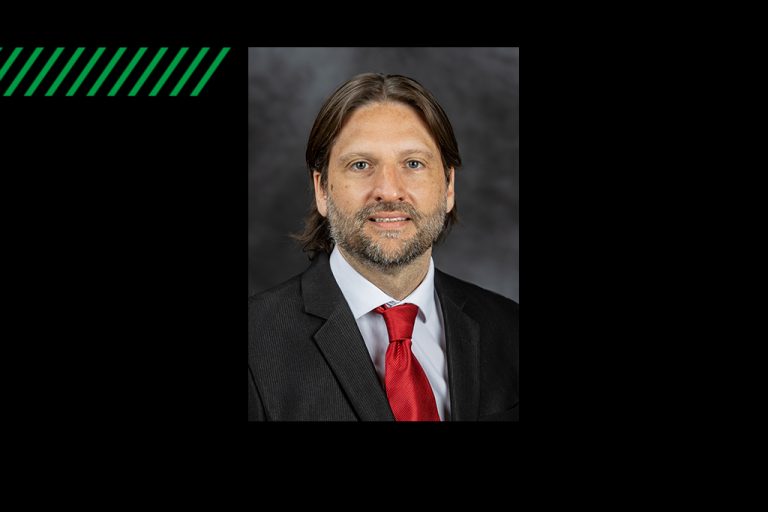
Professor of Biology and researcher Vasyl Tkach loves parasites. And in a way that only a parasitologist could appreciate, he sees mentorship as a kind of passing-on of information and, even more important, passion from one host to the next.
Earlier this year, Tkach received the Clark P. Read Mentor Award from the American Society of Parasitologists, a national honor recognizing outstanding mentorship in parasitology. When he accepted the award, he spoke not about himself, but about his students.
“Working with my students was and is a privilege and the greatest joy of my professional life,” he told colleagues in his acceptance speech. “I consider this a shared award, as without my students I would not be able to do much. Their support and trust mean to me far more than any award.”
This is the approach Tkach has taken in his two decades of teaching at UND, where his fascination with science has inspired generations of students to pursue careers in biology, medicine and research.
An early love of biology
Tkach’s love for living things began early in his childhood in Ukraine. Exploring the fields and forests around his home led him to develop a fascination with complex living things.
“I was very certain since about 8 or 9 years old,” he said in an interview. “I spent all the time I could reading books about natural history. There was no Internet, of course, and no TV to watch; just books. And I spent a lot of time with nature.”
At first, he imagined himself studying plants.
“I wanted to be a botanist — specifically, to study orchids,” he said. “They have very complex biology and are somewhat parasitic themselves, and I was always attracted to that complexity.”
But once he encountered parasitology in college, he was hooked. At Uzhhorod State University, one of his first mentors — a student three years his senior named Vasyl Chumak — showed him the allure of studying parasites.
“His passion for parasites was absolutely infectious,” Tkach recalled. “Being near him and not trying to do some sort of research on parasites was impossible. So, I tried and never looked back.”
From then on, parasites became the center of his work. From the flukes in Minnesota lakes to the helminths — parasitic worms — of Vietnamese bats, parasites exist all around us, Tkach notes. And while an aversion to these creatures is common among people, Tkach’s fascination with them, like Chumak’s, is infectious in its own right.
When Tkach was named a Chester Fritz Distinguished Professor in 2021, UND alumna LeAnne Froese spoke to this passion in her nomination letter.
“He talked about parasites with such enthusiasm,” Froese wrote. “There are not too many people in this world who can find the beauty in parasites, but it soon became one of my favorite classes. His excitement for learning and all things nature was contagious.”
Tkach said that, much like orchids, parasites fascinated him because of their complexity.
“It’s just a notion of a living creature living inside other living creatures,” Tkach explained. “They are extremely well adapted, physiologically, and have complex life cycles. That’s the most fascinating science.”
Mentorship as mutualism
To Tkach, mentor-mentee relationships resemble what parasitologists call a “mutualistic symbiosis.”
“A good mentor-student relationship means both sides benefit,” he said. “I learn from my students all the time. If we go through only what I already know, that would be rather a lost time for me and the students. When they ask questions or approach something differently, I’m learning in that process, and it makes things very rewarding.
“I do not have any particular set of rules because each student is different, with their own strengths, weaknesses, interests, motivation and life outside the lab,” he added. “We need to learn these things as soon as possible, play to their strengths, and not attempt to change anyone to be similar to you.”
Students say that philosophy makes a difference. “Dr. Tkach was ever-present to give feedback and criticisms,” said Dawn Cleveland, a UND doctoral student in biomedical sciences. “He is the most involved professor I have ever worked with, and his passion for teaching is deeply apparent.”

Lessons and bonding in the field
But, Tkach explained, some of the most important mentorship opportunities take place outside the classroom.
“Fieldwork is not only necessary for our research but is the best bonding technique I know,” he said. “Sometimes, I’ve had to carry my students on my back across a creek. They’ve carried me, too.”
Those shared experiences, whether in North Dakota wetlands or the jungles of Vietnam, also give Tkach the chance to draw on another passion: art. He attended art school in his youth and still prepares illustrations of parasites for his publications today.
“I love art and history, and I go to museums wherever I can,” he said. “When a student comes back from Florence or Rome and tells me about the paintings and statues they saw, I enjoy that very much, because I have seen them, too, and we can discuss them. I find that it’s a good way to connect and learn about people outside of science.”
One trip in particular still stands out in his memory. During his acceptance speech, Tkach described taking undergraduate student Stephen Greiman on a collecting expedition to the Gulf Coast.
Greiman had planned to apply for veterinary school and had asked Tkach for a recommendation. But after days of collecting specimens, he surprised his professor on the flight home.
“Stephen asked me to scrap that letter to veterinary school, and write a letter to graduate school instead,” Tkach remembered. “This bright young man decided to trade the career as a veterinary doctor for becoming a researcher and a university faculty member. Although I usually ask students to think at least twice about such serious choices, I did not do it that time. I was very glad to hear Stephen’s decision.”
Today, Greiman is a professor at Georgia Southern University and an award-winning parasitologist in his own right.
A symbiosis that spreads
You see, much like the organisms he studies, Tkach’s passion for science has a way of finding new hosts. And that’s the way Tkach likes it, because for him, seeing students such as Greiman thrive is one of the most rewarding parts of his job.
“It is every mentor’s wish that their students surpass them,” Tkach said. “And my Ph.D. students have done that, publishing and achieving far more than I did at the same career stage. This brings me joy.
“What makes me even happier is seeing them bringing flocks of their own students to our meetings. This tells me that the goal has been achieved.”
The Clark P. Read Mentor Award is the latest in a long list of honors for Tkach, who not only is a past president of the American Society of Parasitologists, but also received the Henry Baldwin Ward Medal — that organization’s most prestigious award — in 2017. But Tkach views these awards much like he views mentorship: as an ongoing exchange.
He reflects on his service at UND in much the same way.
“UND wasn’t just my first employment place in the United States,” he said. “It has treated me really well. I was able to do here far more than I could have ever expected.
“So, whatever I can do next is a bonus. I already exceeded my own expectations,” he said with a laugh.
Once again, his students agree. UND alumna Taylor Chermak says that her experience with Tkach was life-changing, proving that the honors he has received were not incidental. Instead, they were wonderful recognitions of an outstanding career:
“I would not be at my current stage in graduate school and professional development had I joined a different lab,” wrote Chermak in a nomination letter. “I cannot think of another mentor who has demonstrated better leadership to the training of young scientists.”
****
>> Questions or comments about the UND LEADS Strategic Plan? Your thoughts are welcome! Please contact Ryan Zerr, associate vice president for Strategy & Implementation, or Anna Marie Kinney, coordinator of the University Writing Program, the co-chairs of the UND LEADS Implementation Committee. You also may offer your thoughts by visiting the UND LEADS Strategic Plan home page and clicking on the “Provide your feedback” link.
Thank you for your support of the UND LEADS Strategic Plan!