UND CONNECT: The case of the ‘Bride in the Woods’
Students earn credentials with professional training in crime scene investigation at Forensic Science Boot Camp
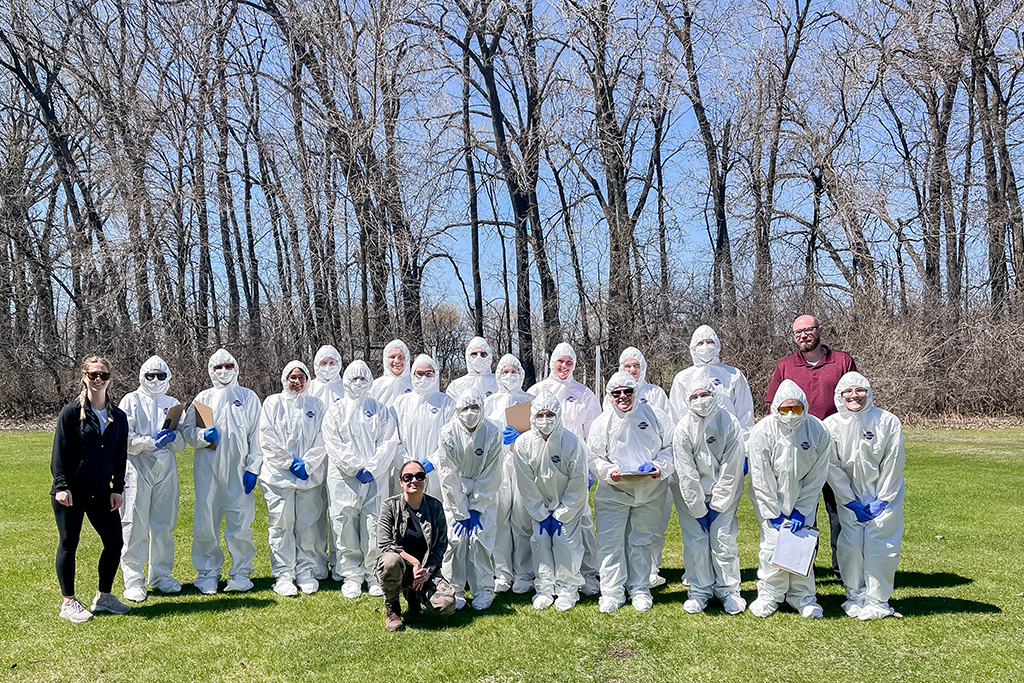
Most people who get invited to a wedding party have come to expect a few things:
1) They will enjoy air-conditioned comfort.
2) They will celebrate with the bride and the groom.
3) And they definitely will not be the ones dressed in white.
But these people were not like most people. Nor was this particular wedding party at Naastad Acres near Hatton, N.D., like any other. For starters …
1) It was sunny and HOT during the main outdoor event.
2) The bride was nowhere to be seen — at least not at first.
3) And every one of the guests wore white — albeit, the matching attire was head-to-toe hazmat gear.
That’s because this wedding-gone-wrong was the site of a mock crime scene and three-day learning laboratory.
“The Bride in the Woods” weekend was all part of the second annual Forensic Science Boot Camp organized by UND Forensic Science Director Lavinia Iancu and Teaching Assistant Professor Lindsay Fugleberg, along with help from Special Agent Derek Madsen of the North Dakota Bureau of Criminal Investigation.
Students collaborate with experts in the field
“The collaboration between our program and the state Bureau of Criminal Investigation is of paramount importance for many reasons,” Iancu said. “The involvement of NDBCI provides students with real-world insights and hands-on experience that’s crucial for their professional development.
“This kind of practical training goes way beyond the classroom by offering students a unique opportunity to apply their theoretical knowledge in very realistic scenarios.”
And the added bonus?
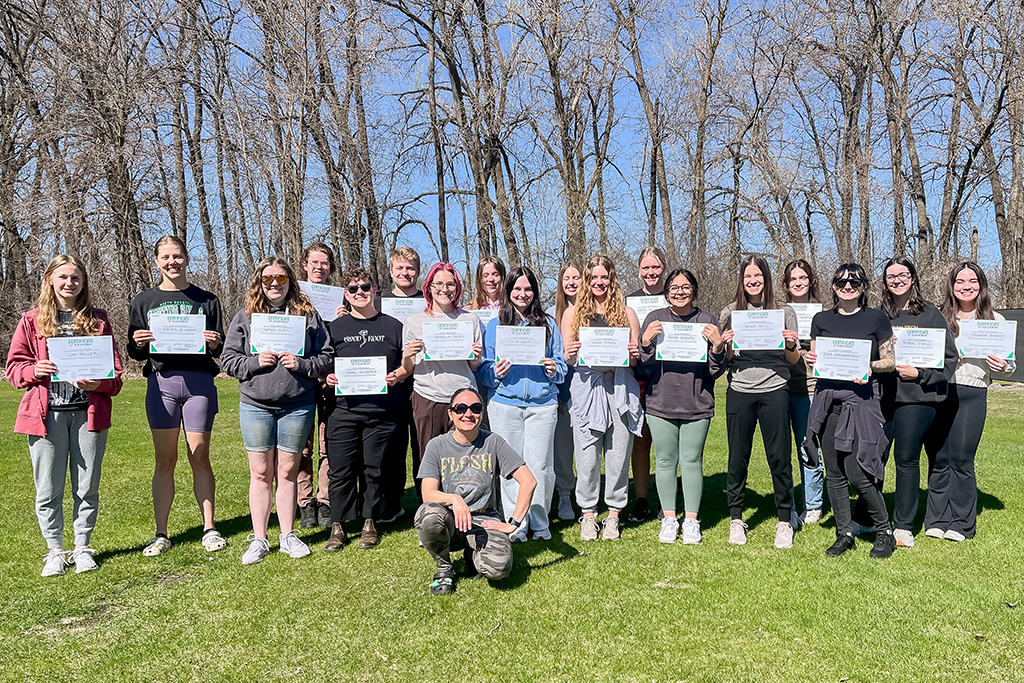
At the end of the weekend, the nearly 20 participating undergraduates completed a test to earn a special Certificate of Achievement endorsed by UND’s Forensic Science program and the NDBCI — a valuable credential for resumes and job interviews alike.
UND CONNECT grant supports boot camp
The extensive training was made possible with the help of a UND CONNECT grant, which Iancu said enabled them to more than double the number of hands-on activities this year.
The mini CONNECT grants — provided by the North Dakota Economic Diversification Research Grant Fund — aim to “inspire a sense of wonder, a love of discovery and a commitment to serve” while collaborating with partners to meet the “evolving needs of our people, tribal nations and the state of North Dakota.”
“By collaborating with the NDBCI, the Forensic Science Boot Camp embodies the spirit of UND CONNECT by integrating faculty expertise, student experiential learning and community partner engagement,” Iancu said. “The project not only enhances the quality of education for our students, but it also provides tangible benefits to the state of North Dakota by preparing well-trained forensic professionals who can contribute to the community’s safety and justice system.”
Hiker discovers a body in the woods
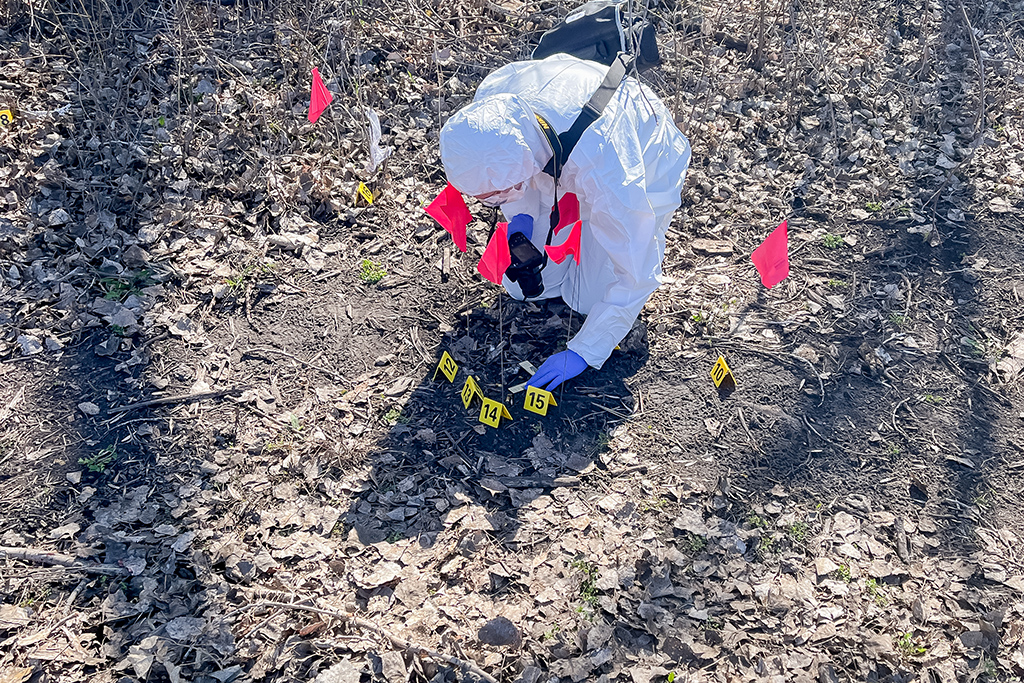
The case of “The Bride in the Woods” began with the students hearing from a witness — a man named Daniel, aka Iancu’s husband — who had discovered a woman’s body while hiking in the woods earlier that morning. The students were part of the team called in to investigate.
No one was told in advance the woman’s suspected cause of death. In fact, Iancu explained that she purposely kept the scenario vague because she wanted the students to sense the reality of working an expansive, three-point crime scene outside in the elements and from scratch.
“I wanted to keep it as real as possible. I didn’t want to give them a lot of details as they went in because keen observation is very important,” Iancu said. “They needed to go in eyes-open with full hazmat gear on and respecting all protocols.”
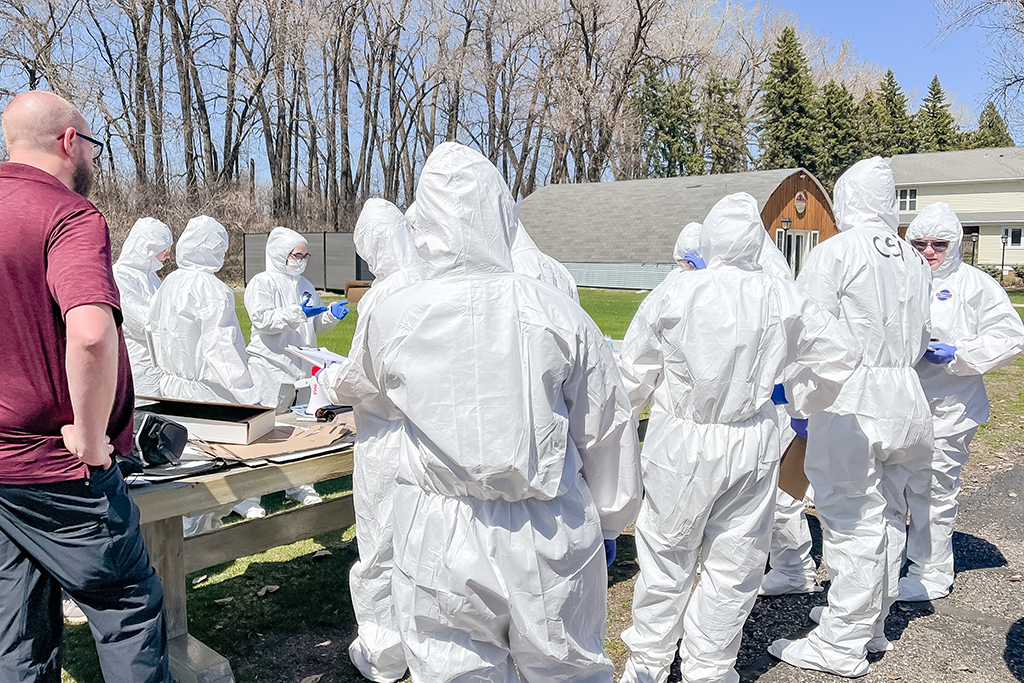
But before any of the students were let loose to investigate, Iancu said they were broken into three groups with each group assigned to focus on a key area.
The group members also had specific roles: photographer, evidence marker, scene sketcher/documenter, measurement/logistics and general “gopher” to communicate with other groups as well as check in and out of the crime scene area to fetch more evidence bags, ask questions and the like.
Slow and steady, CSI teams keep it real
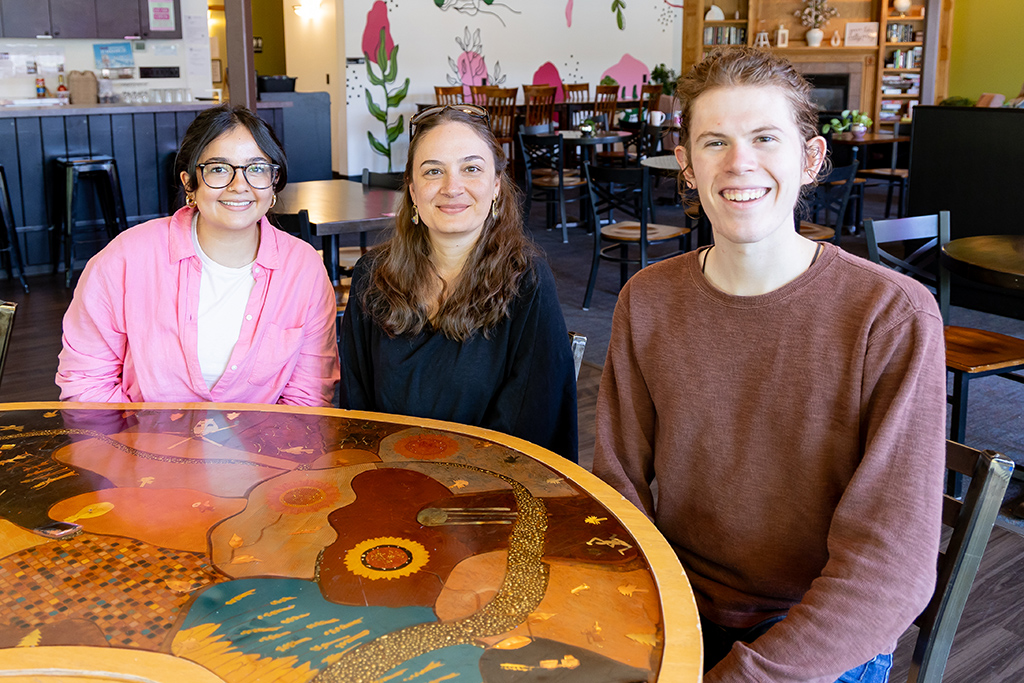
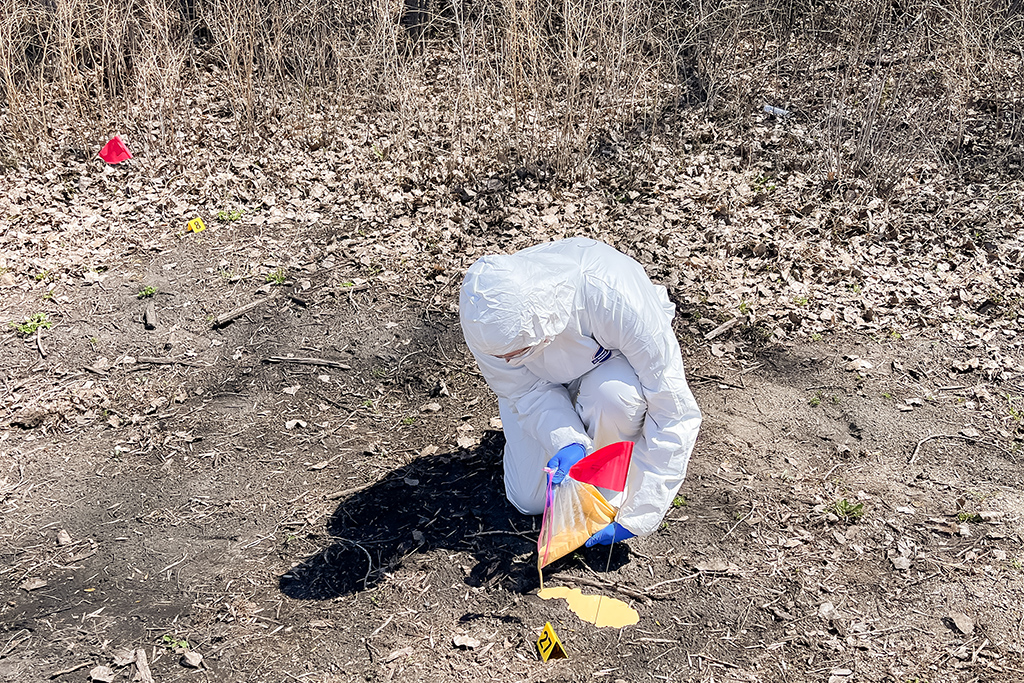
Ranna Dawlaty, Fargo, a recent Forensic Science (Molecular Biology-emphasis) graduate, was one of the photographers sent in first to assess the initial crime scene while a partner followed closely behind to flag the evidence to keep it from being trampled or otherwise compromised.
“I was on Team 1, and we knew the gazebo area was what we were supposed to map out,” Dawlaty said. “Right away, we figured some sort of altercation had happened there. We found two wine glasses with fingerprints and a lipstick stain on one of them.”
The team also discovered an earring, a picnic blanket, the remnants of a disheveled bouquet with blood spatter and what appeared to be lace material both in the immediate crime scene and on the bushes and trees leading out of the area.
“It was hard for our group because we were so excited that we immediately wanted to interpret what could have happened,” Dawlaty said. “We were saying, ‘Oh, this is probably where she was stabbed.’ But we didn’t even know how she died yet. We had to stop ourselves and say, ‘Wait, that’s not our job. Our job is to find the evidence. We’ll get together later to find out what happened.’”
Sorting the clues from the clutter
Thomas Sikorski, a senior Forensic Science and Pre-Med major from West Fargo, N.D., was in charge of plotting out the scene measurements at the second — and what would become the primary — crime scene where the woman was believed to have been killed.
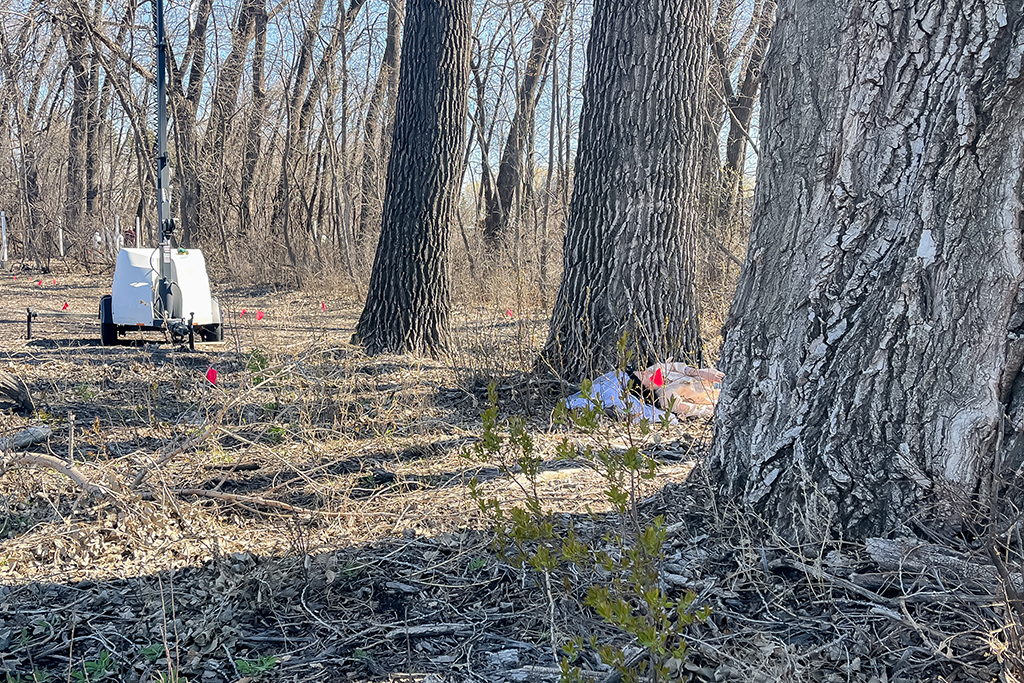
He acknowledged the case proved to be far more complex than those designed in the close quarters of the classroom. This crime scene would involve a very large field of evidence spread throughout a T-shaped zone in a wooded area abutting a gravel parking lot.
“We had evidence that could be real evidence, so it all felt very real to me,” Sikorski said. “There’s a lot of different things you can learn in the classroom, but there were so many extra decisions we had to make out there.
“Nothing is going to align perfectly with key cut structure. We didn’t always know how to handle or package every piece of evidence, so we’d ask Derek, and he’d tell us what he’d done in his past experience.”
And Tip No. 1? Not everything you find is a clue.
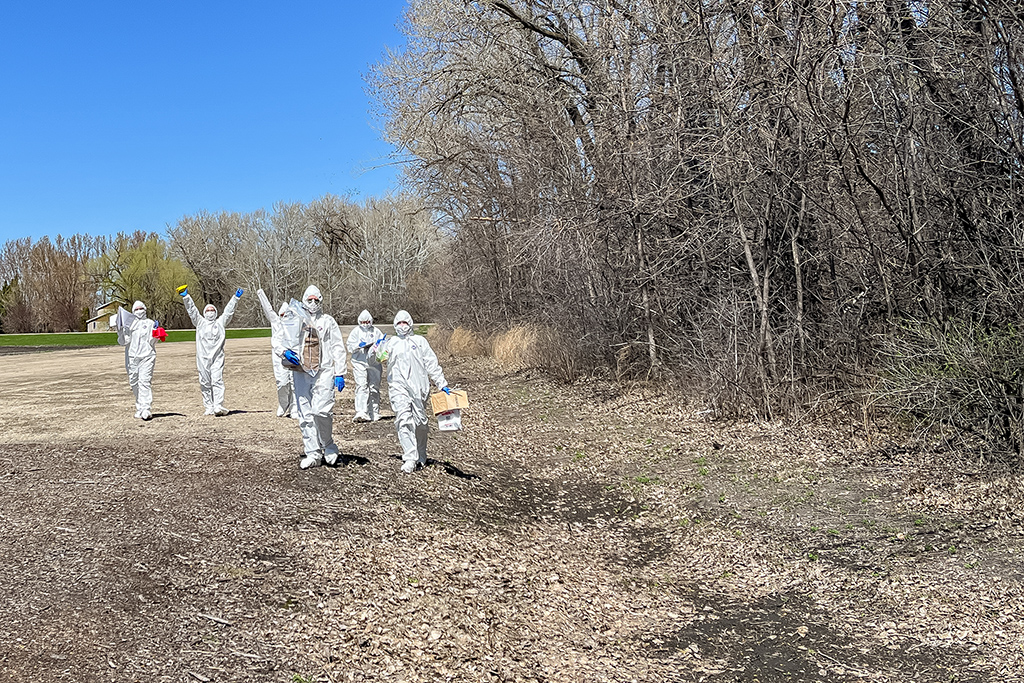
Sikorski laughed as he explained how his team had cordoned off the entire parking lot and collected more than 35 pieces of evidence — ranging from well-weathered beer cans to vape pens to nearly a franchise worth of food wrappers.
“You’ve heard of the farmer’s tan? Well, I had the forensic scientist’s sunburn,” said Sikorski, laughing again while motioning with his hands to show a thin strip across his eyes and forehead — the only skin that was not covered by his protective gear.
“I think everyone else was waiting for our team to finish. I’m out there sweating in my hazmat suit and learning how to do all these things, and it’s fantastic learning,” Sikorski said. “But I’m just going everywhere. I’m marking and measuring (all the relative distances). I had this megasized measuring tape, but it still wasn’t long enough.”
Investigators adjust their focus
Added Iancu: “They had like a Santa Claus bag of evidence.”
But that, too, can be a lesson, she explained.
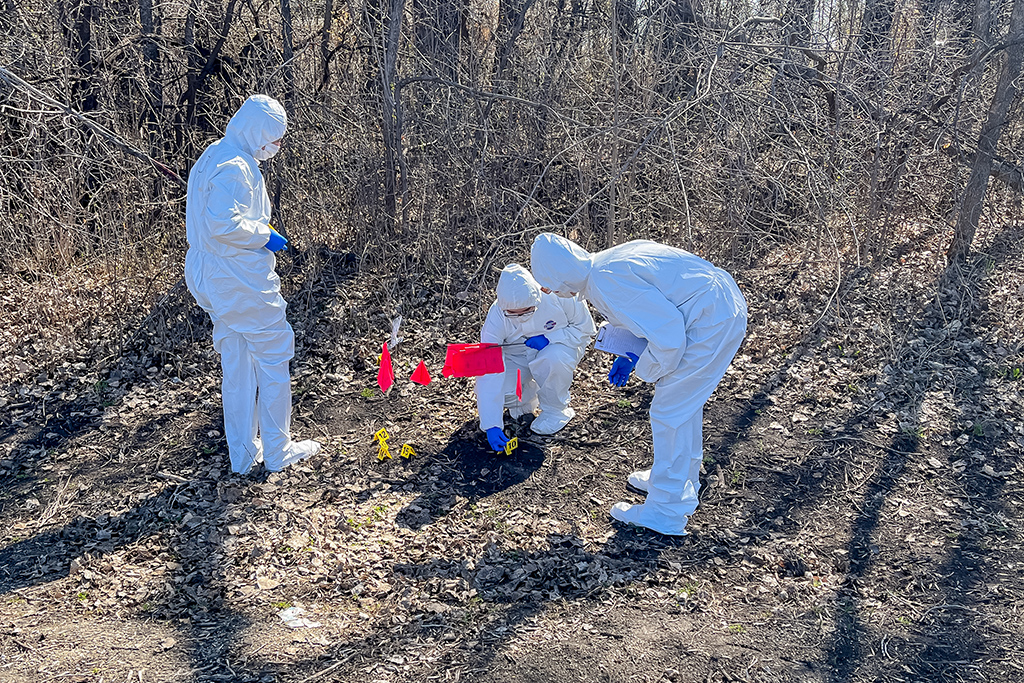
When you’re surveying a scene out in nature, you’re going to find a lot of materials that don’t belong, and not all of them are going to be relevant.
In other words, experienced investigators get very good at discerning the difference between pay dirt and plain dirt.
“For instance, if you have a body that is not severely decomposed, and you have all this old, very dusty stuff around it, that might be a good indicator that it’s been there for a while and it might not be connected to the crime,” Iancu said.
“But another good exercise is not to omit things that seem weird just because you (cannot connect the dots yet). That piece might actually be really important. You sharpen those skills the more cases you work on.”
In Sikorski’s case, the team did get back on track and narrowed its search as it followed a trail of shredded, mud-caked lace along the tree line abutting the gravel parking lot.
“Once we got close, it was obvious where someone had walked into the woods because we could see blood, broken branches and bullet marks on the trees,” Sikorski said.
And they knew they had found the evidence jackpot once they spotted a blood-matted tiara — some of its telltale tattered lace still attached — half-buried in thick brush.
“As we photographed and flagged the footprints, we had to be very mindful to walk around them so we wouldn’t disrupt what we thought were the perpetrator’s path,” he said.
Next, a team member made plaster casts of the footprints while another used a metal detector to find the suspected murder weapon — a gun — along with several spent bullet casings.
Dotting their i’s and crossing their t’s
Meanwhile, Team 3 was getting busy at the third crime scene at the opposite end of the T zone. They had followed what looked to be drag marks along the muddy gravel lot before spotting the woman’s body partially hidden in the trees.
It was there where they listened to Clinical & Translational Science master’s student Julia Kochanowski — who played the coroner (she worked alongside a real coroner at the UND Forensic Pathology Center) — talk about proper procedures when dealing with a corpse.
Iancu pointed out to UND Today that the rules are different from state to state.
Of course, there was more evidence to photograph and document — namely the blood and bullet holes on the bridal dress, along with the gunpowder residue.
Iancu said all of the above was courtesy of UND Police Chief Rodney Clark and Police Lt. Carlos Caro, who did their best to make everything about the dress authentic — only the blood was fake.
“Those have been some interesting conversations,” Iancu said with a laugh. “But they took care of the dress. We actually had quite a big adventure with that dress.”
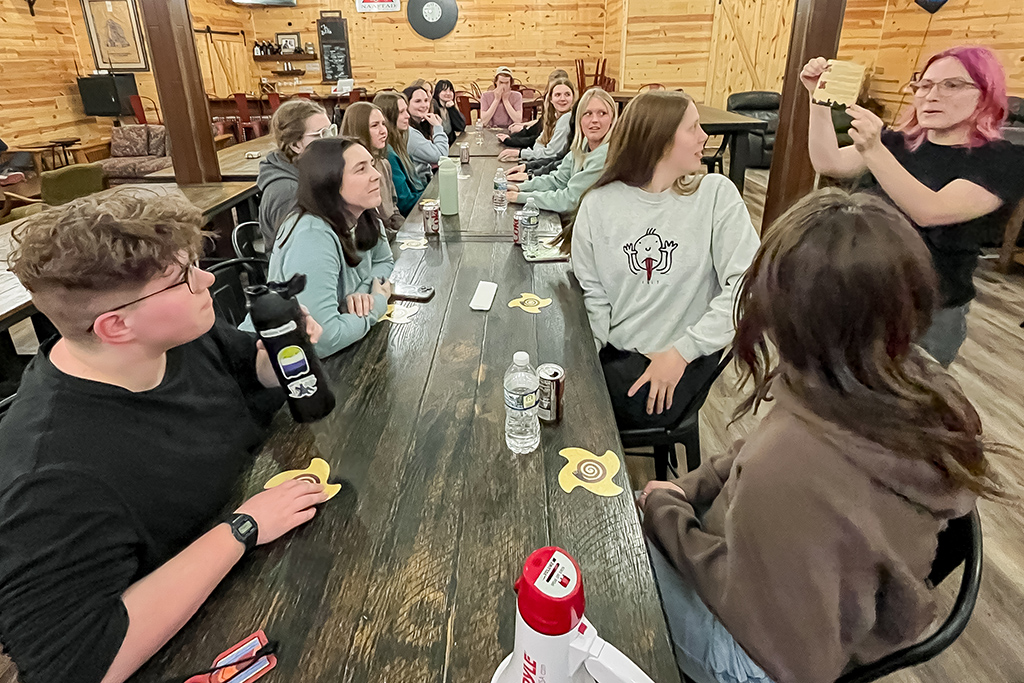
After a very long day, the students went back to the indoor gathering space for dinner and the official debriefing and feedback session.
But not everything was so serious all weekend. There also was time for games, bonfires and plenty of laughs.
“In the van ride out there, I didn’t even know half the names of the other students, but in just three short days, we were all laughing and joking like the best of friends,” Dawlaty said. “I wasn’t expecting such a strong bonding experience, but it was really amazing.”
>> Do you want to read more UND Today stories? Just hit the link or go to our home page to subscribe to our twice-weekly newsletter.