Connecting with community on Indigenous Peoples Day
Connection — not competition — sustains human life, says award-winning author and educator Anton Treuer at UND

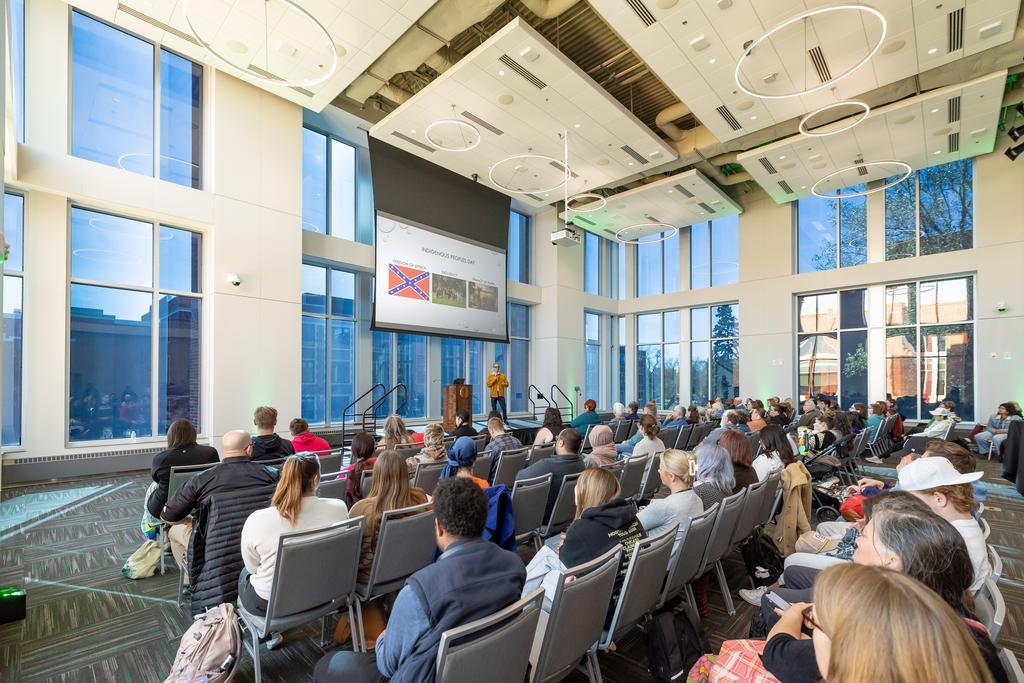
As the first note of a prayer song sounded in the Memorial Union ballroom, this year’s Indigenous Peoples Day celebration was officially underway. And, while Indigenous people were at the center of the celebration, the message of human connection — and each person’s responsibility to maintain it — was what seemed to resonate.
Hosted by the Indigenous Student Center, the program opened with a welcome from Director Keith Malaterre and UND’s Land Acknowledgment, recognizing the Ojibwe and Dakota peoples as the ancestral caretakers of the land on which the University stands. Psychology major Jamison Cook followed with a prayer song.
The event’s keynote speaker, Anton Treuer, is a professor of Ojibwe at Bemidji State University and the author of more than 20 books, including “Everything You Wanted to Know About Indians But Were Afraid to Ask” and “Where Wolves Don’t Die,” a young adult coming-of-age thriller and his first work of fiction.
Beyond writing, Treuer’s work spans Ojibwe language revitalization, cultural preservation and education. In 2018, he was named a Guardian of Culture and Lifeways by the Association of Tribal Archives, Libraries and Museums. At Bemidji State University, he is leading the development of an Ojibwe teacher training program for future language educators.
But on Monday, Treuer spoke as a storyteller, inviting the audience to reflect on the ways that human connection heals and strengthens them.
‘Relational health matters way more than we’ve ever imagined’
Opening in Ojibwe, Treuer introduced himself as Wagosh — “Fox” — from the Eagle Clan and Leech Lake. He framed Indigenous Peoples’ Day as “an inflection point to make things different and better,” focusing on how connection — not competition — sustains human life.
“All humans of all persuasions, cultures and backgrounds want their kids to have a decent chance at a long, healthy, happy life,” he said. “Yes, eating right and exercising matters, but relational health matters way more than we’ve ever imagined.”
Relational health, Treuer explained, is the network of supportive relationships that shape well-being — family, community, ceremony and shared purpose. Using stories of Ojibwe elders who lived well past 100, he illustrated how Indigenous communities naturally strengthen these bonds.
“Indigenous folks of every type have maintained a myriad of diverse ways to deliver community and relational health — ceremony, cultural practice, community,” he said. “It feeds all these other things, like sense of purpose.”
The benefits of a strong community and connection to those around you have always been a part of human history, Treuer said. And these connections are still essential to survival today.
“If you go back to caveman days, we survived not because we outcompeted the person in the next cave, but because the person in the next cave loved us and would intervene if we were in trouble. As human beings, we are hardwired to need connection.”
That ethic of care, he said, has long been at the heart of Indigenous life — and remains the key to thriving and longevity to this day. Treuer, who used examples of several tribal elders who lived past 100, said that their communal practices are part of the reason they lived so long.
Health is a practice, not a goal
But health and longevity, Treuer said, aren’t a finish line. Instead, acts that strengthen relational health are something people need to practice every day.
For their part, Indigenous cultures share communal practices as a form of healing. “Our ceremonial space is a community of practice,” he explained. “We practice feasting and offering, and we practice praying for others, not just ourselves. Health, healing and happiness are not destinations — they’re practices.”
While it may be tempting to get discouraged by a lack of progress and comfort early on, the key to longevity and health is to stick with it, much like going to the gym.
“You can’t get all your workouts in one day. Some days go better than others, but if you keep practicing, you do become healthier.”
In the same vein, Treuer urged non-Native allies to lean into that work with courage and humility when joining conversations and learning about Native cultures and needs.
“Be brave and lean in,” he said. “It’s like you’ve been skipping leg day for a long time — and now someone wants you to go to the gym. … If you keep going, you acclimate to that, and you do become stronger.”
The preference to stick to comfortable territory, Treuer said, is not limited to individuals. What and how Americans are taught in school plays a role in their receptiveness to new ideas and worldviews.
“Education should prepare us for the world we live in, not the world that used to exist,” he said. “We have to teach all our stories — not just the ones that make us comfortable.”
That narrowing, he explained, doesn’t just harm Native communities — it limits everyone.
“White students are guaranteed to see themselves in the curriculum,” he said. “Students of color aren’t always given that same mirror — and that’s a disservice to everyone.”
Still, rather than reflecting on these problems with pessimism, Treuer believes that the story of American Indigenous communities is an example of resilience.
Quoting Abigail Echo-Hawk, he said, “We are not a historically underserved population. My history is one of ancestors who survived so I could thrive. I am colonially underserved, institutionally underserved — and historically resilient.”

‘Someone has to find the grace’
That resilience, Treuer said, must also shape how people approach difficult conversations. Kneejerk reactions and dismissiveness in conversations about race or inequality hamper human connection. Open dialogue surrounding issues or points of contention could open the door to healing for everyone.
“We’ve had 500 years in a row of shut-up culture,” he told the crowd. “It might not be wise to answer 500 years of ‘shut-up culture’ with ‘shut up.’ Someone has to find the grace to be the first one to restore the practice of humanity.”
Healing, he emphasized, isn’t just for those who have been marginalized — it’s for everyone.
“Even when we ‘win,’ sometimes we lose,” he said. “Healing isn’t just for the victims of history — it’s for all of us.”
‘We remake the world in miniature every day’
But Treuer’s discussions on cultural polarization and discordance were followed with words of hope and encouragement.
“America is an emotional toddler,” he said. “We’re just learning to walk — and someone has to be patient enough to say, ‘Good job, baby, keep going.’”
Quoting historian Howard Zinn, Treuer reminded the audience that, “The future is an infinite succession of presents, and to live now as we think human beings should live … is itself a marvelous victory.”
In other words, Treuer said, healing and change begins with connection and community.
“We remake the world in miniature every day. We can make things different every day,” he said. “The only way through all of this stuff is together.”