From the Navy to the School of Law: Meet Dean Del Crandall
UND’s new School of Law dean talks leadership, legal education and why the University’s mission convinced him to make the move to North Dakota
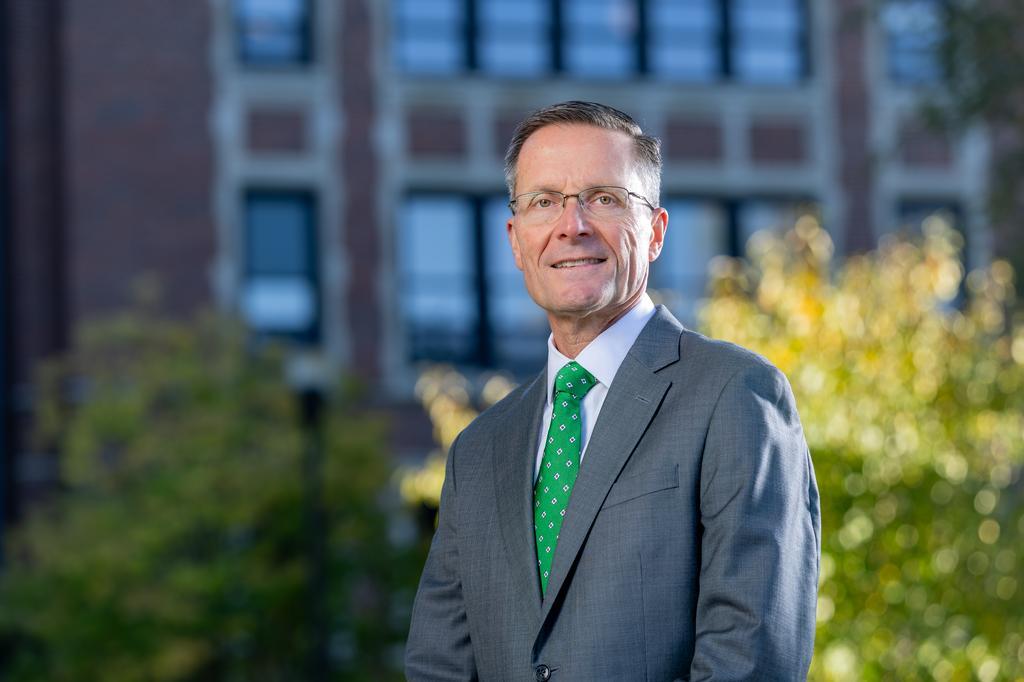
Editor’s note: Del Crandall joined UND this summer as dean of the School of Law following a 40-year career in the U.S. Navy, where he served as judge advocate general and retired as a three-star admiral.
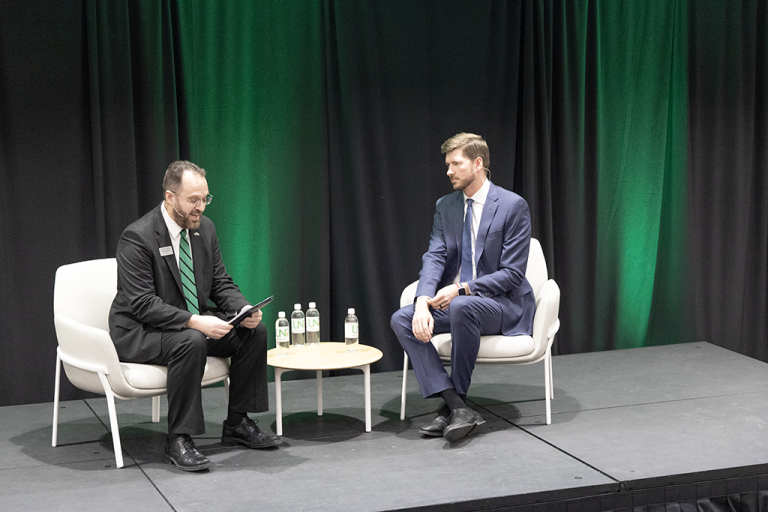
UND Today recently sat down with Crandall to talk about his path to higher education, the leadership lessons he brings from the Navy and what he sees as the School of Law’s role in serving students and the state. The following Q&A has been edited for length and clarity.
You’ve been here for a little over two months now. How are you settling into the role?
I definitely feel like I’m learning something every day, and the team is really helpful and supportive, both here at the School of Law and across the University — my fellow deans and leaders around campus.
In all humility, I don’t have my bearings yet.
Every day I’m learning more and getting better, but then I turn a corner and I wonder, “What is that?”
But with so many people helping, it’s all going well.
You started your Navy career as a surface warfare officer. What drew you to law?
To be a very successful surface warfare officer, you need to have fire in your belly to want command of a warship.
I really enjoyed my two and a half years on board. I enjoyed leading the sailors who reported to me, and I liked the mission. I just knew that, unlike my captain, I didn’t want to spend the next 20 years of my career at sea.
But I loved the Navy, so I started looking at what else I could do that would allow me to stay in the Navy and lead and help sailors.
I learned about the Law Education Program, where the Navy selects five or six officers each year from other programs, sends them to law school and then they become judge advocates.
The analytical rigor of the law appealed to me — learning how to dissect problems and develop solutions for your clients. I also liked the importance of communicating and advocating on someone’s behalf.
My mom, who had been an elementary school teacher, started law school two years before I did, and my wife and I went to law school at the same time. So, all of that — my mom serving as a role model, my wife’s longtime interest in law and the things I had learned as a surface warfare officer — converged when I applied for law school.
Your Navy career put you in a lot of different leadership roles. What lessons do you bring with you to UND?
The Navy is a leadership school on steroids. Every two or three years, you’re changing duty stations, your boss is changing and the people who work for you are changing.
One of the leaders who had a big impact on me was Captain Hardy Kircher, the executive officer on the aircraft carrier where I was stationed as a JAG. The executive officer has to make sure the decks are clean, people are fed, people are disciplined and the ship is operating the way it needs to. It’s one of the toughest jobs on the ship.
What stood out to me about him was his consistency. Every day, I found the same Hardy Kircher. He cared about the mission, he cared about his sailors and he cared about the ship. He was also great with a young department head like me, helping train me and helping me grow.
He was what we called a “deck plate leader.” He walked the ship, saw people where they worked and was authentic. Sailors can smell out false leaders.
It’s those kinds of things that I hope I’ve taken away from my career in the Navy and would like to bring here. I like to get out and see people where they work. I truly value what people do for our community because it takes every person on the team.
I don’t care what their roles are — the people who collect our trash each day, who fix our facilities, or the person teaching the highest-level course in the law school and doing incredible scholarly research. It takes everybody to grow the best attorneys, and we owe that to our students and to the state of North Dakota.
After 40 years in the Navy, how did you find yourself looking at higher education?
I knew I didn’t want to stop working. I felt like there was more I wanted to contribute. I just wasn’t sure what area that would be in.
I narrowed it down to three buckets: the nonprofit world, working on a company’s general counsel team or leadership in higher education.
I kept finding myself circling that third bucket.
At one point, I was in Washington, D.C. to have breakfast with a former colleague from the JAG Corps. I took the Metro, and the closest I could get to where we were meeting was George Washington University at Foggy Bottom. I popped out of the Metro, and there were students walking by in backpacks and I just started feeling the energy.
I thought, “This is a message. I’m supposed to be pursuing this third bucket.”
So, I did.
Everyone told me I was a nontraditional candidate. They said the path would be steeper and more difficult. Most people come up through the academy, and so I would be unique.
There were a lot of cover letters, lots of rejection, and then some traction. And I think, honestly, I learned a lot through the process.
What attracted you to UND?
There was a lot that attracted me to UND.
Part of the reason I ended up picking that higher ed bucket was because I saw a lot of commonalities between leading in the military and higher education.
Most people come into the military because they’re searching for something, trying to find an opportunity and change the trajectory of their lives. It’s just amazing how the military positively impacts people’s lives.
And I thought, “Well, higher ed does that too.”
I would get excited when I read about schools that were helping people who may not otherwise have the opportunity to get to law school or even think about becoming a lawyer.
And UND was one of the schools I became much more passionate about as I looked at its mission. When I came for my on-campus interview, a lot of that was confirmed.
It’s a small but strategically growing law school, and it’s extremely collegial. When I went to law school, I didn’t really get to know and work closely with a faculty member until my third year. Here, students can start doing that the first day they walk into school. The faculty and staff are extremely committed to student success.
We also have nationally recognized programs that people may not expect at a law school our size, including our Indian and Tribal Law program and our legal research and writing program, and our graduates have had tremendous success earning federal clerkships.
There’s a lot going for this place. What I’ve learned is that it’s very North Dakota not to brag about it, but maybe we can talk about it more.
I just think it’s a special place, and I want more people to know about it.
The School of Law is North Dakota’s only law school. How do you think about the responsibility that comes with that?
Part of the reason why I’m here is because I think the mission is so compelling. To me, that mission is growing practice-ready attorneys and increasing the number who will stay and provide legal services across North Dakota.
I have a responsibility to make sure we’re delivering the very best attorneys to the state.
There are counties in North Dakota without practicing lawyers and others that need more practicing lawyers for all kinds of issues — transactional issues, family law issues, criminal defense.
We’ve talked with the State Bar Association about how we can encourage more students to stay in North Dakota after earning their law license and hopefully eliminate some of those legal deserts in the state.
I understand some will leave the state, but one of the goals is to help students understand how practicing in North Dakota can be incredibly rewarding.
Tied to that is our phenomenal alumni network. So there’s a responsibility to them, too. We ask our alumni to mentor students and, in some cases, offer summer employment or externships. If we’re going to ask that of them, we have a responsibility to deliver the best practice-ready students we can along the way.
It’s incredible what graduates of this law school have accomplished. We have alumni who have become federal and state judges and leaders in government and at law firms. As a leader, I want to make sure I’m helping take care of a place, growing it and nurturing it, so that it continues on such a positive trajectory.
Artificial intelligence is changing higher education and the legal profession. How is the School of Law preparing students to respond?
I’ve asked Carolyn Williams, Nick Datzov and Jen Cook, three faculty members who have spent a lot of time thinking about AI, for their thoughts. A lot of what they said makes sense to me.
If I had to boil it down, I think they would agree that AI is no longer optional for law students.
Professor Cook’s thoughts were that today, “practice-ready means AI-ready.”
That doesn’t mean mastering a specific AI tool. It means being familiar with how AI will affect your clients and your work, where it can make your work better and more complete.
I think adaptability is really important, and students need to be thinking about how they incorporate AI into their work, how they check that work and how they handle their ethical duties in light of AI, whether it’s competence, communication or confidentiality. AI raises issues in all of those areas.
I think we’ve all heard about “hallucinations” where attorneys have cited cases in briefs that AI has just made up.
Professor Datzov had an interesting way of putting it: “AI won’t replace lawyers, but lawyers who use AI will replace lawyers who don’t.”
I think that’s a good way to talk about it. We can’t ignore it, so we have to help students prepare for it as best we can. We don’t have all the answers just yet, but everybody is working through this — not just at the School of Law or UND, but across the world.
Finally, what should people know about you outside of your work at the School of Law?
I’m proud to say that my wife, Barb, and I will be married 40 years this December.
We love to hike, so there are a lot of things we’re looking forward to exploring in North Dakota. We’ve had people recommend some of the state parks nearby and we’re super excited to get to the western part of the state.
We have a dog and a cat, and we live close to the Greenway, so we’ve really enjoyed walking there. I run most mornings, and I like to kayak. I haven’t put my kayak in the water yet, so I want to do that soon.
I also like to read. One of my favorite books is “The Boys in the Boat.” It’s nonfiction, but it reads like a novel. It’s just this fascinating true story about the grit and determination of a crew team from the University of Washington that represented the United States at the Olympics in Berlin in 1936.
I also like Nordic murder mysteries. I usually have at least one book going on my nightstand at any time.
We have three adult sons. None of them live here, but we’re hoping to get them here for Christmas. So hopefully we’ll have snow.