STEM U: How UND educates the workforce of the future
Workforce preparation takes place in labs, classrooms and the Alaskan Arctic, among other locations across UND and beyond
In most states, including North Dakota until recently, candidates for governor run on platforms of creating jobs.
Not so for Kelly Armstrong, during his successful gubernatorial campaign in North Dakota last year. Because the problem in North Dakota is not too few jobs, he said, but too few workers to fill those jobs:
“It’s fun to campaign on not necessarily trying to bring in more economic development, but to develop the economic development that’s already here,” Armstrong said in a meeting with Grand Forks business leaders, as the Grand Forks Herald reported before the election.
And of course, when the talk turns to growing the state’s workforce, skilled workers — those working in science, technology, engineering and mathematics (STEM) in particular — are the most highly sought after of all.
That’s where UND comes in.
UND is committed to preparing its students to meet real-world challenges and bolster North Dakota’s STEM workforce development. As shown by another article in today’s “The Next 10 Years: UND and the North Dakota Workforce” series, that commitment is driving construction of the University’s new STEM Complex and the proposed Health Professions Collaborative Facility.
But it’s also the force behind countless other initiatives on campus — projects whose impacts can be seen in every college and virtually every classroom.
Here are a few:
- In the fields of Space Studies and Unmanned Aircraft Systems, UND can claim several firsts. In 2009, the University became the first in the nation to offer a degree in UAS Operations — helping Grand Forks establish its reputation as the “Silicon Valley of Drones.”
2021 saw UND become the first member institution of the U.S. Space Force’s University Partnership Program. Fast forward to the present, and UND has partnered with the defense community and private sector in fields including spacesuit and satellite testing and design.
In July, the department of Space Studies’ work culminated in launching the first-ever satellites ever commissioned in North Dakota — named ROADS One and Two. Once they are deemed to be in good operational health, full control of the satellites will be transferred to UND, where they will be operated remotely from Odegard Hall.
- New bachelor’s degrees in Aerospace and Cybersecurity Engineering. A first-in-the-region doctorate in Artificial Intelligence. Cutting-edge research in materials science and defense resiliency in cold weather environments — the opportunities to pursue world-class scholarship appear endless.
Regarding AI, UND’s President Andy Armacost challenged the campus community to become the state’s Artificial Intelligence University during his State of the University Address in August. Speaking earlier this month at the annual UAS Summit & Expo, Armacost reiterated this goal.
“I think the University of North Dakota, as a flagship institution that involves not just our technology development, but also our amazing work in the liberal arts and humanities, allows us to look at AI in the context of humanity,” Armacost said.
“How do we adopt these technologies, keeping humanity at the forefront?”
UND’s momentum in STEM initiatives is reflected in growing enrollment.
This fall, the University set a record for enrollment with 15,844. Two of UND’s academic colleges traditionally associated with STEM — Arts & Sciences and Engineering & Mines — also have seen steady growth in the past decade.
According to data obtained for University Analytics & Planning, from the fall semester of 2015 to present, enrollment in the College of Arts & Sciences grew from 929 to 952 students. The College of Engineering & Mines grew from 2,188 to 2,753 in the same timeframe, and is now UND’s largest by enrollment.
With its robust training of students in both the hard sciences and humanities, and its commitment to ensuring students graduate with digital literacy and other essential skills, UND will continue to help North Dakota overcome one of the most severe worker shortages in the country.
The importance of effective scientific communication
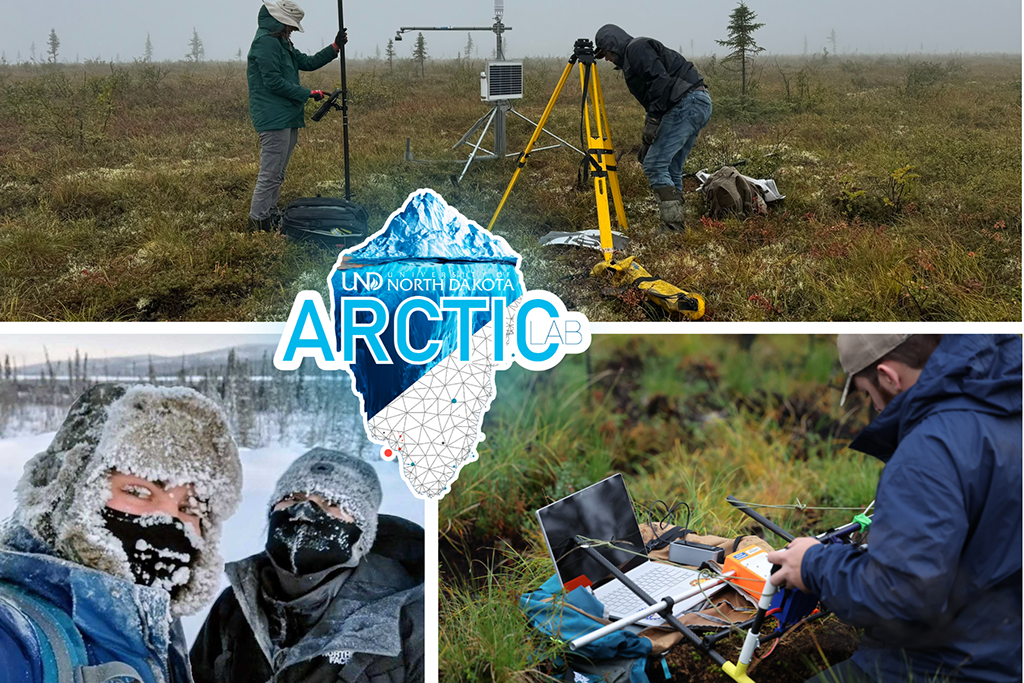
While members of the UND ARCTIC LAB are conducting research in the Alaskan wilderness, a group of UND undergraduate students in Communication is ensuring that their story is told.
In 2022, the UND ARCTIC Lab was named part of a $17 million Arctic research initiative known as the Defense Resiliency Platform Against Extreme Cold Weather. As a collaborative effort among UND, Virginia Tech, the University of Minnesota and Stony Brook University, alongside the U.S. Army Corps of Engineers’ Cold Regions Research and Engineering Laboratory, the project aims to enhance the U.S. Army’s capabilities in extreme cold weather environments.
The ARCTIC team consists of students, staff and faculty from the College of Arts & Sciences, College of Engineering & Mines and John D. Odegard School of Aerospace Sciences. Additionally, it is represented by staff at the Computational Research Center, and through a collaboration with RIAS, the Research Institute for Autonomous Systems.
UND’s principal investigator on the project, Professor of Communication Timothy Pasch, has partnered with his colleague Emily Gibbens-Buteau, assistant professor of Communication, to work with undergraduate UND students to become research journalists/broader impacts reporters in the field of science communication.
Gibbens-Buteau supervises the CORE Communication Research Team consisting of five undergraduate students. The team works with ARCTIC Lab members to publicize the research’s impacts via stories, imagery, videography and social media outreach.
“The goal is for the students to bring awareness to research,” said Pasch. “Often, scholarly peer-reviewed publications live in what is known colloquially as the ‘Ivory Tower.’ Our science reporters translate this work into impactful stories that bring the people, experiences and impacts of the research to life in powerful ways.”
Gibbens-Buteau emphasized the importance of storytelling — irrespective of one’s profession.
“No matter what field you end up in or job you do, you have to be able to craft a story and get that message across,” she said. “Stories turn research into something that people can truly connect with.”
The team’s work is a yearlong research project, said Gibbens-Buteau. Its members are expected to track their social media analytics at the end of each semester and present their work at both Communication Appreciation Day and the Undergraduate Showcase — the latter hosted by the College of Arts & Sciences.
Quinn Berg, a senior majoring in Communication and Journalism, said his experience on the CORE team introduced him to the intricacies of working with a dynamic research group.
“This is the first time I’ve worked with a team where collaboration is of the utmost importance,” Berg said. “Not one person can do everything. It’s very important that we’re all working together and optimizing the way our roles intersect.”
Mia Nixon, a junior majoring in Communication and minoring in Space Studies, said the project has exposed her to academic language with which she was unfamiliar — something she considers an asset for her career.
“I sit in on the ARCTIC LAB’s weekly meetings,” she said. “I’m getting exposed to a lot of new STEM language that I can use in the Space Studies workforce in the future.”
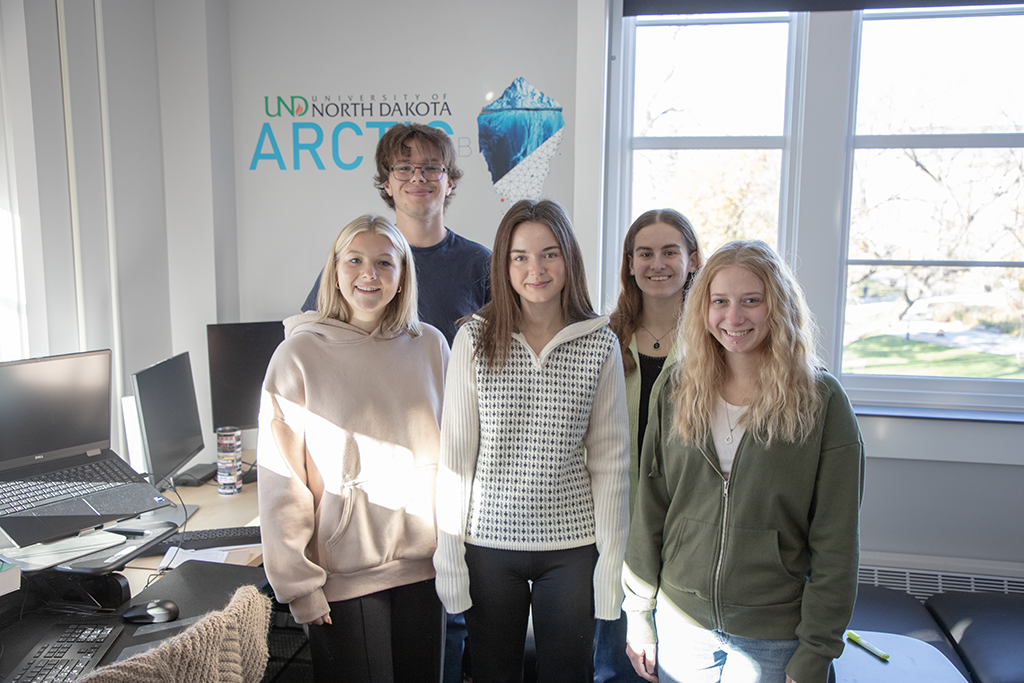
Pasch added that UND undergraduate and graduate students encompassing a range of disciplines are receiving valuable hands-on learning experiences, reporting on scientific outputs and presenting their research at conferences.
Gibbens-Buteau said that although most of her students have experience with social media platforms via coursework and internships, gaining experience with such a technically oriented project is invaluable.
“Being able to give these students — who would never get this experience otherwise — the chance at science, research and broader impacts communication is incredibly meaningful,” she said. “I think this will be a highlight of their undergraduate careers.”
Mini but mighty
- On the far western edge of campus, a state-of-the-art facility is forging materials with vital links to national security and computing. Equally important, according to its director, is the facility’s potential to augment North Dakota’s workforce.
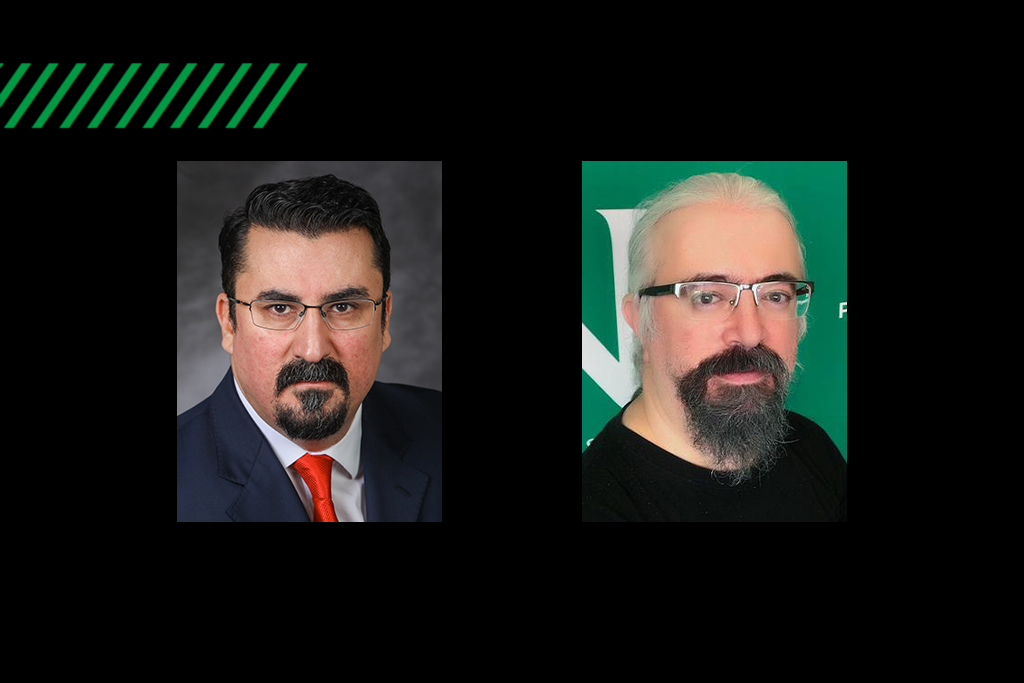
UND’s recently established Nanofoundry — led by Nuri Oncel, professor of Physics & Astrophysics — employs a process called molecular beam epitaxy to grow thin films of vanadium nitride.
The chemical compound is used in applications such as cryptography and intelligence gathering. That’s because transition metal nitrides, Oncel said, can act as superconductors — essential components of quantum computing.
They also act as efficient conductors of electricity in semiconductors.
“Vanadium nitride is very stiff and resistant to environmental conditions,” Oncel said. “This makes it more valuable for electronics operating under harsh conditions.”
Oncel and his colleague, Deniz Cakir, associate professor of Physics & Astrophysics, are conducting their research with the help of a three-year, $500,000 grant awarded by the Air Force Office of Scientific Research.
Additionally, the North Dakota Legislature in 2023 appropriated $14 million toward UND’s broader national security initiatives — a portion of which helped establish the Nanofoundry and buy its equipment.
Housed in both Witmer Hall and the Tech Accelerator, the Nanofoundry is “the kitchen of electrical engineering and applied physics,” due to the collaboration it creates between departments, including Chemistry, Physics and the College of Engineering & Mines, Oncel said.
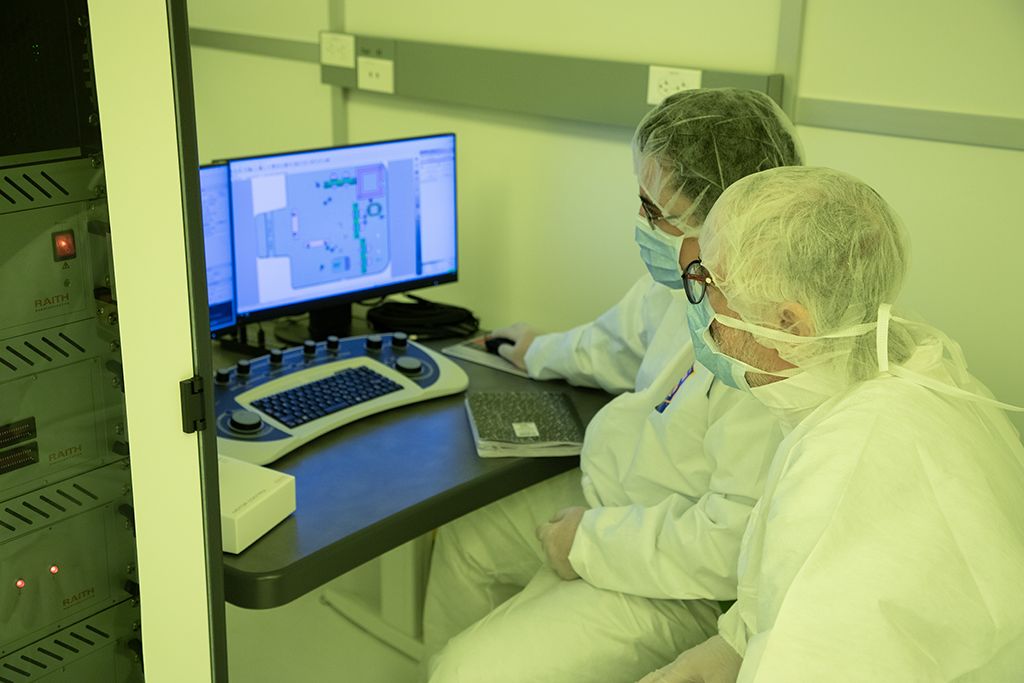
The facility is generating increased research activity on campus, leading to additional faculty hires in the departments of Electrical Engineering, Physics and Chemistry. “My hope is that all of these new faculty members will be permanent users of the facility that we have here,” Oncel said.
Private industry players and the defense community also are interested in using the state-of-the-art facilities.
“We already have a good customer base,” he said. “Startups are interested in using the equipment. And we are always in conversation with companies such as Northrop Grumman.”
Oncel said the Nanofoundry — with its strong experiential learning opportunities for both undergraduate and graduate students — should be a blessing for the state’s workforce. The education and experience they are receiving, he added, apply to many in-demand careers in the defense, computing and engineering sectors.
R1 is just the beginning
This past February, UND marked a major milestone by obtaining an R1 designation from the Carnegie Foundation — placing UND in a peer group of 187 universities recognized for “very high research activity.”
Such strong growth in research activity is a major asset for North Dakota’s future, said UND Provost Eric Link.
“Our research is making a difference here at the University of North Dakota, and the impact this research is having on the state of North Dakota and beyond is exciting to watch,” he said.
“This work stretches across the campus and involves faculty and students alike. Looking toward the future, with the construction of the new science and engineering complex, continued investment and innovation in critical areas of energy, national security, AI, health and medicine, and so much more, UND will continue to solve real-world challenges, enrich our understanding of humanity and the world we live in, and increase quality of life for everyone.”
Don’t miss the full series …
>> UND is on the case. While North Dakota’s workforce shortage is serious, it’s also the kind of problem that UND can and will help solve.
>> The North Dakota magnet of online education. UND’s online programs keep North Dakotans rooted and thriving in-state, while drawing people and positive attention from far and wide.
>> STEM U: New buildings promise to engineer student success. How UND’s STEM Complex and proposed Health Professions Collaborative Facility will grow key components of the state’s workforce.
>> STEM U: How UND educates the workforce of the future. Workforce preparation takes place in labs, classrooms and the Alaskan Arctic, among other locations across UND and beyond.
>> Growing our own physicians and physician assistants. With ND85, UND hopes to raise the number of North Dakota residents enrolled in M.D., P.A. programs at its School of Medicine & Health Sciences.
>> VIDEO: How UND is leading the way in STEM. The deans of UND’s College of Engineering & Mines and College of Arts & Sciences join President Andy Armacost for a conversation about STEM training.