Only in North Dakota: Flying unmanned aircraft statewide
First-in-the-nation FAA partnership enables statewide drone flights, strengthening UND and North Dakota’s aviation leadership
“Three … two … one.”
With the press of a button inside UND’s Robin Hall, an important Federal Aviation Administration radar data feed went live — marking a historic milestone that leaders say cements North Dakota as home to the most advanced uncrewed aircraft systems (UAS) ecosystem in the nation.
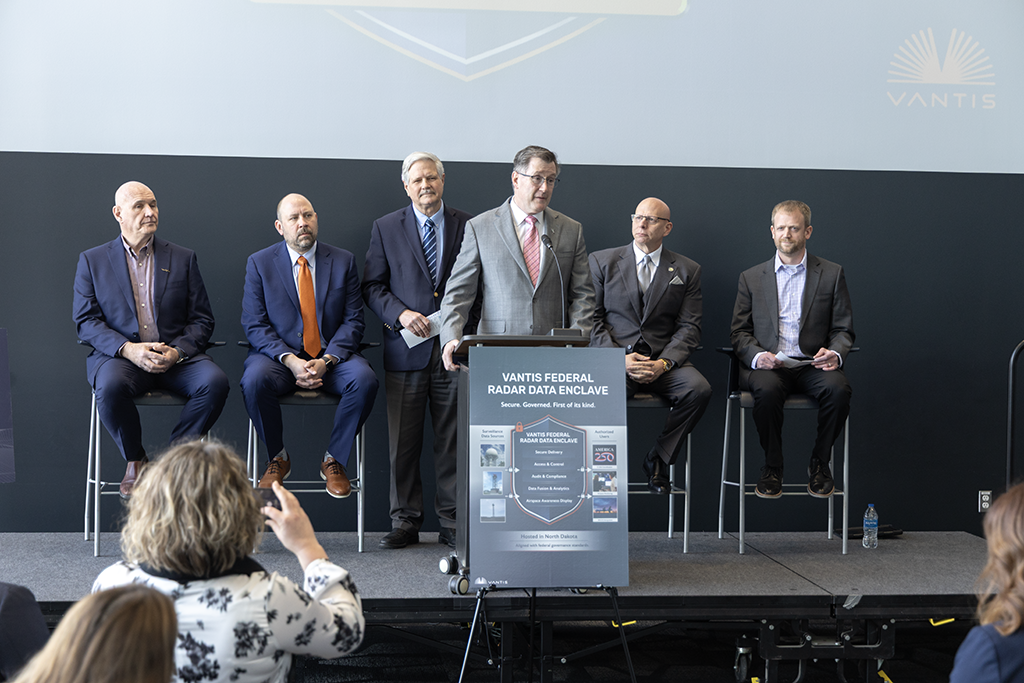
Applause filled the room as U.S. Sen. John Hoeven, UND President Andrew Armacost, FAA Air Traffic Organization Chief Operating Officer Frank McIntosh and industry partners formally activated the secure system, enabling beyond visual line of sight (BVLOS) drone operations across the entire state.
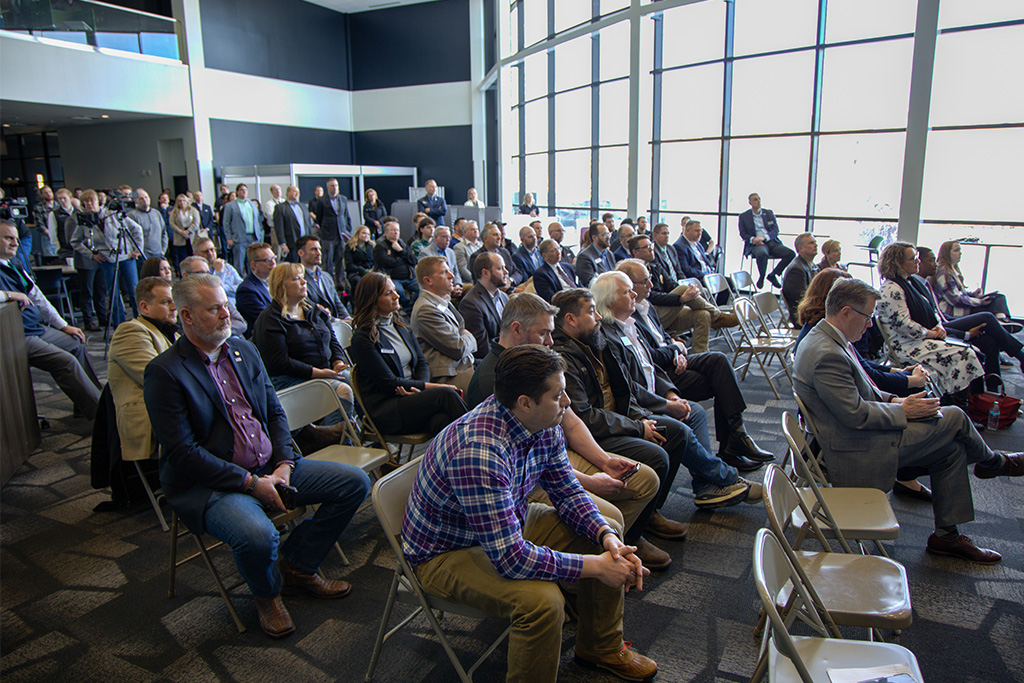
And they did so with the push of a button from a tablet computer in front of more than 150 people gathered for the event in Robin Hall on Feb 27.
The activation gives North Dakota access to the same real-time radar data used by federal air traffic controllers — a capability, now called the Vantis Federal Radar Enclave, that no other state currently has.
“What it means is we can now fly unmanned aircraft statewide across North Dakota,” Hoeven said. “No other state in the country can do that. It’s a massive competitive advantage.”
From concept to implementation
The milestone builds on authority secured in the FAA Reauthorization Act of 2024, legislation Hoeven championed directing the FAA to provide a radar data feed to a qualified non-federal entity. North Dakota’s Northern Plains UAS Test Site, working through its Vantis statewide network, was selected to receive and operationalize that feed.
While the legislative authorization was announced two years ago at the UAS Summit in Grand Forks, leaders emphasized that transforming authority into an operational system required extensive technical development.
The result is the Federal Radar Data Enclave — a secure physical and virtual environment that ingests federal and state radar data, fuses it with additional sensor inputs and distributes it to authorized users through the operations center at Grand Sky.
Trevor Woods, executive director of the Northern Plains UAS Test Site, described the enclave as a first-of-its-kind architecture that enhances both innovation and safety.
“This is a governed environment for surveillance radars that enhances the safety and operations of the National Airspace System,” Woods said. “North Dakota is demonstrating how to do this right, and others are looking here as the blueprint.
“We’re demonstrating how to do this, correctly, and everyone’s looking to North Dakota on how to expand this in the future.”
The system allows drone operators to conduct BVLOS flights without requiring chase aircraft — dramatically expanding operational flexibility. Previously, BVLOS operations were limited to specific corridors. Now, nearly the entire state is open to qualifying unmanned operations, aside from small topographical gaps below 3,000 feet.
With access to integrated radar data, authorized users can better identify and manage unauthorized drone activity — capabilities increasingly critical for military bases, and border security.
State, Federal and Industry working together
Technology partner Thales, a global technology leader, played a key role in developing the secure infrastructure underpinning the radar enclave. Director of Technology at Thales Frank Matus said building the system required meeting the highest levels of cybersecurity and physical security standards.
“This program here in North Dakota is really transformational, not only for talent, but also the industry,” he said.
State lawmakers and Gov. Kelly Armstrong’s administration were also recognized for sustained investment in building the UAS ecosystem — an effort that combines federal authorization, state infrastructure funding and private-sector participation.
“This has been decades in the making,” Armacost said. “Today represents the culmination or the start of an activity that was announced about a year and a half ago at the UAS symposium here in Grand Forks.”
With the radar feed live, North Dakota’s statewide BVLOS capability positions UND, Grand Sky and the Northern Plains UAS Test Site not only at the forefront of next-generation aviation — but as the model for how it can be done safely, securely and at scale.