UND celebrates power of music therapy with just a little ‘L-O-V-E’
Stories from neuroscientist Daniel Levitin — plus a little singalong — turn possible skeptics into believers
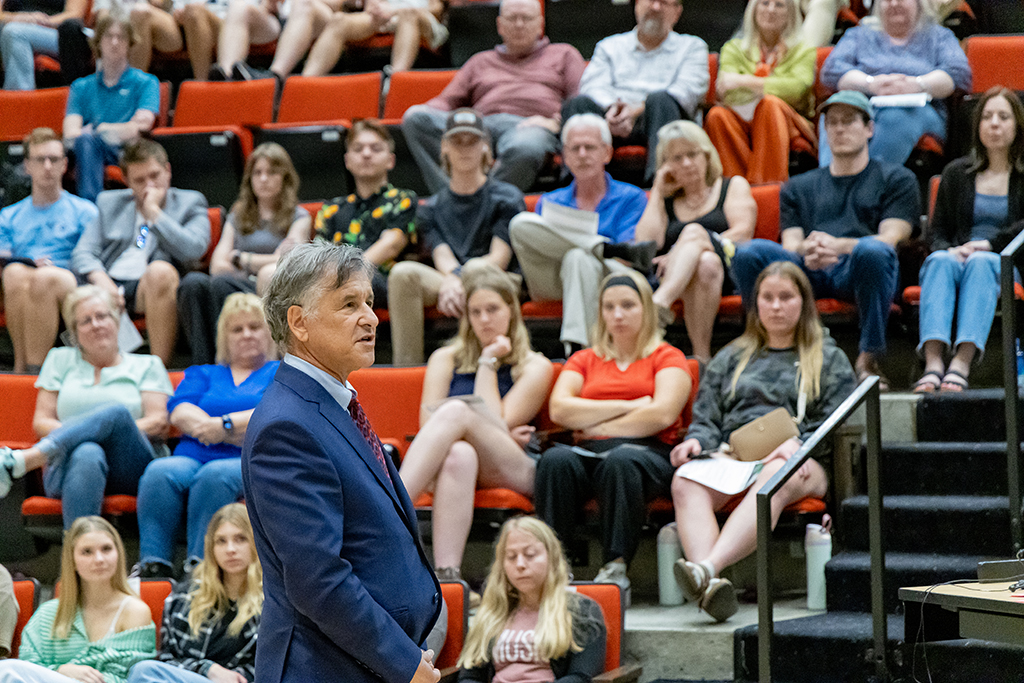
Music therapy — the brain science and the educational training — was still a mystery to at least some of the 100-plus people gathered recently inside the Josephine Campbell Recital Hall in UND’s Hughes Fine Arts Center.
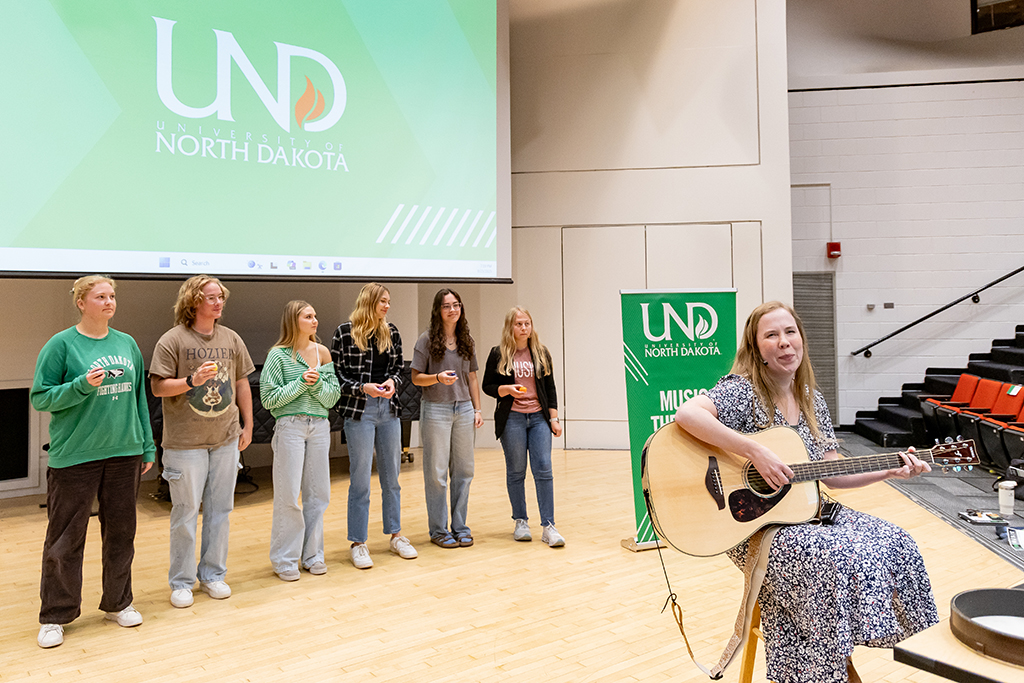
They had come to learn more about what Music Therapy Program Director Carly Flaagan described on stage as an “evidence-based practice of using music as the agent of change to promote health care outcomes across the spectrum of life within an established therapeutic relationship.”
Right off the bat, Flaagan acknowledged that the very definition of music therapy can sound like a mouthful and seem a bit confusing. But on this evening, participants also would get to hear from one of the world’s leading experts on the subject.
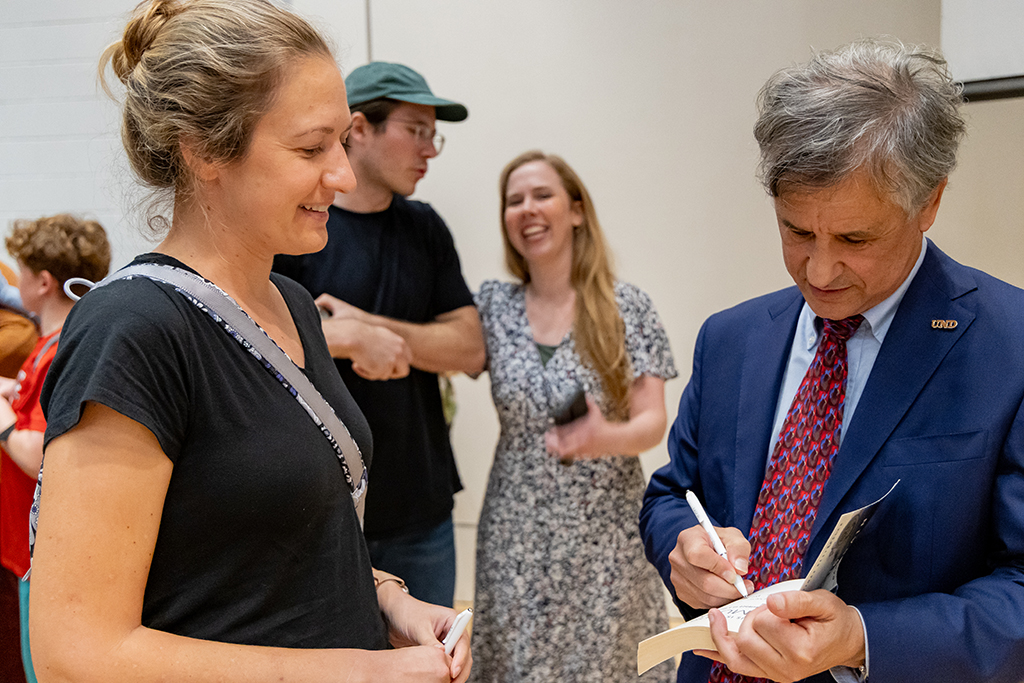
Renowned neuroscientist and researcher, repeat bestselling author and accomplished musician Daniel Levitin had come to campus to talk to students and the Greater Grand Forks community while helping the College of Arts & Sciences celebrate the return of its Music Therapy bachelor’s degree after a 10-year pause.
Spreading the word and better understanding
“If that definition sounds broad and abstract, it’s because that’s on purpose,” an enthusiastic Flaagan explained during her introductory remarks. “Music therapy is difficult to describe in a nutshell because it’s so expansive in its approaches to practice and in where professional music therapists can work and in the kinds of people they can serve.”
For instance, she told the crowd, you’ll find music therapists in hospitals and on hospice teams, in nursing homes and memory care facilities, as well as in schools, psychiatric units and in private practices.
“Music therapy can have impacts both big and small on people’s lives. It can help people of all ages and in many populations,” Flaagan said. “It can help a baby and its parents bond in the NICU. It can help an Alzheimer’s patient be present and connect to their core self through musical memory and engagement.
“It can help an autistic individual develop strategies for joint attention, and it can support young children in developing early language and communication skills. The list goes on and on. Music therapy even can be there as a person takes their last few breaths — bringing down their heart rate to make those moments more peaceful.”
Because music is such an intrinsic part of the human experience, Flaagan said most people have little trouble understanding how music therapy can influence mood. However, understanding its tremendous power to transcend emotional health to help people overcome physical or cognitive challenges can be significantly harder to grasp.
So, exactly how does music therapy work?
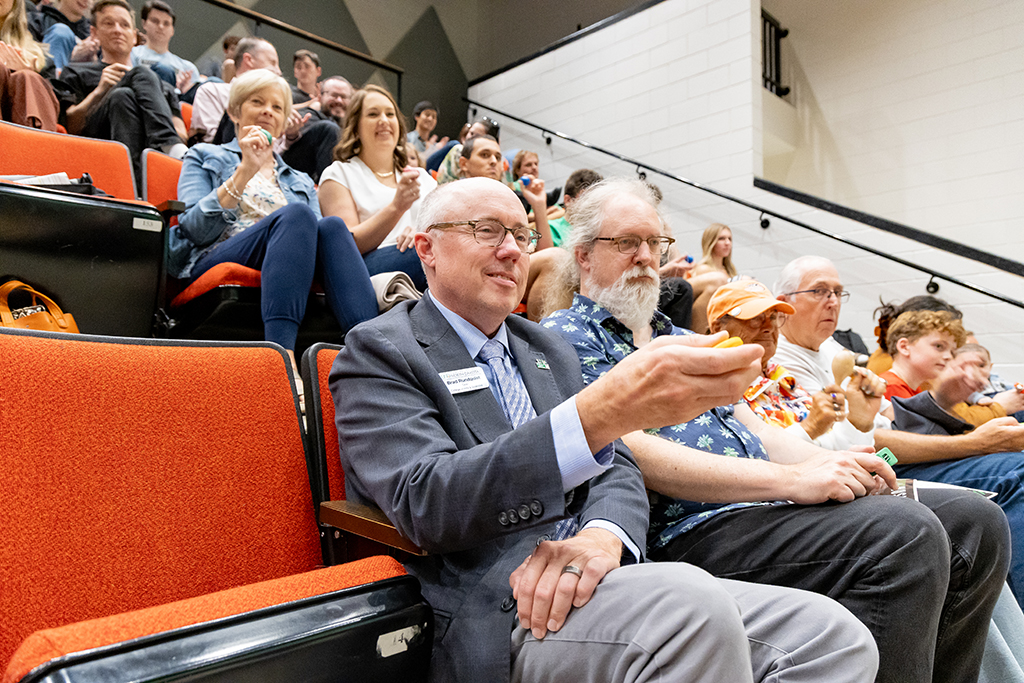
Flaagan would begin to answer that question by inviting the audience to take part in an experiential exercise demonstrating how selective attention can be used to prompt a desired response that becomes almost automatic.
“Everyone in the first few rows, check under your seats,” Flaagan instructed the guests. With puzzled looks on their faces, people immediately ducked down to pull out dozens of colorful percussive instruments. The people seated farther back would be able to participate, too. They’d clap their hands to provide another brand of percussion.
After Flaagan roughly divided the auditorium into four sections, she assigned each group a letter cue based on the “L-O-V-E” song lyrics made famous by jazz pianist and crooner Nat King Cole.
The directions that came next were simple: Every time you hear your letter, strike a single beat. With that, Flaagan picked up her guitar and began to strum and sing:
L is for the way you look at me …
O is for the only one I see …
V is very, very extraordinary …
E is even more than anyone that you adore …
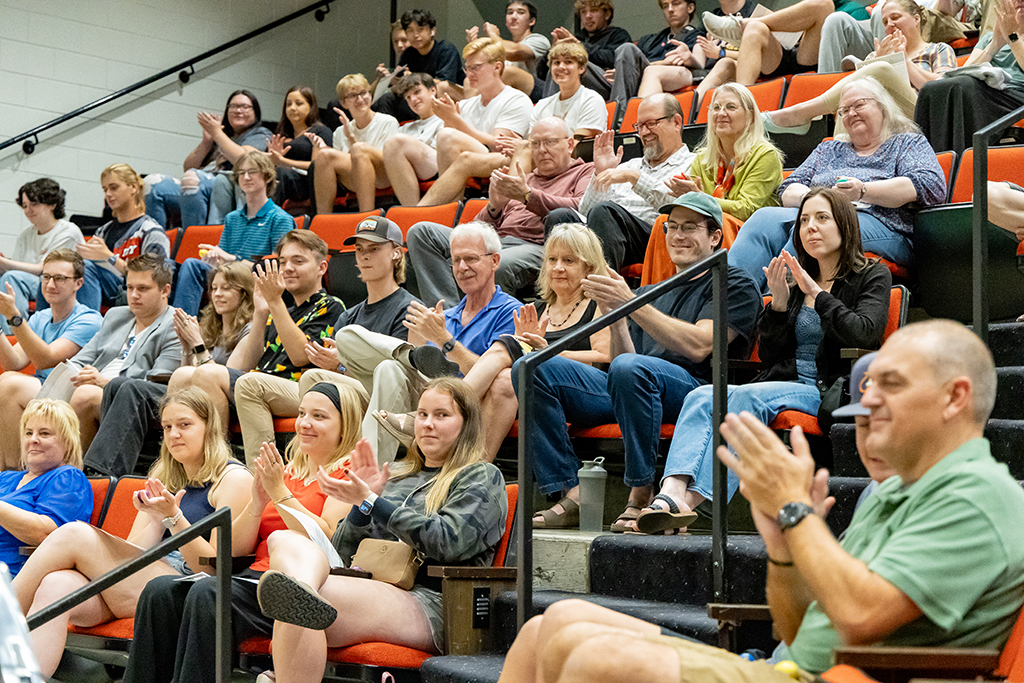
In a heartbeat, the entire hall was transformed into a giant ensemble — listening, waiting, restraining and striking at just the right moment. Even as Flaagan quickened the pace with each line and verse, she could not throw the focused musicians off the beat.
“I love that you all did that with me,” a breathless Flaagan said over the last chord. “That is selective attention — ignoring what doesn’t matter so you can do the right thing at the right time. Tonight, you didn’t just hear about music therapy — you did it.”
Heads began to nod in unison. It was beginning to make sense.
And it made even more sense as Flaagan explained how music therapists can use a similar technique to help stroke victims retrain their brains to recover “lost” motions such as how to use a fork to feed themselves.
The exercise may have sparked the evening’s first aha moment, but there would be many more as Levitin took the stage.
The proof is in the science and the brain
First, a little background: Levitin completed his postdoctoral training in neuroimaging at Stanford University Medical School and training in cognitive psychology at the University of California-Berkeley after earning his bachelor’s from Stanford and his doctorate in psychology from the University of Oregon.
His research spans music, the brain, health, productivity and creativity, and he has published more than 300 articles in prestigious journals such as Science, Nature and Proceedings of the National Academy of Sciences. His work has been featured in popular press, including The New York Times, as well as Scientific American and Rolling Stone magazines, and his TED talk is said to be one of the most viewed of all time.
Levitin also is the author of several New York Times bestsellers, including “This Is Your Brain on Music,” “The World in Six Songs,” “The Organized Mind,” “Successful Aging” and the latest, “I Heard There Was a Secret Chord: Music as Medicine.”
Levitin has consulted for companies the likes of Apple, Microsoft and Sony, and he’s also spoken at institutions ranging from Congress to Google and Amazon. As a musician, he has performed with legends such as Mel Torme, Sting and Rosanne Cash, and he has contributed to albums and films, including “Good Will Hunting” and “Pulp Fiction.”
The neuroscientist opened his UND talk by reminding the audience that while music itself is ancient — humans have buried musical instruments with their dead as far back as 4,600 years — the scientific study of music’s medical effects is relatively new.
People long have seen the value in music, Levitin said, but it wouldn’t be until the advent of modern brain imaging and neurochemistry in the early 2000s that researchers actually could “see” how music activates pleasure circuits, lowers stress markers and influences immune function. And it was that evidence that finally persuaded the National Institutes of Health to take music seriously.
The NIH in 2013 issued a call for proposals, and a few years later it began to award tens of millions of dollars in research grants. Fast-forward to today, and virtually all 21 NIH institutes — from cancer to aging to addiction — are investing in music-as-medicine research, he said.
Levitin’s point was clear: what our ancestors intuited thousands of years ago now is being confirmed with science. And that momentum is only growing.
“My lab was one of the first labs to study the musical brain, and it was the objective nature of brain scans actually showing where music affects the brain, where the blood goes and the measurement of neurochemistry, that allowed us to make advances,” Levitin said. “And now it’s commonplace in journals across all different biomedical and scientific fields to have something about music.”
Levitin went on to say that he and physician-geneticist Francis Collins — best known for his leadership of the Human Genome Project — are working to get a bill introduced that would make Medicare pay for forms of music therapy that currently are not covered.
For the doubters, seeing is believing
The bottom line, Levitin said, is that “music therapy is evidence-based, not pseudoscientific.”
For the sake of example, he talked about how …
- When patients listen to their own choice of “relaxing” music before going into surgery, it can steady their heart rate and breathing as effectively as prescription-level drugs — but without the side effects and cost. Though Spotify’s “relaxation” playlist didn’t budge stress markers, personal favorites were shown to lower the heart rate about five beats per minute — a clinically meaningful drop.
- The immune system listens, too. Certain music therapy approaches have been linked to boosts in IgA — an infection-fighting antibody — and to shifts in stress chemistry (cortisol down), alertness (epinephrine up) and sleep regulators (melatonin up).
- Pleasure itself has a fingerprint. Music also has been shown to tickle the brain’s reward network — first dopamine (during anticipation), then endogenous opioids (during consummation). Again, it’s not as strong as Oxycontin, he cautioned, but it is potentially enough to reduce pain or reduce the amount of opioid medication required.
The audience burst into laughter as Levitin cracked: “The whole opioid crisis could have been avoided if only the Sackler family had invested in music instead of in opioids.”
When words won’t come, sing
The data. The charts. The brain scans. It all was very persuasive, but it would be Levitin’s stories of real people that had people shaking their heads and whispering, “No way.”
Case in point, melodic intonation therapy can teach patients who’ve lost speech (after a left-hemisphere stroke, for example) to sing simple phrases before gradually bridging from melody back to speech as new neural pathways grow. It was the approach used in the recovery of Rep. Gabrielle “Gabby” Giffords, the Arizona congresswoman who was shot in a 2011 assassination attempt.
“The bullet entered her head here, and it obliterated her speech area,” Levitin said as he motioned to his head. “She could not talk, but she could still sing. So, she was taught to sing common, everyday requests — ‘I need to go to the bathroom. I want a glass of water. I want to lie down now. Go, away. You’re bothering me.’
“We know from two decades of neuroscience that music and speech centers are different,” Levitin explained. “They’re partly overlapping, but they’re also distinct circuits. So, even when you’re listening to music that has lyrics, those lyrics are processed in a musical mode. They’re not being processed entirely by speech centers.”
With Alzheimer’s and dementia, music enjoyed from ages 13 to 20 — the imprint years, Levitin said — can later unlock faces, names and stories when nothing else can. To demonstrate, he played a short clip of a man named Henry who was featured in the documentary “Alive Inside.”
Slumped and silent, Henry hadn’t spoken for years, but when headphones were placed on his head and he could hear the voice of Cab Calloway, one of his favorite artists from his youth, he suddenly sat straight up with his eyes wide open, responding to questions and speaking about love.
“Henry was able to talk again because he was able to reconnect with that part of himself he thought he had lost,” Levitin said. “Through just that little bit of music, he found himself again. He found some memories and was reminded of times when he was younger, and he was able to speak again for another week. That’s a big boon to the aging population.”
Levitin also spoke of Glen Campbell and Tony Bennett — artists who still could perform robustly even as other abilities slipped. The point wasn’t celebrity, it was circuitry.
“There are all these complicated things going on that kind of defy a simple understanding of ‘brain working, brain not working,’ It’s not a binary thing,” Levitin said.
And for Parkinson’s disease? Levitin showed a video of a man who struggled to take even a single step with the help of a walker. A music therapist then played a song with a tempo to match his natural gait, and within seconds, he was stepping one foot in front of the other. He appeared to be dancing forward, and he even was able to ditch his walker at one point.
“This is transformational,” Levitin said. “If you think mobility is not a big deal, imagine not being able to go to the bathroom in the middle of the night or being able to get up and get your own glass of water.
“Mobility is a huge deal, and music restores this autonomy, dignity and self-respect — just music.”
People share firsthand stories of music therapy
For UND’s first new cohort of Music Therapy majors, the night was more than inspiring. It was affirming.
“Having someone of Dr. Levitin’s stature here at the very start of their journey tells our students this program — and their choice of career — are valued,” Flaagan said. “It empowers them. It validates why they’re here.”
Sophomore Eli Stevenson seconded that.
“I really enjoyed how the complex topics were explained in such a palatable way,” Stevenson said. “I was able to understand the depths of what this major is actually going to get me into. It was really helpful.”
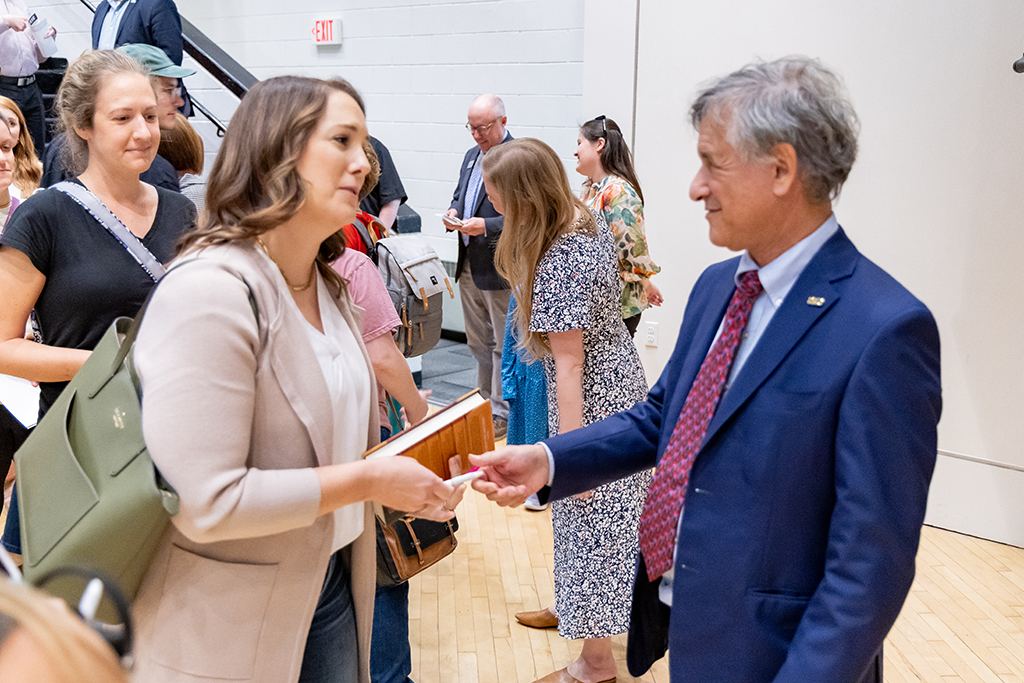
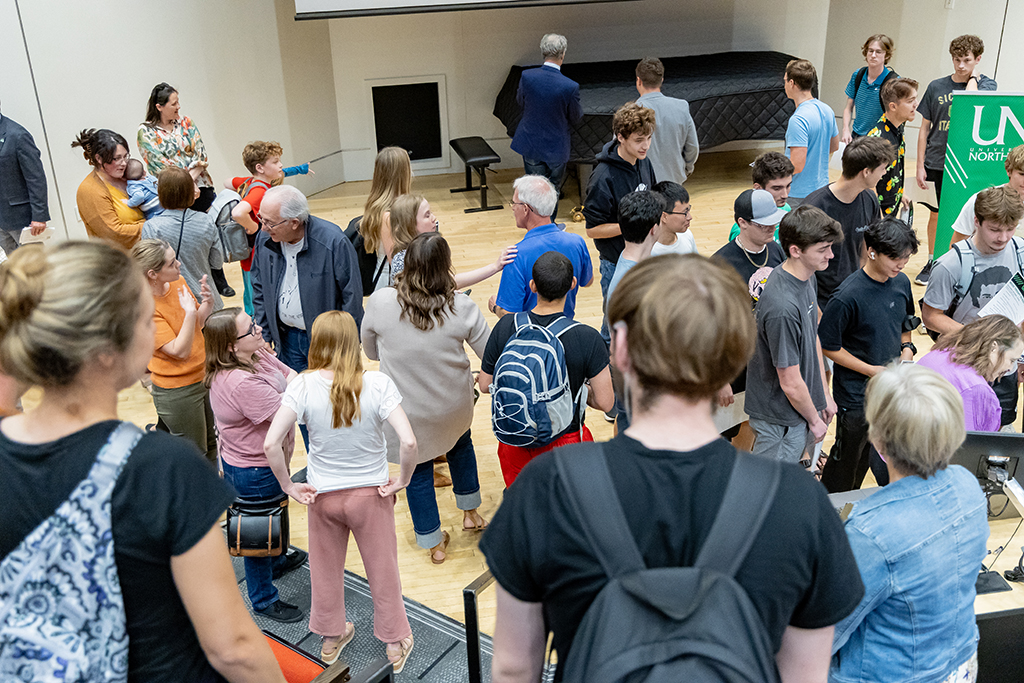
In the lobby afterward, more people shared their personal stories of seeing music therapy’s effects firsthand.
First, there was Walter Knipe. He said he never understood why listening to the sounds of Glen Campbell eased his headaches. “That steady beat — it just worked,” he said. “Tonight helped me realize why.”
And attendee Sam Johnson recalled his late mother’s final years with Parkinson’s dementia.
“All the things Levitin talked about tonight, I witnessed with my mother,” Johnson said. “She couldn’t talk or carry on a conversation, but when the music therapist* would come to play music, my mother would get a big smile on her face. The lyrics came back, and she’d sing ‘Five Foot Two, Eyes of Blue.’
“The music kept her involved and excited. She’d even get up and try to dance a little bit. She’d play a little piece of Chopin at the piano. It really brought back memories for her. She would actually be able to talk a little bit following a music session. It was remarkable to see. Her quality of life improved tremendously because of the music.” (*Johnson spoke at length about the work UND Music Therapy alumna Lindsey Moffitt did with his mother.)
And this from Mitch Wigness, a development director with the UND Alumni Association & Foundation: “We all know that music plays a special part in our daily activities and our brains and our moods. But to see the scientific side of it and know that, neurologically, music therapy can help those with cognitive issues, and to see its effects, was eye-opening.
“This is such a critical program in studying how we operate. It’s fascinating, and I’m excited that UND has committed to music therapy’s resurgence here on campus.”
And Flaagan is excited, too.
>> A call to action: Flaagan invited the audience to reach out if they’re interested in hosting a presentation or if they want to work on a business proposal to hire a music therapist. “We would love to support you and the whole community,” she said. “We want to increase everyone’s opportunity to access these vital and important health care services.”
>> Do you want to read more UND Today stories? Just hit the link or go to our home page to subscribe to our twice-weekly newsletter.