Ethical marketing: A force for good
Take a pause before you persuade, Olafson Ethics Symposium speaker Melissa Fors Shackelford tells UND students
When one imagines a marketing executive, the first image that comes to mind may be a Don Draper type: whiskey in hand, cigarette smoke swirling, morally apathetic and focused on the bottom line, regardless of the human cost.
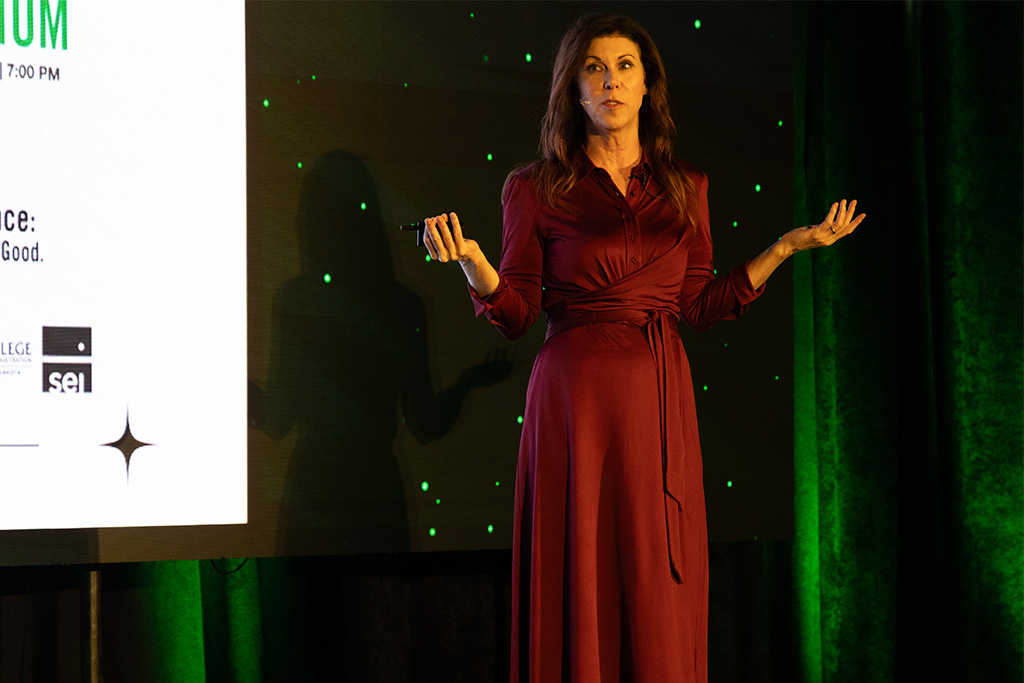
This need not be the case, said Melissa Fors Shackelford, keynote speaker for the College of Business & Public Administration’s 20th annual Olafson Ethics Symposium. The symposium – honoring the philanthropic support of UND alumnus Robert Olafson – invites speakers spanning the business community to lecture on the importance of personal and professional ethics.
“Marketing is a profession that gets lots of pressure — always pushing marketers to do more, to sell more, to get more customers,” Fors Shackelford said as she opened her keynote on marketing ethics. “When you have all that pressure, those little gray areas are a little bit easier to step into.”
Instead of submitting to a profit-driven culture, Fors Shackelford suggests that young marketers take it upon themselves to use marketing as a driver for change, trust and human connection.
Fors Shackelford, founder of Shackelford Strategies, author and longtime marketer, framed her keynote around this idea as she drew from years of experience in the marketing world to show the importance of an ethical approach.
A lasting lesson from addiction treatment marketing
Fors Shackelford began by drawing on the field she knows best. For a decade, she led marketing for the Hazelden Betty Ford Foundation, which she described as “the nation’s largest nonprofit addiction treatment and mental health organization.” Clients and their families rarely come to them in ideal circumstances, she said.
“Nobody calls addiction treatment centers when they’re having a great day,” she said. “They call when their family’s in crisis, when somebody’s overdosed, when somebody’s gotten a DUI, when somebody’s hit rock bottom.”
Fors Shackelford noted it is because of these circumstances that bad actors target potential clients in an effort to mislead and misinform them — and fleece them for their cash.
Those moments made the deceptive practices she saw in the wider addiction-treatment industry especially troubling. She described how families searching online for the foundation would instead land on look-alike websites and call centers that sold “leads” to the highest bidder rather than connecting people with licensed, ethical care.
Her organization decided to fight back by calling out bad actors and protecting patients. Still, the abuses were so widespread that the largest driver of internet traffic stepped in.
“When an industry won’t police itself from unethical activity, someone else is going to step in,” Fors Shackelford said. “And in our case, it was Google banning us.”
Google’s decision to ban addiction-treatment advertising entirely — grouping it with weapons, illegal drugs and payday loans industries as a high-risk category — forced the industry through a “reckoning,” she said. Reinstated advertisers now must pass a rigorous certification process to prove they are “ethical, licensed, accredited and credible.”
Patterns of predatory marketing
The pattern, Fors Shackelford argued, is not unique to addiction treatment. She walked through examples from cigarette advertising in the 1960s, the marketing of flavored vape products and the recent surge in online sports betting.
On vaping, she noted that companies recycled tactics once used by tobacco firms.
“They were doing deceptive advertising because they weren’t telling the truth about the health risks of their vape pens,” she said.
At the same time, “they were targeting children,” she said, pointing to ads running on Nickelodeon, Cartoon Network and in Seventeen Magazine.
“There’s no way you can say that’s not targeting children,” she emphasized.
Recently, sports betting has raised similar alarms, especially on college campuses. Research suggests that 50% of male college students have placed at least one bet in the last year, she said. Against that backdrop, ads that promise “risk-free” wagering are misleading at best.
“Gambling is not risk-free. Gambling, by its nature, inherently has risk, and that’s a big problem,” Fors Shackelford said.
Citing research, she noted that “the younger people start to gamble, the more likely they’ll become a gambling addict,” and that “the suicide rate of gambling addicts is 10 to 15 times higher than the general population.”
Like predatory marketing that latched itself on the addiction treatment industry, advertisements for nicotine products and gambling can be actively harmful. But Fors Shackelford offered students in attendance some advice on avoiding these pitfalls.
Guardrails for ethical marketing
For example, she pointed students toward professional standards such as the American Marketing Association’s code of ethics. The AMA, she said, urges marketers to “first, do no harm,” to “foster trust in the marketing system” and to “embrace ethical values” such as honesty, fairness and respect.
To help, Fors Shackelford suggested asking practical questions before launching an advertising campaign:
“Does this build trust, or does this erode it?”
“Is this message fully true?”
“Would I be proud to defend this if it went viral for the wrong reason?”

Marketing as a force for good
It wasn’t all doom and gloom, though. Fors Shackelford remained optimistic about the landscape of marketing, dedicating the final portion of her keynote to those she called “the good guys” — the brands and companies that use marketing to “change our cultural conversation” instead of exploiting it.
She cited campaigns such as Always’ “Like a Girl,” which challenged stereotypes about womanhood and femininity, and Dove’s “Real Beauty” campaign, which used women of all shapes, sizes and ages to reframe how audiences think about beauty and body image.
Another campaign she cited as having a positive real-world impact was an Xbox Super Bowl ad featuring the gaming console’s new disability-friendly controller.
“It wasn’t really about an Xbox and it wasn’t really about Microsoft. It was about these kids,” Fors Shackelford said. “It was about being inclusive for everybody, and it really changed the conversation. These days, you see so many adaptive products and more ads that include people living with disabilities, and a lot of this was sparked by that 2019 Microsoft ad.”
Campaigns such as these represent marketing at its best and most impactful, she added.
“This is when marketing works with purpose and integrity,” she said. “It sees itself as a force for good, a force for change.”
A better future with ethical marketing
As Fors Shackelford closed her keynote, she took a moment to reinforce the idea that marketing can operate not just as a sales pitch, but an opportunity to change culture and lives. Moments of reflection and consideration, like the questions she’d suggested minutes earlier, can be transformative.
“What I want to leave you with is: marketing is not neutral,” Fors Shackelford said. “Every message can shape culture, perception and behavior for the better or for the worse.”
“For me, ethics is really about intention, not being perfect,” she said. “In marketing, it really comes down to taking a pause before we persuade.”