‘The grass is green where you water it’
UND alumna Amber Flynn shares her perspective and journey with leadership for latest 18:83 talk
As Amber Flynn looked up at the branches, laying on her back, she likely thought her life as she knew it was over.
She had just fallen 20 feet from a tree, straight to the ground. She couldn’t get up.
Before her freshman year of high school, Flynn had been an active kid — inline skating everywhere and playing basketball, volleyball and soccer in Grand Forks.
With weeks to go until the start of school, the fall she’d endured crushed one vertebra, broke another and collapsed a lung.
“And I showed up on the first day as a freshman with a mouthful of metal, a back brace and the best Nike sweatsuit that you could find in town,” Flynn said.
But for her, a moment that could have felt like the end presented a new way of being.
She could have been paralyzed. She knew she was lucky.
“That fall literally and figuratively changed me,” Flynn remarked.
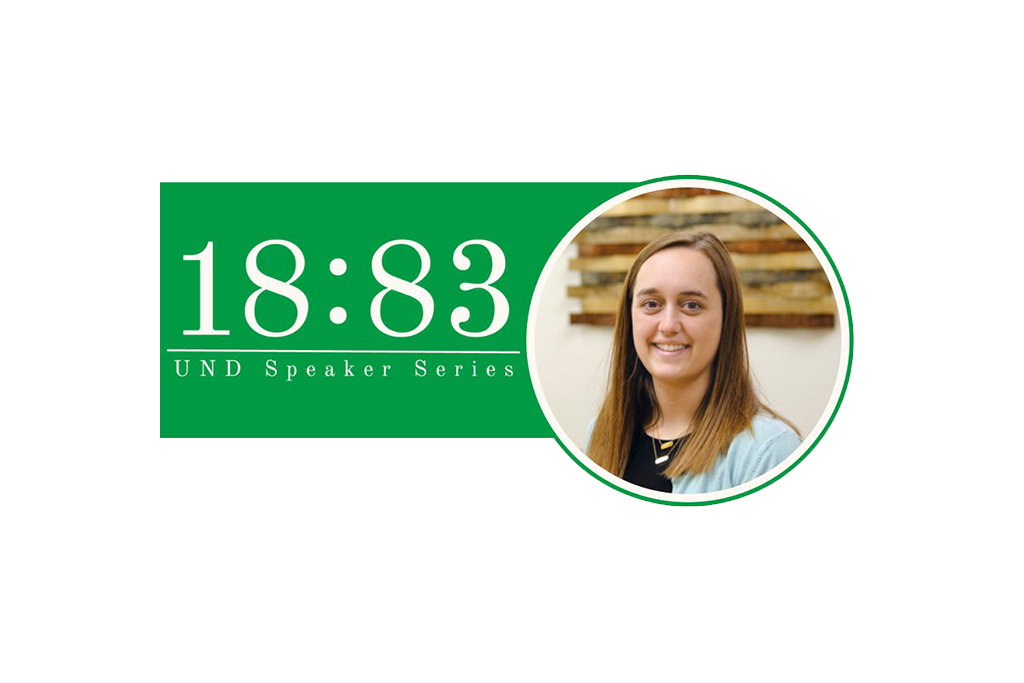
At the Memorial Union, for the latest installment of the 18:83 Speaker Series, Flynn shared some of the lessons she learned throughout and beyond her recovery from that incident.
Today, she’s a mother of three, a UND graduate, the owner of Grand Real Estate and an active member of the Grand Forks community.
What makes grass green
Being in the real estate business, Flynn knows firsthand that “sometimes your neighbor’s grass is greener because their water bill is higher.”
But those with green thumbs, or those with green-thumbed neighbors, know all the meticulous care and hard work that makes a lawn pristine.
“The grass is green where you water it,” she said.
In reflecting on the circumstances of her injury, she decided to look at the beauty from where she was standing, not where she thought she should be.
Her talk followed that concept through four aspects of her approach to leadership: passion, perspective, grace and compassion.
Passion from flames to embers
On passion, Flynn’s experience in simultaneously running a business, raising a family and serving on multiple boards changed her view of the word.
Passion in life is often portrayed as a roaring flame.
“Sometimes I’ve felt like maybe I’m not as passionate about things anymore, especially in seasons of exhaustion and burnout,” she said.
“But I learned that passion is sometimes an ember that needs tending to.”
And from some second-hand knowledge from a linguistics professor, Flynn learned that the root of “passion” comes from the Latin word for “suffer,” which further changed Flynn’s outlook.
“Passion isn’t just about excitement and enthusiasm,” she said. “It’s about enduring the difficult parts around what we care most deeply about.”
Stemming from these ideas, Flynn talked about her journey with mental health, and how burnout is all too apparent in positions of leadership.
“Through therapy, I learned that sometimes heart work and hard work are conflicting,” she said. “Sometimes it feels like suffering, just like passion does.”
With burnout playing an outsized role in people leaving leadership positions, Flynn said it’s important to rest and learn to tend to what one has — not to play the comparison game or wish for greener grass.
Perspective meets grace
Flynn then presented two photos of a tree near her parents’ house.
One showed a once tall and proud tree partly shattered by lightning, forever scarred.
The next photo, from the other side, showed the tree in a different light entirely. It was resplendent in its bright green leaves, under a golden sun, with a rainbow perfectly framing the background.
“No one would ever know it had faced pain, suffering and brokenness,” Flynn said.
“It’s easy to make judgments from one side of the story. But if you shift your perspective even slightly, you might see what looks whole and strong while never seeing the pain and suffering behind it.”
Flynn shared that she serves on the Grand Forks School Board, and that the comments she hears in those meetings can be angry, harsh and pointed.
While her first instincts might be to defend herself or correct the person speaking, she’s learned to listen to what’s underneath.
“Usually, those words aren’t about policy or disagreement,” she said. “They’re about pain, love for their children or fear.”
And while the idea of grace is easy to preach, it’s hard to practice, Flynn continued.
She’s learned that grace means giving other people space to grow at their own pace, whether that’s “keeping her mouth shut” at a School Board meeting or trying to get her kids (and sometimes her husband) to put things away in the house.
“Sometimes progress looks a lot like patience, just like it does when you’re tending to your grass,” Flynn said.
Building gardens
And if grace means giving space, then compassion is filling that space with love.
“When we lead with compassion, we stop comparing lawns and we start building gardens,” Flynn said.
Through her leadership journey, she has come to value compassion as wisdom, quiet strength and essential to building trust — turning frustration into collaboration.
It also represents the courage to see yourself and others as humans, flaws and all.
But to offer compassion, one needs to practice it inwardly, she said.
“Maybe, at the end of the day, we’re all just existing in the same yard, watering our own patches of grass,” she mused.
“No matter where you are, no matter what season you’re in, you can make the grass green where you stand. Water it. Tend to it. And when it feels dry, borrow some water from your neighbor’s hose … because your patch deserves to be as green as you make it.”
The next installment of the 18:83 Speaker Series will be held on Wednesday, Nov. 12, featuring Tamba-Kuii Bailey, associate vice president and advisor to the president for Community & Belonging at UND.