UND’s message to North Dakotans: Strive to lower radon’s risk
That risk is real, but residents can and should mitigate it, says Interim Dean Soojung Kim in her Randy Rasmussen Lecture
By Madison Dame
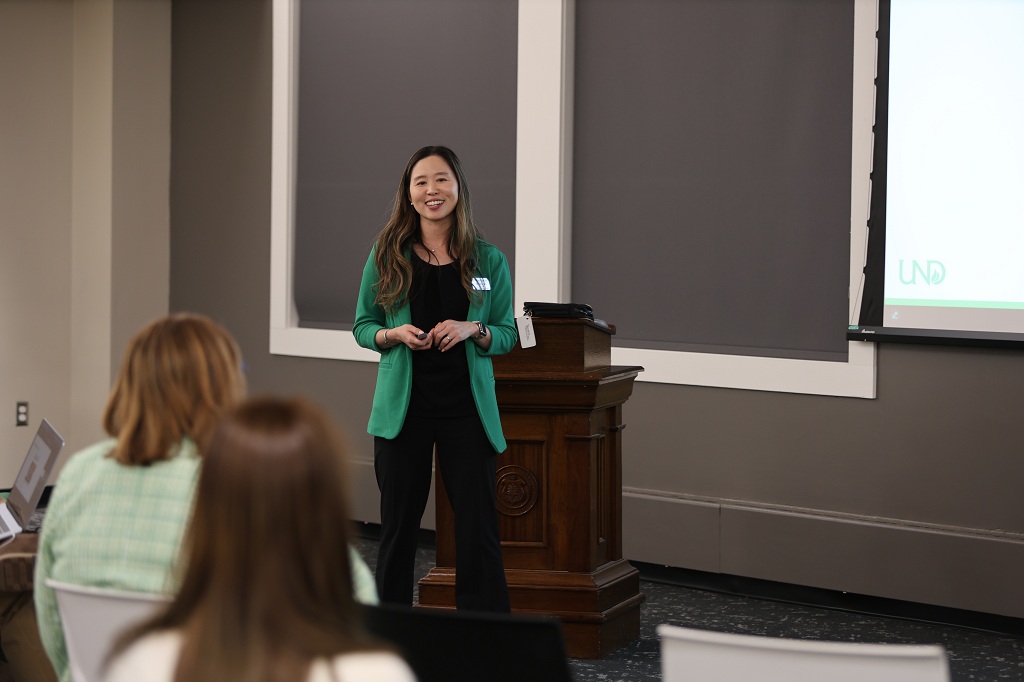
Radon poses serious risks to North Dakota residents, and it is important to understand those risks and how to identify and mitigate them, said Soojung Kim, interim dean of the School of Graduate Studies at UND.
Radon is a radioactive gas and the second leading cause of lung cancer, Kim explained. And North Dakota residents face an especially heightened risk: one in 15 homes nationwide poses a high radon risk, but in North Dakota, the ratio is two in three.
The Environmental Protection Agency recommends remediation when radon levels reach or exceed 4 picocuries per liter (pCi/L) in residential buildings. Areas where average indoor levels are above that threshold are designated as Zone One, the category of highest potential risk.
“All North Dakota counties are considered Zone One,” Kim said.
Kim’s lecture was part of the Randy Rasmussen Memorial Lecture Series, established by the Chester Fritz Library to honor the memory of Randy Rasmussen, a beloved member of both the Grand Forks community and the library staff. The series features speakers whose work reflects Rasmussen’s interests, which included film, fine arts, publishing and much more. At least two lectures are held each year, one in the fall and one in the spring.
Developing a research app
Kim noted that her academic background and training in Communication are very theoretical. “I appreciated that so much,” she said. “But I also struggled somewhat through my education and professional journey, in that I want to solve real problems, not just talk about theory.”
Calling attention to North Dakota’s radon challenge is one way she can work to solve a real problem, not just discuss it in only theoretical terms, she said.
The project has come a long way since she started it in 2018. That year, she was invited to join Radon Outreach and Research (ROAR), a research group led by Gary Schwartz, founding chair in the Department of Population Health at UND. ROAR includes experts across Medicine, Epidemiology, Biostatistics and Public Health.
Kim earned her first internal grant, the Early Career Award, in 2018. The funding allowed her and her colleagues to conduct a pilot intervention study using an original radon app they developed in collaboration with the technical partner, Triad Interactive Media.
The pilot study involved college students – a group that typically doesn’t own homes or think much about long-term risks such as cancer, Kim said. But the project helped the researchers learn that the app is a promising tool for increasing knowledge about radon and boosting the likelihood of individuals ordering radon test kits, one of the first steps toward testing their homes.
“We got pretty excited,” she said. “Although the app we used at the time wasn’t fully developed, it was novel enough at that time to address this issue in a way that we had never done before.”
The next stage of the research involved Grand Forks community members who were more likely to be concerned about radon – people such as daycare parents, many of whom would be homeowners with young families.
This new study illuminated a new problem, though.
“What we weren’t able to clearly answer was why only a fraction of individuals who ordered and received a test kit actually used it,” Kim said.
Without people using the kits, homes with high radon levels are unlikely to be mitigated. And North Dakota does not have a law requiring radon testing, she noted.
However, there is a law requires that if a house has previously been tested, any test results must be disclosed during its sale, Kim said.
Now, with funding from the U.S. Department of Housing and Urban Development, Kim and her colleagues are conducting randomized clinical trials to identify effective ways to encourage more people to actually use the test kits once they receive them.
From app to library
The project took a significant step in 2023, when Kim and Schwartz received a grant from the National Center for Healthy Housing to place 40 digital radon testing kits in the Grand Forks Public Library.
In previous studies, the team used short-term charcoal testing kits that cost about $15 each. Users had to place the test kit in their basement for two to three days, mail it to the laboratory, wait for the results, and then interpret the findings, Kim said. This multi-step process is where many people dropped off, because each step required timely and correct follow-through.
Another barrier is the cost of mitigation if the results exceed 4 pCi/L. About eight years ago, it cost about $1,200 to mitigate her own home, Kim said. Today, she estimates the price could be nearly double, and there is a limited number of contractors in the region who are available to do the work.
“As you can see, there are barriers,” some of which will discourage people from testing their homes or addressing high radon levels if remediation is needed, she said. Those barriers include lack of resources, time and knowledge: “There are a whole bunch of areas where people can fail.”
Thanks to the 2023 project, people can now check out user-friendly digital radon testing kits from the Grand Forks Public Library. Each kit is about the size of a cellphone and comes with instructions, as well as general information, and practical tips.
The digital kits require only a few days of use before generating a radon reading. Mailing or lab processing is not required. The longer the device sits in place, the more reliable test results become, she said.
“This is our initial step from apps to the libraries,” she said. “We thought making these digital test kits available in the existing public infrastructure was going to be an important first step.”
Part of what makes this step so important is the dramatic difference in price: digital test kits cost around $150 each, compared to charcoal kits at about $15.
And it’s working. According to a story earlier this year in the Grand Forks Herald, the radon kits were the most frequently checked-out items at the library.
Expanding beyond Grand Forks
“With that success, I was able to put the same program in place at the Fargo Public Library thanks to the UND CONNECT grant,” Kim said.
“It’s another new grant that we secured to improve the health and lives of North Dakotans. With $5,000 from UND CONNECT, we were able to purchase 30 digital kits.”
“It’s been a year and a half since we started this program,” she said. The smaller number of kits in Fargo, combined with the city’s larger population, initially created a waiting list for the test kits.
Kim said she’s also heard about an uptick in radon mitigation contracts in the Fargo area, which leads her to believe that the program is having an impact, although there is no hard data.
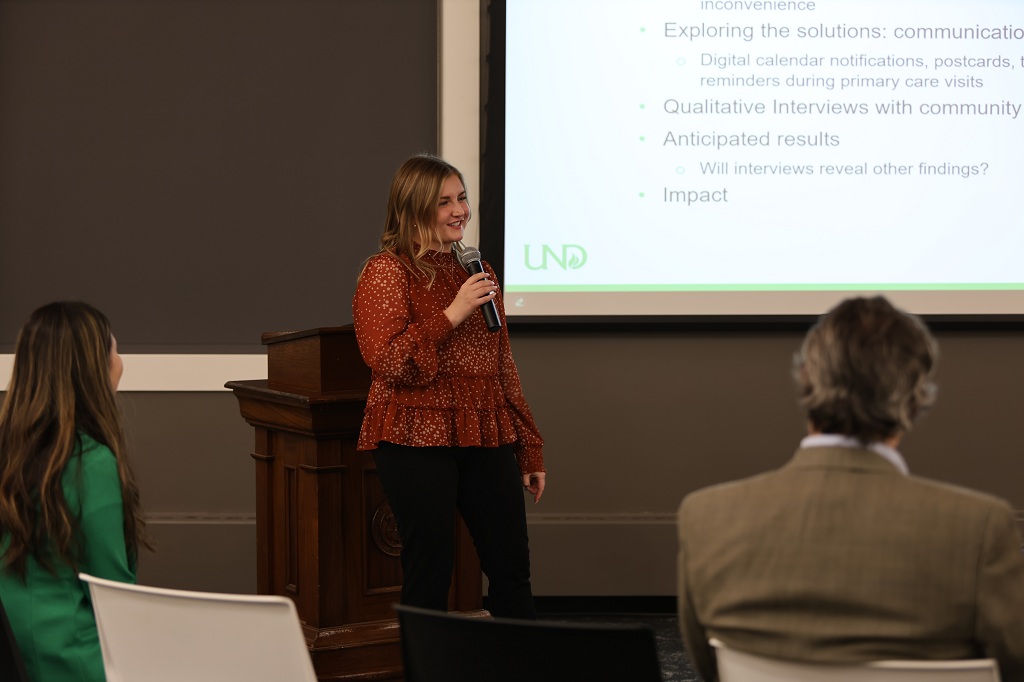
Sydney Rea, a graduate student who has been working with Kim, will take over some of the related research this spring. Based on anecdotal reports that many North Dakotans have heard about the library programs but haven’t check out the digital kits, Rea will focus on identifying the barriers that prevent people from using the kits and exploring potential solutions.
“With our most recently awarded grant, we are also partnering with the UND Family Medicine Clinics over in Bismarck and Minot,” Kim said. “We’ll be working with primary care clinics to share the app and test different strategies to motivate radon testing behaviors, because we know the app can perform well in key areas.”
Lessons learned
Near the end of her presentation, Kim shared a few takeaways from her research.
“What can I do to serve the state with my talent and my work?” she said. “That’s always been a question for me. Even if I were to move to a different state — which I’m not planning to do — I would bring that question with me, because it applies wherever I am.”
At UND, she has channeled this drive by building relationships across disciplines, collaborating with colleagues to tackle complex problems, and partnering with libraries and other community partners – all to better serve her community.
“They’ve all come to understand this is a collective issue, something we have to work together for our communities, while pivoting adaptively as we see new evidence,” Kim said. “This been a really interesting journey.”
Kim said she feels fortunate to conduct such practical research that addresses a real public health concern while also publishing in high-impact peer-reviewed journals.
“When I focus my efforts on the greater goals, the joy comes from knowing that we are doing something truly important for the people we care about,” she said. “That’s been the most important lesson that I’ve learned.”
Her final message to the audience – and to residents throughout the region – was simple: check out a digital radon testing kit from the library, and to get your home tested if you haven’t already.
The following links may provide useful background and other information for interested readers:
UND’s Radon Outreach And Research (ROAR) Project
UND Today story: Taking action against radon health risks
UND Today story: In Service, through providing free radon detector kits
About the author:
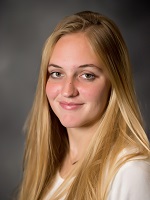
Madison Dame is a Communications and Journalism major at UND. After graduation, she hopes to pursue a career as a journalist.