Growing North Dakota’s own
UND’s online, residency-based principal pipeline builds deep bench of future school leaders for every corner of the state
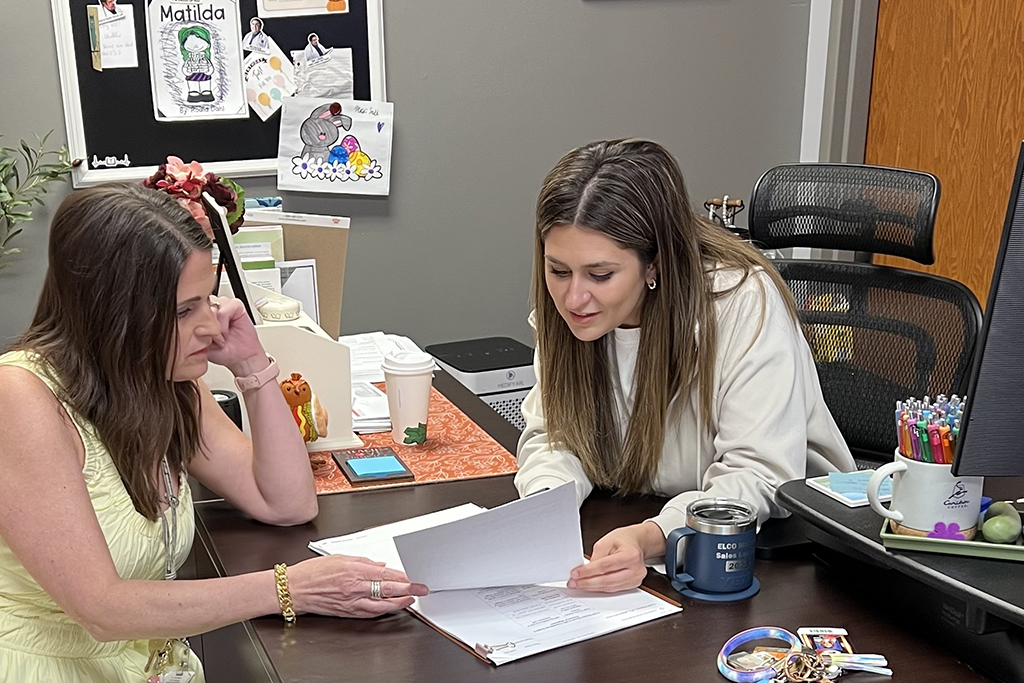
On a frigid December morning in Pembina, N.D., Principal Dave Muhonen is everywhere at once.
He might be greeting kindergartners coming through the doors, checking in with high school teachers about finals, fielding a call about a staffing change and mentally juggling lunch schedules, bus routes and a parent meeting scheduled for that afternoon.
As the new Pre-K-12 principal at North Border-Pembina in the northeast corner of the state, Muhonen jokes that he has to keep an eye on “a bunch of different pots cooking.”
A year ago, every one of those pots looked very different.
“Last fall, I was putting in a lot of apprenticeship hours in Grafton (N.D.) while taking three UND classes all at once that semester,” he said. “I was extremely busy and kind of pulled in a number of different directions. It was rigorous, but it taught me how to manage not only my time but also my sanity and stress level. The workload really prepared me for the workload that comes with being an administrator.”
Building a strong bench of leaders
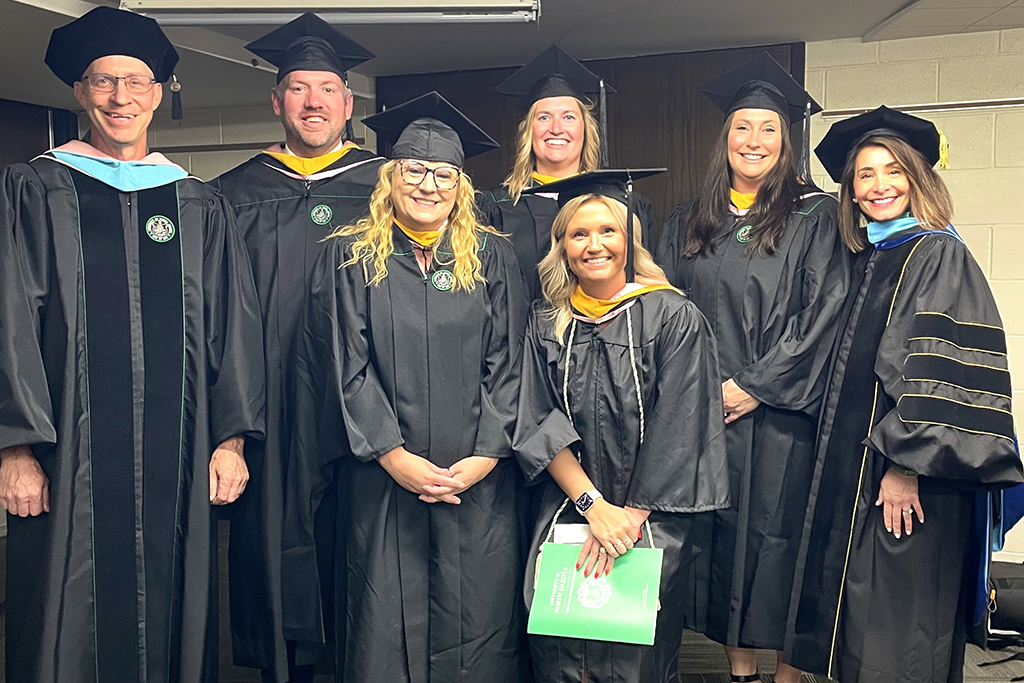
Muhonen is part of the first University of North Dakota cohort to graduate from the Aspiring Principals Pipeline Grant program, an innovative, online-plus-residency master’s degree that is reshaping how North Dakota prepares its school leaders.
Backed by the North Dakota Department of Public Instruction’s Grow Your Own initiative and funded through the U.S. Department of Labor, the program is a centerpiece of the state’s effort to build a strong, homegrown bench of principals before a shortage hits.
Muhonen’s story is the program’s promise made real — a homegrown educator who stayed rooted in a North Dakota community, learned under experienced principals, earned a rigorous graduate degree online and then stepped directly into leadership in a rural district that needed him.
And Muhonen is not alone. Out of the program’s first 10 graduates, eight secured leadership positions the very next academic year — six as principals or assistant principals. The two others accepted leadership roles in instructional coaching and in human resources/professional development in a central administration office, respectively.
Statewide education leaders say the success is no accident.

The architect behind UND’s program is Laura Link, associate professor of Teaching & Leadership and director of UND’s online Master’s in Teaching & Leadership.
“We wanted a bench of principals ready to go,” Link said. “Working educators devote an academic year, really three semesters, to learning alongside an experienced principal — right there at the ground level, getting ground-level intelligence about the job and ground-level experience.”
She sees the pipeline not as an academic exercise, but as a long-overdue solution to a real and rising challenge.
“North Dakota is seeing the same trends as the rest of the country — and in some ways, they’re even more challenging,” she said. “We see a lot of our principals aren’t staying very long in the position. By the end of next year, projections account for about 40% turnover in the principalship.”
The concern is not just numerical. It’s academic.
“Teacher knowledge and skills are primarily important for student learning,” Link explained. “But having the longevity of an effective principal with those teachers is also very important. There’s a direct handshake between having an experienced, qualified, effective principal in the role and optimal student learning. We want to fill the pipeline with as many highly qualified pre-service principals on the bench as we can.”
The question guiding UND’s program design was straightforward:
What if principals had residencies, the way doctors do?
“Much like the medical community, we want them to practice under an expert before they’re on their own,” Link said. “We can teach the theory on campus. But the practice of leadership — the art of leadership — is something you have to see and experience.”
A University-district partnership that became a model
One of the most enthusiastic partners in the pipeline has been Grand Forks Public Schools, a district large enough to feel the strain of leadership vacancies and complex enough to benefit from well-prepared school leaders.
Superintendent Terry Brenner describes the collaboration as one of the most impactful UND-district partnerships he’s seen in his career.
“Our collaboration was successful because of a shared commitment to preparing high-quality school leaders and the remarkable and intentional partnership we have with UND Professor Dr. Laura Link,” he said. “Her dynamic leadership courage, deep understanding of district needs and responsiveness to our real-time challenges made this work not only aligned, but truly impactful.”
Grand Forks principals didn’t simply host apprentices — they immersed them.
“In Grand Forks, our principals and district leaders opened their buildings, offices and their practice to aspiring leaders, giving them ‘just-in-time’ opportunities to learn, stretch, lead and reflect,” Brenner said. “This synergy between university expertise and district realities has made the partnership exceptionally strong and deeply meaningful.”
He added that the mentorship structure is exactly what helps aspiring leaders thrive.
“Our mentor principals and residency coaches played a pivotal role. They modeled the daily realities of leadership in an authentic, transparent way,” he said. “They provided immediate feedback, opened doors to difficult conversations and allowed aspiring leaders to experience decision-making in real time — sometimes hour by hour.
“That ‘just-in-time’ mentorship is invaluable. It accelerated confidence, sharpened judgment and helped candidates understand what principled, student-centered leadership looks like in action. And it really opened eyes to what principals really deal with behind the scenes.”
Districts see apprentices as ‘ready on Day One’
When the final program report showed that eight of the 10 graduates immediately moved into leadership roles, Brenner said it reflected both need and preparation.
“It tells us two very important things,” he said. “First, the demand is real. Districts across the state are facing principal shortages and need prepared, confident leaders. Second, the readiness is undeniable. These graduates stepped into leadership roles almost immediately because their preparation was authentic, rigorous and grounded in school-based experiences.
“The fact that eight of 10 secured leadership roles so quickly underscores how effective this University-district partnership truly is. And it should be noted that there are other school districts included in the eight securing leadership roles — not just Grand Forks Public Schools.”
Before the program existed, Brenner said, applicant pools often were thin.
“It was not uncommon to have very few applicants — sometimes only one or two — for a principal opening,” he said. “Today, because of this partnership with Dr. Link and UND, we are seeing larger, stronger and more diverse applicant pools. We now have candidates who are trained, mentored, coached and ready. That shift alone tells the story of how significant and far-reaching this program’s impact has been.”
State’s vision for Grow Your Own leadership
If Link is the architect and Brenner is the district-level champion, Laurie Matzke is the policy leader who helped lay the foundation at the state level. Matzke is NDDPI’s chief of Program Development & Growth.
“We have been seeing concerns about a principal shortage across the state,” Matzke said. “But more so than that, we love the apprenticeship model. If you are going to be a principal some day, what a great opportunity to continue working your current job and also work under a principal for a couple of years.”
The face-to-face training cannot be matched.
“We hear all the time that principals weren’t prepared for the position once they took it on,” she added. “The apprenticeship model gives them the support and the mentoring they need before stepping into that seat.”
Matzke also praises UND for exceeding expectations.
“One component of the grant was they had to have a mentoring piece,” she said. “But UND gave them a triple dose — a University mentor, the principal and a residency coach. They went above and beyond.”
Why online learning makes this possible
While the residency is in person, the coursework is entirely online and asynchronous — a requirement of the federal grant and a philosophical commitment by UND.
“Especially in the graduate space, our people are working professionals,” Link said. “They’re teaching full time, sponsoring athletics and clubs, running ticket counters, raising families. Meeting them in the online space fits the modern lifestyle of the modern professional.”
Matzke remembers what studying for a master’s degree used to look like for rural educators.
“Back in the day, you had to drive to Grand Forks or Fargo twice a week in the winter,” she said. “Treacherous roads. Long nights. And you had to be there. Now everything’s online. Digital learning has been a game changer.”
Muhonen agreed.
“In such a short time, I felt like I’d known my UND professors for years,” he said. “They were always there, always responsive. Honestly, I felt more connected than I felt in my six and a half years as an undergrad earning multiple degrees elsewhere.”
Real schools. Real experience. Real leadership.
Throughout his compressed three-semester program, Muhonen worked side by side with his mentor principals in Grafton.
“We had that access behind the curtain,” he said. “What the principal does day to day, the hard calls, the problem-solving — that’s what prepares you.”
A UND course in educational law also proved transformative.
“That has come in a lot this year,” he said. “It helped me to slow down, do my due diligence and resolve issues without drama — and without lawsuits.”
And when he moved into the principalship, his leadership team came with him. He hired Heather Robideaux, his Grafton colleague and another graduate of the UND cohort, as assistant principal.
“We’re kind of a perfect pair,” he said with a laugh. “We balance each other out. Going through the same program helped us step into leadership together.”
Impact: Stability, continuity and student success
For Brenner, the ripple effects of strong leadership extend far beyond school offices.
“Schools gain leaders who are better prepared on Day One,” he said. “Teachers benefit from principals who know how to support instruction, culture and collaboration. And students experience more consistent, focused and effective leadership — something that directly influences achievement, belonging and well-being.”
He sees the pipeline as transformative.
“Strong leadership isn’t just beneficial — it’s transformative,” Brenner said. “This pipeline increases the likelihood that every student in our district learns in a school led by someone prepared, steady and forward-thinking in our ever-changing school environment.”
A national model and pathway for entire profession
Matzke said North Dakota was the nation’s first state with a fully approved registered principal apprenticeship. Other states now call regularly for guidance, and UND faculty already have presented the model at national conventions.
Meanwhile, Matzke and NDDPI are expanding a full Grow Your Own continuum:
- High School Pre-Apprenticeship. (The latest development.)
- Para-to-Teacher Apprenticeship.
- Lead Teacher Apprenticeship.
- Principal Apprenticeship.
“And everything’s paid for,” Matzke said. “It’s a path into education where you can grow and learn and achieve — all within North Dakota.”
‘The principal is the glue’
Link emphasizes that strong leadership ultimately serves one purpose.
“Teacher knowledge and skills are super important for student learning,” she said. “But the principal is the one who sets the school framework for success. The principal is the glue.”
She also sees the early outcomes as validation of a model built with intention.
“Within just a few short semesters, we were able to see positive returns,” she said. “We are multiplying talent in tangible ways, and it speaks to the power of combining coursework with place-based, authentic leadership practice.”
So, what’s ahead?
Brenner already can imagine the long-term payoff:
“My dream outcome is a self-sustaining leadership pipeline that continually prepares high-quality principals for Grand Forks and for every corner of North Dakota — small, midsize and large school districts. I hope to see cohorts growing, mentorship networks expanding and districts across the state benefiting from this model. … Ideally, five years from now, principal shortages will be the exception — not the norm — because collectively we had the foresight to invest in future school leaders.”
For Link, the “why” remains simple.
“This program matters because student learning matters,” she said. “Just like doctors practice under expert physicians, our aspiring principals need the same. We want them to have many vantage points, expert guidance and real-time experience — so when they step into our schools, our students and teachers have the very best.”
And for a small rural state that chose not to wait for leaders to arrive but instead decided to grow its own, that’s exactly the point.
As for Principal Muhonen, he sees the possibility for a state of educational bliss.
“I can’t advocate for this program strongly enough. We all came out of there with a wealth of knowledge that was practical and applicable and didn’t take a lot of work to implement,” Muhonen said. “Whether you’re an aspiring principal or not, everything we learned could be and should be used in our schools. Now if only we could get every educator tuned into it, wow, we’d all be teaching and learning in Mayberry.”