Pack the Pantry unites UND against food insecurity
College of Nursing & Professional Disciplines challenge rallies UND community, addresses issue that affects up to one-third of UND students

Cooking oil flies off the shelf.
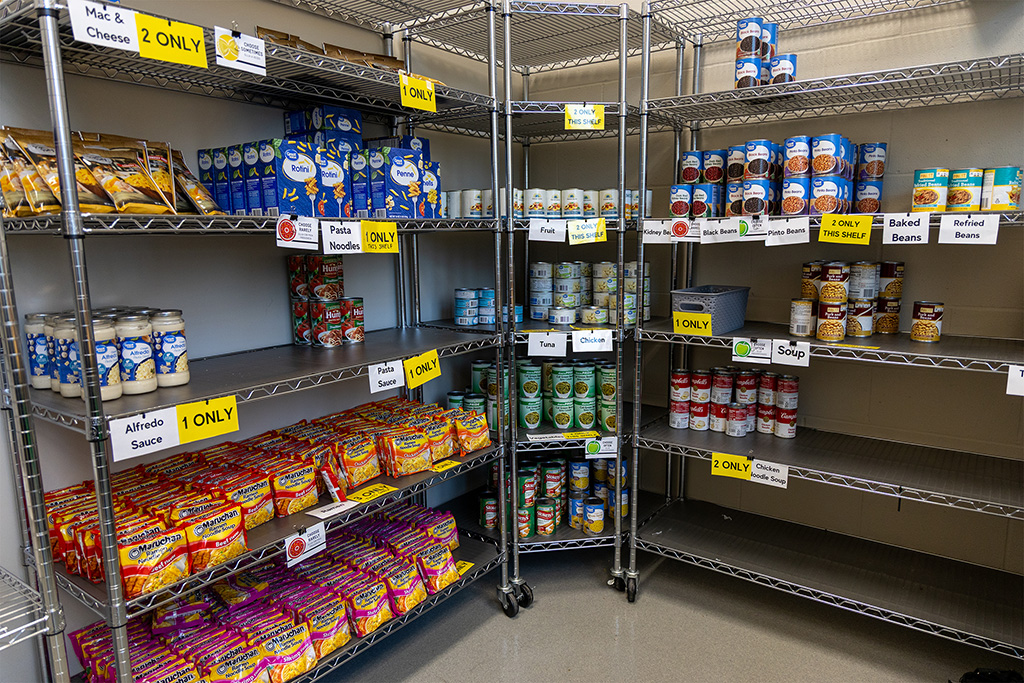
So do cans of chicken and tuna — shelf-stable proteins that can turn a box of pasta or a packet of ramen into something that lasts. At UND’s Food For Thought food pantry in the Memorial Union, those patterns show up again and again, said Kristi Okerlund, director of Student Involvement.
This points to a reality that’s easy to miss in everyday campus life: Many students are quietly trying to make it through the semester without reliable access to nutrient-dense food. Nathaniel Johnson, assistant professor of nutrition and dietetics at the College of Nursing and Professional Disciplines, says the problem is becoming harder to ignore.
“With increased cost of living across the board and increased educational costs, college kids are at increased risk of food insecurity,” said Johnson. In fact, a quarter to a third of UND students experience food insecurity.
To help meet that need, UND’s College of Nursing & Professional Disciplines (CNPD) is bringing back the Pack the Pantry Campus Challenge, a campuswide competition running Feb. 19 through March 5, 2026, inviting departments, colleges, student groups and self-created teams to collect pantry items and raise funds for students who rely on Food For Thought.
Last year, plastic bins sat outside department suites and were gradually filled with cooking supplies, toiletries and other essentials. The UND community showed they were eager to help as teams collected 3,594 items and raised more than $4,325 in online donations.
A new perspective on food insecurity
When Johnson talks about food insecurity among college students, he’s careful to explain that it doesn’t always look like skipped meals.
“In United States or Western food insecurity, usually you don’t see a decrease in calories,” Johnson said. “You see unhealthy eating behaviors and a high reliance on processed foods.”
A student might get “enough” calories, but still miss the nutrients that support health, energy and concentration — including fiber, protein and micronutrients.
“If you’re only eating processed foods, you’re going to get enough calories,” Johnson said, “but are you getting enough nutrients that are actually going to benefit your health? The answer is, really no.”
Johnson also emphasizes the importance of what he calls food agency — the mix of kitchen skills, nutrition knowledge and access to equipment — another common barrier even when students have some financial resources.
“If you’re living in a dorm, what equipment do you have to cook?” Johnson said. “You can’t have a hot plate, so maybe you use a microwave. But then your dietary choices are limited to microwave foods, and you still struggle to meet nutrition needs.”
Even students with meal plans can run into food insecurity, Johnson added, depending on work schedules, activities and dining center hours.
“You can have a meal plan and be food insecure depending on your job or your activities, and when the meal centers are open,” Johnson said.
The Food for Thought pantry serves as a supplemental resource for these students, allowing better access to nutritious food. And the impact is bigger than one might expect.
Food for thought – literally
One of the most significant impacts of food insecurity in student populations, Johnson said, shows up in the classroom.
“We found in our research that students who are food insecure, generally speaking, have lower GPAs,”: he said. The lack of crucial nutrients can cause issues with concentration, memory and energy.
Okerlund compared the effects to sleep deprivation.
“You cannot be academically successful when you’re hungry,” she said. “Just like if you and I didn’t sleep well, things are just more difficult. if you haven’t eaten a good meal for four days, studying and learning becomes really hard.”
To better understand how to ensure student success, the pantry tracks broad demographic information — not to monitor individual students, Okerlund emphasized, but to see where needs are concentrated.
“It’s not to say, ‘Oh, this student has come to the food pantry 20 times,’” Okerlund said. “But it’s really being able to look at those demographics … what are the most common majors using the food pantry? Or what level of school are they at? Or how can we best work with the colleges?”
The pantry uses this data to work with colleges and make sure vulnerable populations know about available resources. Okerlund says it seems to be working, as they see a steady increase in students visiting the pantry.
A pantry in just the right place
Food For Thought opened in April 2018 with a $5,000 allocation from Student Government, and demand has grown steadily since then. In the fall semester, the pantry recorded thousands of visits from hundreds of unique students, Okerlund said — and even then, she believes many students who need support still aren’t coming in.
That’s part of why the pantry’s location matters.
‘When this building was designed, we wanted the food pantry to be right on the main floor for easy access,’ Okerlund said. ‘But it’s also right next to an entrance, so that if a student doesn’t want to be highly visible using the pantry, there’s a quick way out so they’re not noticed.’
The pantry is located on the first floor of the Memorial Union in Room 138 and is open Monday through Friday, 8 a.m. to 4 p.m., with student employees available to help.
What students need
Usage data also helps pantry staff understand what students need most. Meat is a pricier item, so canned chicken and tuna fly off the shelves.
“Canned chicken and tuna are still good protein. There’s good nutritional value in it. It’s the same with beans,” Okerlund said.
Cooking oil also goes quickly — one of those staple items that’s easy to overlook until you don’t have it.
The pantry stocks familiar student staples like ramen, too, while also encouraging students to “build it up” with proteins and vegetables when they can.
“If they mix it with some of those proteins or add black beans and some vegetables, the nutritional value really grows,” Okerlund said.
How to help fight food insecurity at UND
The Pack the Pantry Campus Challenge runs Feb. 19 through March 5, 2026. Teams earn points by donating physical items or contributing financial online gifts earmarked for the pantry — one item or one dollar equals one point — with a traveling trophy awarded to the l top team.
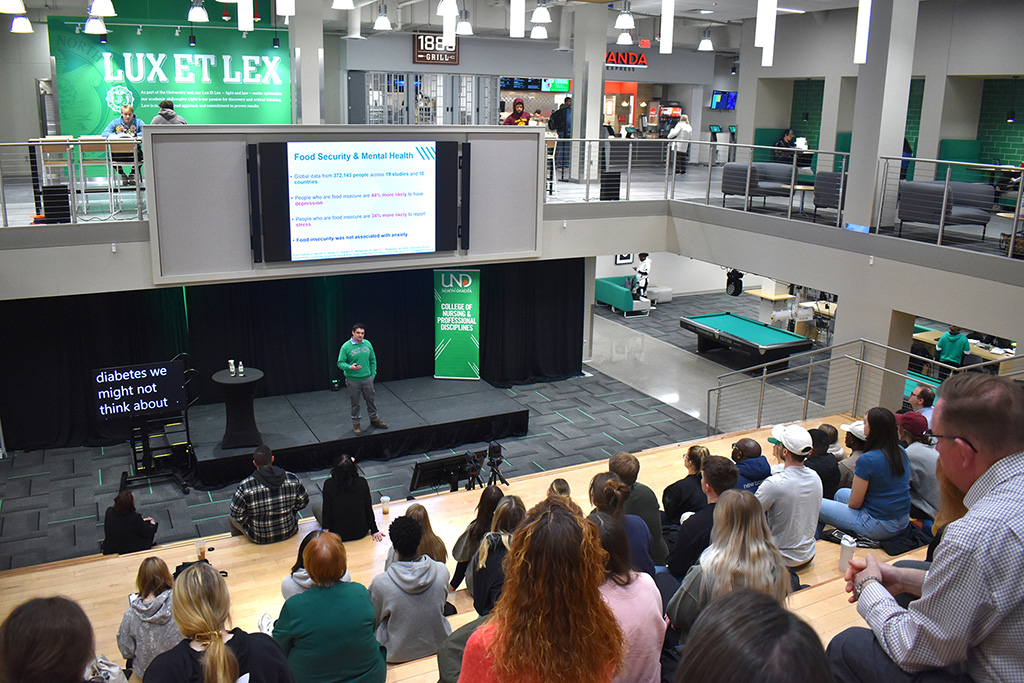
The challenge also includes a chance to learn more about the issue behind the donations. CNPD will host a Feeding Futures Presentation on Feb. 26 at 2 p.m. on the Social Stairs in the Memorial Union, featuring short talks from faculty and student leaders in Nutrition & Dietetics, Nursing and Social Work on how food insecurity affects student well-being, mental health, financial health and academic success. Guests are encouraged to bring donations.
Most-needed items include white rice, vegetable oil, peanut butter and jelly, canned tuna/chicken/fruit/vegetables, cereal, pasta and pasta sauce, plus hygiene items like shampoo, dish soap, body wash, toilet paper, paper towels, toothbrushes/toothpaste, feminine hygiene items and laundry soap.
Online donations are especially helpful because funds can be used to purchase perishables like lunch meat, dairy, eggs and bread.
Pack the Pantry registration is open for 2026, and those interested in making online donations can visit the pantry’s donation page.
“If anybody has questions or they want to donate or do a food drive — even if it’s with a community organization — we will never say no,” Okerlund said.