Teaching across borders at UND
Educators from 23 countries worldwide connect, learn how to sharpen students’ critical thinking skills through Fulbright program
The first thing Bojan Kitanovic did in Grand Forks was walk. He arrived a day ahead of his peers — thanks to a flight shuffle — and set off from the UND apartments without a map or a plan, tracing an accidental loop that took him past Sertoma Park, over to Columbia Mall and back again.
“Coming from Europe, the first thing I noticed was the vastness of the country,” Kitanovic said. “The city is so spacious. The roads are so wide. There are fewer people, so it is very calm — and you see far more nature than buildings and skyscrapers. I felt like I was taking a (leisurely) river walk.”
That was until he came upon his first signal light.
“I didn’t know what to do. ‘Can I pass here or not?’ Then, I was introduced to the ‘WAIT,’” he said with a chuckle and mechanical inflection in his voice. “Even though everything was new to me, once I experienced it, it somehow all made sense.”
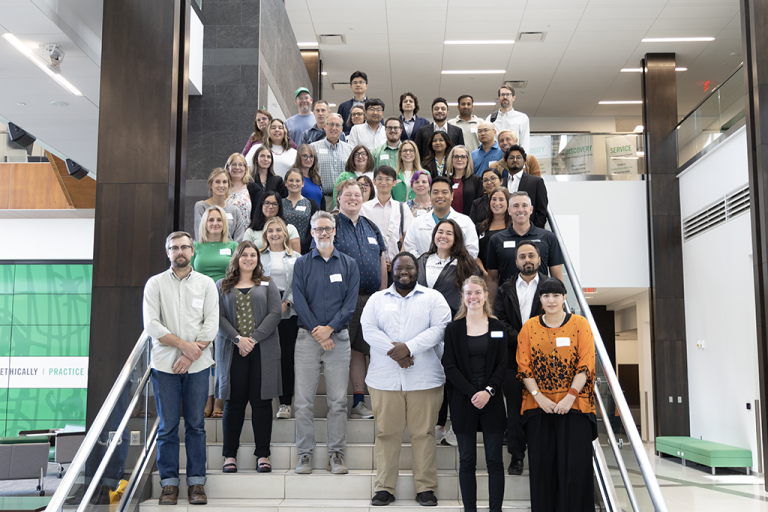
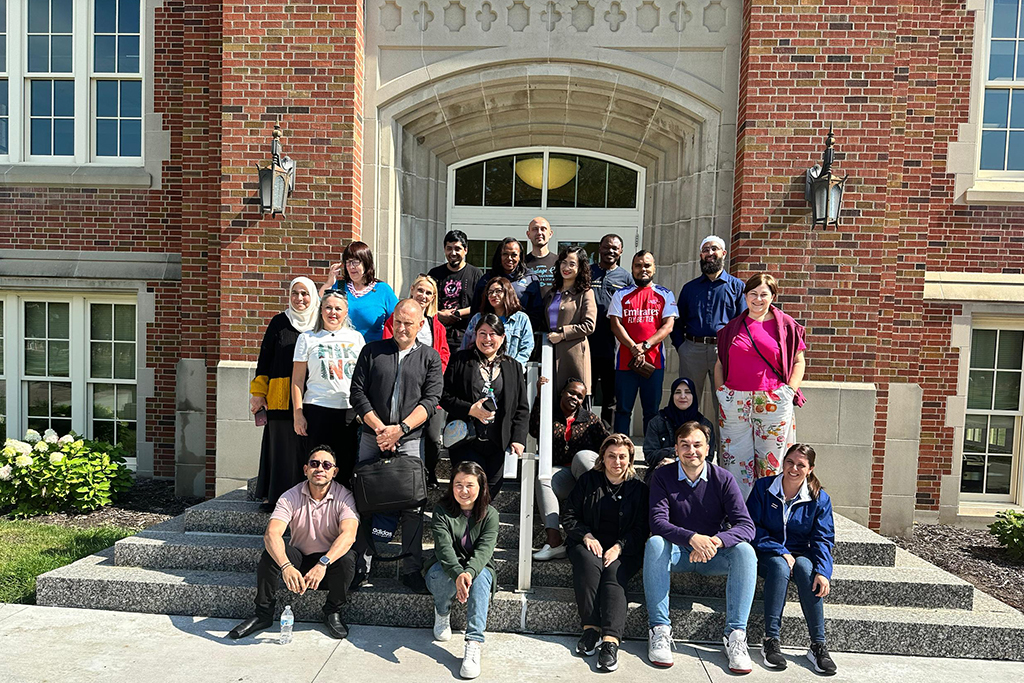
A similar sense of discovery defined the seven weeks that Kitanovic and 22 other educators spent at the University of North Dakota as part of the Fulbright Teaching Excellence and Achievement program.
Representing 23 different countries, the teachers came for a six-week, nondegree professional development experience that turned into something more: a study in how classrooms — and communities — change when ideas cross borders.
“Our teachers and students in Grand Forks have the chance to see education through a global lens,” said Donna Pearson, project director and professor in Teaching, Leadership & Professional Practice within UND’s College of Education and Human Development. “That perspective strengthens our own classrooms.”
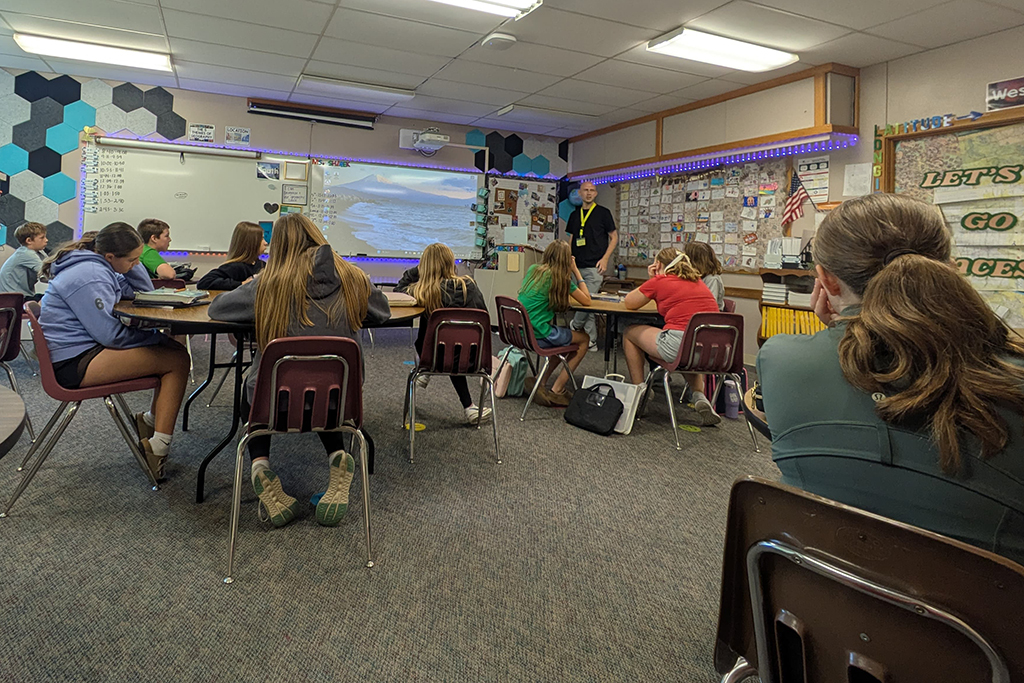
UND was one of only eight U.S. universities to host a Fulbright TEA cohort this year. Under Pearson’s leadership, UND also serves as the group’s Information Analysis center, a role led in the classroom by TLPP colleague and Associate Professor Chris Clark. Other TLPP colleagues also played important roles. Assistant Professor Tony Perry guided technology integration, Assistant Professor Logan Rutten and Associate Professor Tao Wang led methodology instruction, while Pearson herself focused on cultural communication. The schedule was intense: six academic weeks on campus threaded with civic and cultural activities — and one full week embedded in Grand Forks Public Schools, where the visitors logged more than 40 hours observing and co-teaching across six schools.
A precise focus: Information analysis
During a roundtable, visiting teachers referenced “media literacy” as a major draw. Pearson gently reframed the term.
“For this cohort, information analysis is the focus,” she explained. “It means evaluating information from print, audio, video or speech — asking what’s credible, what fits together and how we use it to understand the present. It’s critical thinking applied to the information environments our students live in.”
For Kitanovic, a philosophy teacher from Serbia who also teaches the International Baccalaureate’s Theory of Knowledge, the emphasis clicked immediately.
“Critical thinking is my world,” he said. “But in my country there’s no mandatory course in information analysis. I want to take workshops home for colleagues and students. In the 21st century, it’s of utmost importance.”
What visiting teachers noticed first
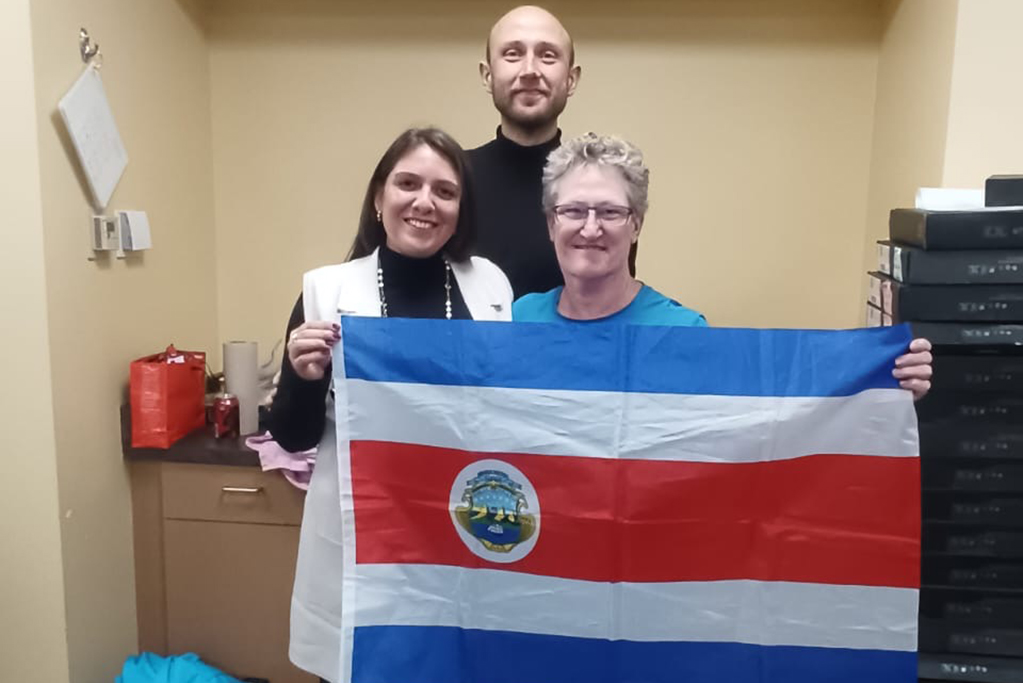
Costa Rican English teacher Daniela Arroyo came with two goals: to deepen her skills in information analysis and technology and to learn how other countries structure classrooms.
She found both. At Valley Middle School she was struck by something deceptively simple: daily team meetings.
“Every grade-level team sits down — every day,” she said. “They talk about discipline, about special needs, about who might need extra social-emotional support. It means everyone is on the same page for the same child. I want to persuade my principal to do this regularly. Maybe not daily at first, but consistently.”
Kitanovic saw the same practice at another school and connected it to something philosophy teachers talk about all the time: consistency.
“When teachers talk, students can’t fall through the cracks,” he said. “Problems aren’t just ‘my class’ or ‘your class.’ They belong to all of us.”
Other differences jumped out, too. Arroyo loved the small-group seating and purposeful traffic flow — the way students seemed to know where to walk and when between classes. And Kitanovic raved about rooms with multiple whiteboards: “If I’m running group work, each group can claim a board. It’s democratic. Students reason together, and the room shows their thinking.”
And then there were the labs. Arroyo visited a biology class and watched students test ideas with their hands, not just their eyes.
“In many of our public schools, we don’t have that equipment,” she said. “You show a video, you describe an experiment, and students imagine it. Here, they get the full experience — moving, manipulating, experimenting. It really helps foster that learning.”
Gamified thinking — and the moment a definition becomes theirs
In a geography class he co-taught, Kitanovic watched an elegant bit of game-based learning unfold. Students worked through a digital quest in stages they could unlock only by answering conceptual questions. The day’s target was the difference between absolute and relative location. Before anyone looked up a definition, the teacher seeded examples:
Where do you live?
“Across from Mike’s house.” Relative.
What’s the school’s address?
A fixed point. Absolute.
“Students arrived at the definitions by reasoning,” Kitanovic said. “If a teacher just gives it, the definition evaporates after class. But when they discover it, they remember.”

Systems, certification — and the gravity of constraints
Comparisons often say as much about systems as they do about classrooms. In Serbia, Kitanovic noted, a person with a degree in philosophy teaches philosophy; to teach sociology or geography would require another five years of formal training. In North Dakota, a social studies certification can cover multiple subjects — opening job possibilities and easing staffing needs.
Arroyo’s comparison was more personal. In Costa Rica’s public schools, special-needs students attend general classes, and teachers like her are responsible for individualized plans.
“This year I have 90 students and a third of them with curriculum accommodations,” she said. “If a student requires a specific test, I must write a separate one. Sometimes that’s 30 different lesson plans and 27 versions of the test on top of the first one. With large class sizes, you do everything you can — but it comes to a point where it’s impossible for us.”
At the schools the Fulbright teachers visited here, Arroyo noticed that classroom aides were dedicated to students with special needs.
“A helping teacher supports the student and the classroom teacher,” she said. “That’s a very big difference.”
Learning from North Dakota — and being welcomed by it
It wasn’t all classrooms and coursework. On free days, small groups traveled to Duluth and explored more of the region. In town, a browse through TJ Maxx turned into a networking moment when Arroyo met another university’s international student director.
“We exchanged emails,” she said. “We talked about future projects. People have been so welcoming.”
Kitanovic felt it everywhere: on campus, downtown, even on those long walks when strangers became guides.
“There’s a phrase, ‘No place like home,’” he said. “But I learned something else here: It’s not blood that binds the family; community does. Because of the people, I felt like I had family on the other side of the world.”
That sense of belonging extended to UND itself. Arroyo laughed about how much a good meal matters — and how often she found one at Wilkerson Commons.
“Food is important,” she said. “There’s variety that respects different cultures. It makes you feel considered.”
The Memorial Union, meanwhile, stunned her. “We don’t have something like that — a beautiful, open place to study, meet, belong. It told me the University really takes care of its students.”
Seeds for what comes next
The Fulbright TEA model assumes the deepest change happens after the flight home. Both visiting teachers talked about small, steady steps.
Arroyo wants to formalize weekly team meetings and pilot video-based assessments in her English classes — short recordings students make themselves, reducing anxiety and increasing authentic language use.
She’ll keep championing collaborative seating and, whenever possible, hands-on labs. And she’s thinking bigger: “I feel inspired to keep studying,” she said. “I have a master’s now, but I want to pursue a Ph.D. — maybe even online with UND.”
Kitanovic imagines an information-analysis workshop series for colleagues and students, adapted to older teens. He wants to keep building game-based reasoning activities and, perhaps more important, keep building bridges.
“People often talk about big global problems,” he said. “I try to start local — clean our own garden, as we say. One activity in one classroom becomes two, then four. You raise awareness; then you make change.”
Pearson sees that arc clearly. “We’ve planted seeds here,” she said. “These teachers will carry new ideas into classrooms around the world — and UND will always be part of that story.”
A celebration — and a beginning
The formal close to the Fulbright TEA experience came with handshakes, shared photos and a few last laughs — but the real ending is still unfolding. The weeks at UND were never meant to be a conclusion so much as a crossing point, a place where ideas gathered momentum before moving outward again.
For the visiting educators, the work continues in classrooms shaped by what they saw here: more collaboration, more attention to how information is evaluated, more intention in how students think together. For UND, the impact lives on in partnerships sustained, perspectives widened and the confidence that global education doesn’t require a huge city — only openness.
Pearson sees that continuation as the program’s true measure of success. “What matters most is what happens next,” she said. “These teachers return home with practical tools but also with relationships. That’s where the real exchange lives — in ongoing conversation, shared problem-solving and mutual respect.”
Back in Grand Forks, Kitanovic’s first walk still says something about the experience as a whole. What began without a map became a loop — outward into unfamiliar space, then back with new understanding. It’s the same path Fulbright traces each year: teachers arrive curious, leave connected and carry a sense of place with them long after they’ve gone.
Wide-open roads. Classroom conversations. Ideas crossing borders. Somehow, it all makes sense.