AI in music, AI in art
UND grad students explore how artificial intelligence can contribute to — and maybe even improve — the creative arts
By Madison Dame
Artificial Intelligence is everywhere now, but have your ever thought about using it to improve your singing or your art?
Zhongling Zhang, a UND doctoral student in Music Education; Justin Montigne, assistant professor of Music; and Master of Visual Arts student Ryan Johnson have.
Here’s how.
‘Who am I when I sing with AI?’
Seeing that AI would be a big part of the future, Zhang and Montigne set out to understand how the technology could help with understanding vocals and training people who might not have time to take voice lessons in person.
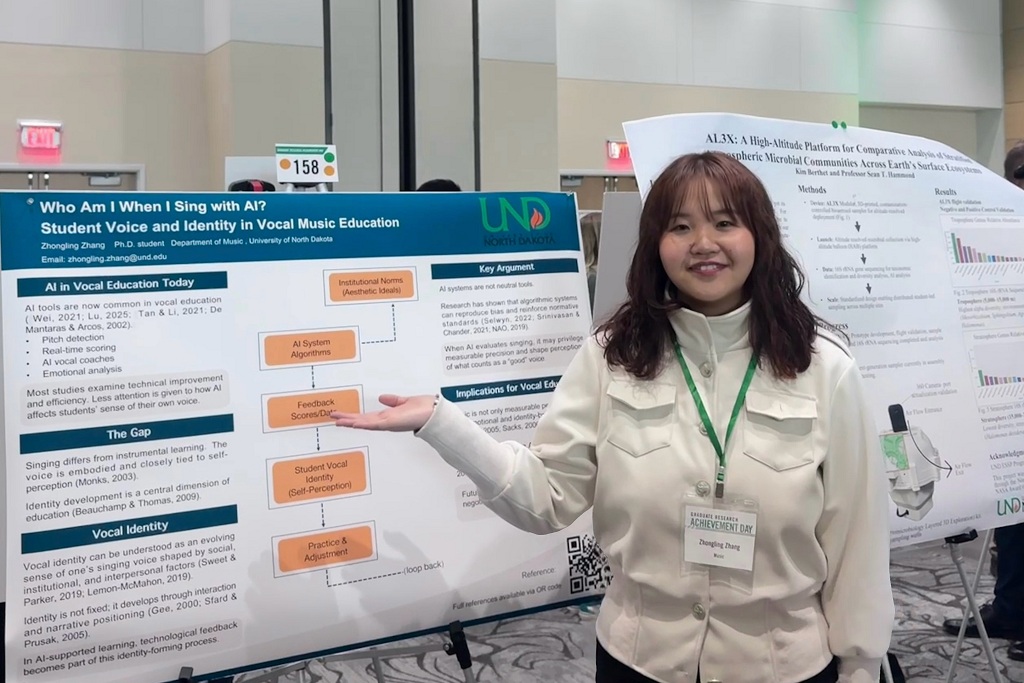
As Zhang titled the poster presenting her research at the UND GRAD or Graduate Research Achievement Day event in March, “Who am I when I sing with AI?”
The proposal just got approved by UND’s Institutional Review Board, a requirement for all research that involves human subjects. Now, Zhang and Montigne are ready to proceed with their research and just need funding to do so.
For this project, Zhang and Montigne would need to recruit about 35 to 40 students from public middle and high schools. To take part, the students would agree to practice singing on an app with an AI coach two to three times a week for 10 to 12 weeks.
Every week, the students would also write reflections and/or share their thoughts in small groups.
Zhang said she’s excited about being able to interact with students. “It’ll be fun to go into the public schools and be face to face to talk to them,” she said.
Over time, learning more about AI in music could help improve K-12 and higher education, Zhang said.
“Personally, I think AI can improve equity by letting more students access high quality instruction,” she said. “That’s why I’d like to explore this topic.”
With a background as a vocalist, Zhang understands how time-consuming voice lessons can be. Moreover, getting a vocal coach can be expensive, she said.
An AI app could both minimize the time commitment and ease the financial strain.
Since starting the project, “I designed the whole research method,” Zhang said. “And, actually, I’m enjoying this part,” in addition to looking forward to visiting the schools.
In Zhang’s view, AI “can let more students access a high quality education,” she said. “And that’s true whether it relates to music or not.”
AI as an artist’s tool
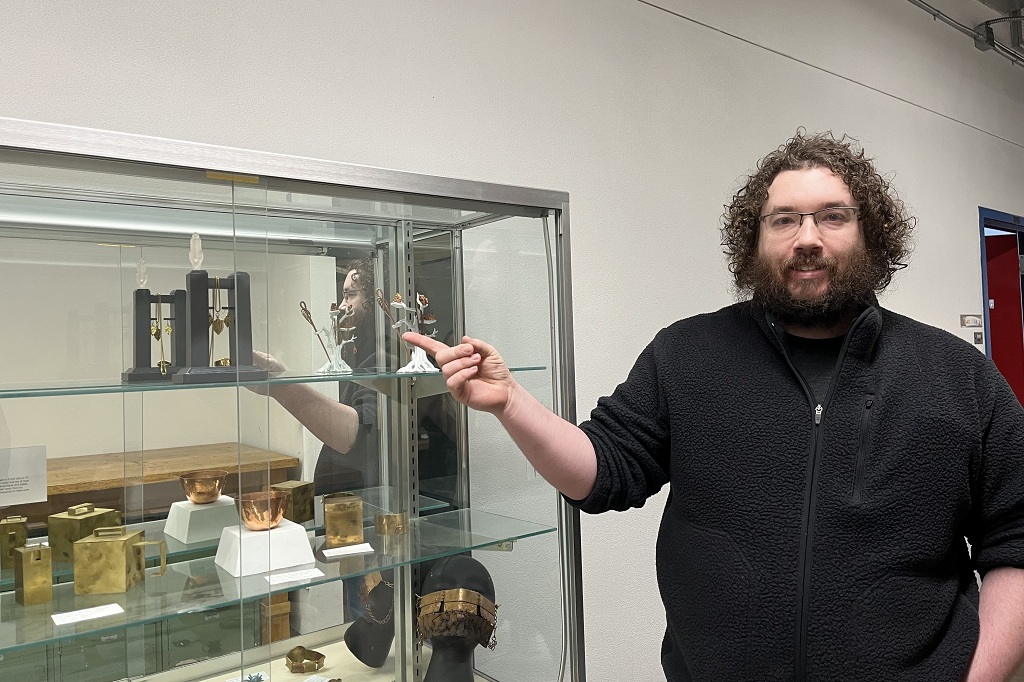
Music is not the only art form that can be affected by AI. Working with various mixed media, UND Master of Visual Arts student Ryan Johnson creates art via 3-D printing, virtual reality, jewelry making and more, and is beginning research on AI’s impact on those methods and activities.
“I was reading about this one artist. She took all her drawings and how she draws, and trained a drawing machine to draw like her,” he said. “When she’s drawing, she has the machine drawing with her. So, it’s trying for co-authorship of an art piece.”
Johnson said he applied something similar to his work by converting one of his drawings to Geometric code, which is the programming language used to operate 3D printers.
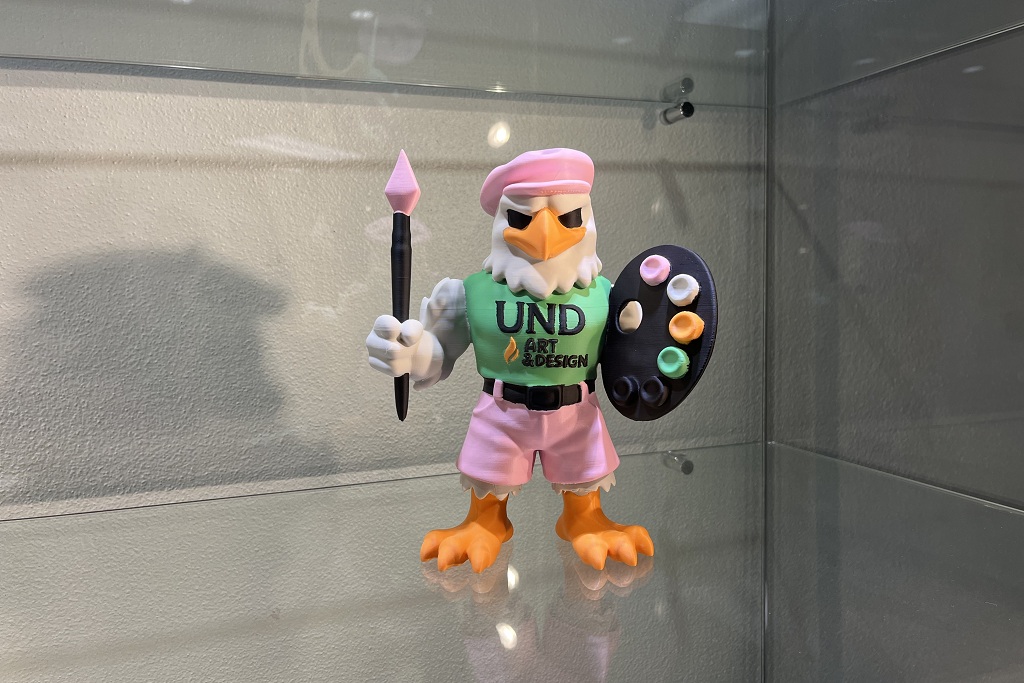
Speaking of 3D printing, you’ll find it in abundance in the “Fab Lab,” as Johnson calls his studio. The Fab or Fabrication Lab also holds various types of machinery, including a 3D printer, a laser cutter, Meta VR goggles and more. Dozens of figures that Johnson had 3D printed line a countertop by the 3D printer.
In addition to 3D printing, Johnson also uses a Meta Quest Virtual Reality headset to help with things such as virtual art shows, The process calls for scanning a gallery display, and by doing so, allowing people to view the art show long after the “real world” version has been taken down.
By the way, when information and data are uploaded to those sites, the person doing the uploading no longer owns that data, Johnson noted. So, when using AI, make sure you know who owns and has access to that data, Johnson says – because you never know what someone else may do with it.
As Zhang and Johnson’s examples make clear, AI is becoming a part of almost all academic endeavors, now very much including music and art. So how about communication, including such tasks as the writing of this story for UND Today?
Only the writer and Sam Altman know for sure.
About the author:
Madison Dame is a graduate student in Communication at UND.