Early Career Scholars Program sets new record
The number of research projects increased this year, as did external funding, published papers and conference appearances
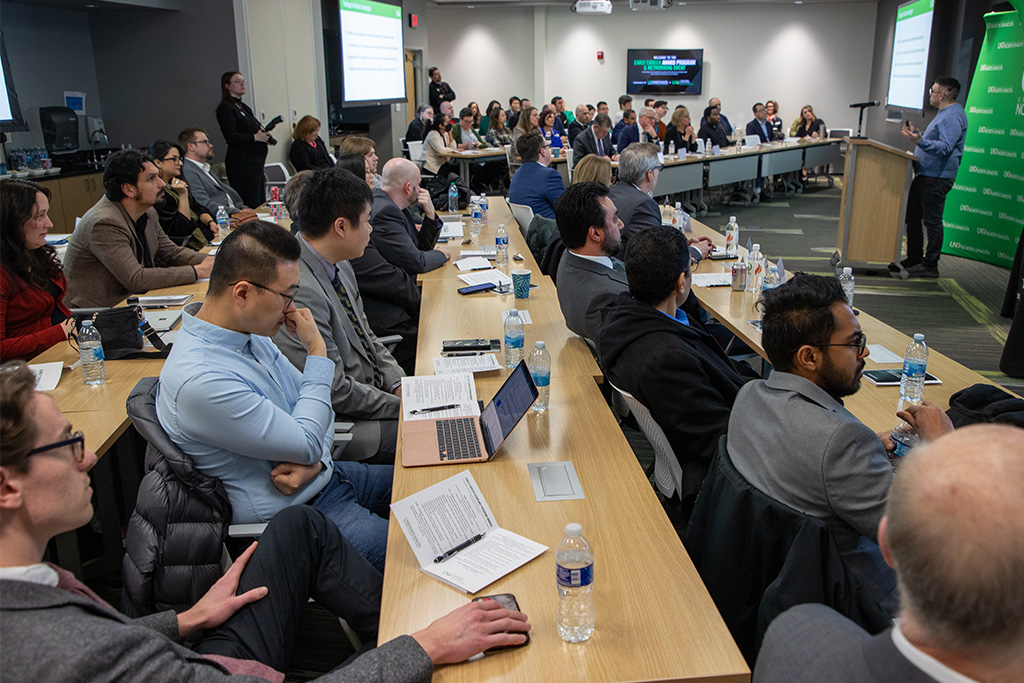
The University of North Dakota’s Early Career Scholars Program hit a new milestone this year, as faculty and mentors gathered to celebrate a record-setting cohort — and to hear what can happen when new researchers are given time, support and the freedom to collaborate across disciplines.
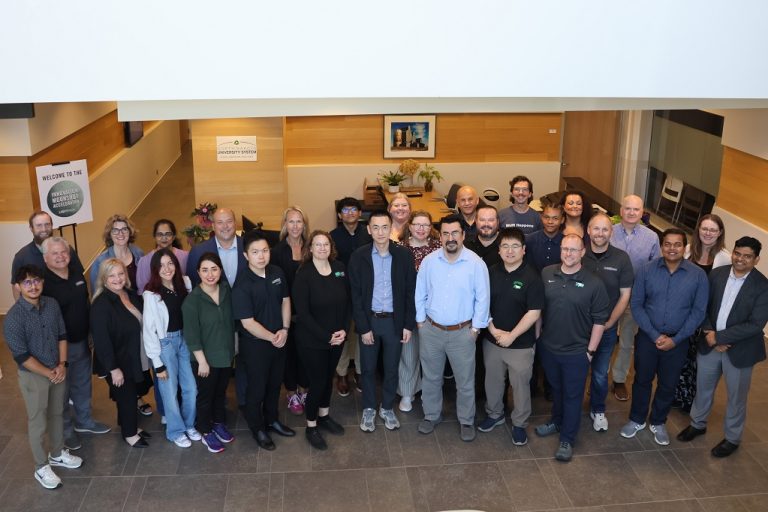
The annual ceremony took place in the UND Core Technology Services building, the new home for the Division of Research & Economic Development. At the event, scholars, mentors and campus leaders recognized the 2025 cohort’s work and welcomed the incoming 2026 group.
The Early Career Scholars Program pairs early-career faculty with experienced mentors and encourages cross-collegiate teams, with the goal of accelerating research trajectories, building lasting collaborations and positioning teams for publications and external funding. The program — now in its fourth year — funded a record number of projects this cycle.
A celebration of discovery — and the community behind it
UND President Andrew Armacost told attendees the energy in the room was hard to miss, pointing to the sense of commitment and shared purpose that comes with research and discovery — and the way mentorship and collaboration help keep that work from becoming isolating. He also tossed aside his notes, to speak off the cuff.
“Literally, I was writing notes for what I wanted to say,” Armacost said. “When I walk into a room, sometimes I just get a feeling. You just feel the energy in the room and what you had prepared – which were some prefab notes – don’t really cut it. And what I feel in this room is a sense of passion, a sense of commitment to something really big.”
Armacost thanked organizers from the office of the Vice President for Research & Economic Development, as well as Michael Mann and Thomasine Heitkamp, both research developers in the office, and said he was proud to be a part of the celebratory event.
“I’m delighted to be here. I’m proud to be your president, and I’m certainly proud of the work that you do to push that sense of discovery on our campus,” he said. “Thank you so much.”
Vice President for Research & Economic Development Scott Snyder framed his remarks around the theme he said has defined UND this year: community.
“That’s what we have here: community,” he said. “We’re all here to celebrate that sense of discovery, that sense of wonder,” both of which are central to the UND LEADS strategic plan.
Snyder also highlighted the program’s year-over-year growth — both in the number of projects funded and in the diversity of disciplines represented — and thanked the mentors whose time and guidance make the model work.
“We had four projects that were funded in Year One, we had six projects funded in Year Two, we had eight projects funded last year and a record 10 projects this year, involving 18 early career scholars and 10 mentors,” he said.
Building momentum — with measurable outcomes
Beyond the celebration, Snyder pointed to outcomes that continue to build across cohorts: manuscripts and conference presentations, proposals submitted for external support, and follow-on awards that expand the original seed investment.
Snyder noted that early cohorts are already producing significant external returns, with externally funded research awards exceeding $1 million tied to prior scholars’ work — a figure expected to grow as later cohorts mature.
“This program to date has been exceptionally successful with numerous professional publications, articles have been accepted for publication or currently in preparation for publication, external proposals that have resulted from some of the research that has been conducted, and well over a million dollars in externally funded research discovery projects,” he said.
From culverts and fish to AI, hypersonics and weather electrification
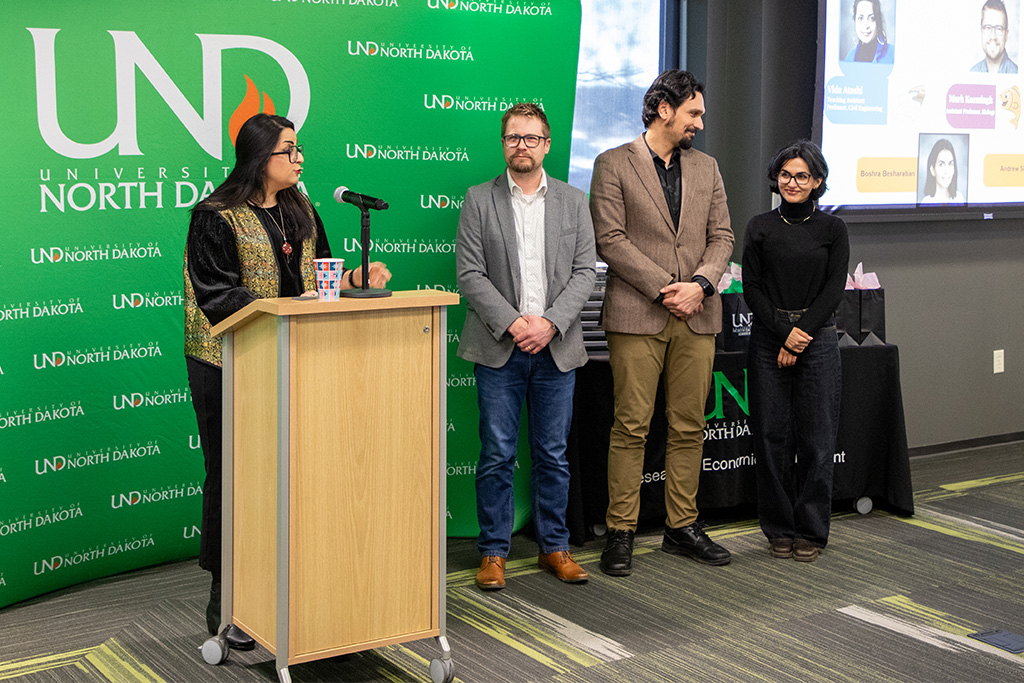
This year’s presentations offered a snapshot of the program’s range — from infrastructure and ecology to cybersecurity, communication research and atmospheric science.
One team described an interdisciplinary effort connecting roads, waterways and fish passage — using scalable detection approaches to identify culvert problems, while exploring cost-effective engineering solutions that could improve fish populations without requiring a costly full culvert replacement. This work also emphasized student involvement and new external partnerships that emerged during the year.
“Part of our job is mentoring and training students, because as a university, we’d like to pass knowledge to other generations,” said Vida Atrashi, teaching assistant professor of Civil Engineering.
In engineering and applied AI, scholars presented work aimed at proactive roadway safety assessment using machine vision — extracting vehicle trajectories from intersection video and evaluating “surrogate” safety measures that can flag risks before crashes occur.
Meanwhile, a hypersonics-focused team described optical diagnostic coatings that turn high-speed imaging into “global” measurement tools — capturing complex flow physics in ways traditional point sensors can’t, while generating follow-on proposal activity.
And in atmospheric sciences, a team shared early results from newly deployed surface electric field measurement stations — creating a dataset not previously collected in the Northern Plains, with applications spanning fog, blowing snow and blowing dust events.
Bryant Smalley, who oversees the Early Careers Scholars Program in his role as associate vice president for Research & Discovery Development, beckoned the capacity crowd in the Core Technology building to give a round of applause to the scholars.
“It’s incredible to see what the 2025 cohort has achieved,” he said. “And what’s even more impressive is that all of these accomplishments happened in just one year. We’re all very excited to see what the 2026 cohort will achieve as well.”
Smalley then assisted in handing out congratulatory plaques to each research team, as they posed for photos with the president, Vice President Snyder and Provost Eric Link.
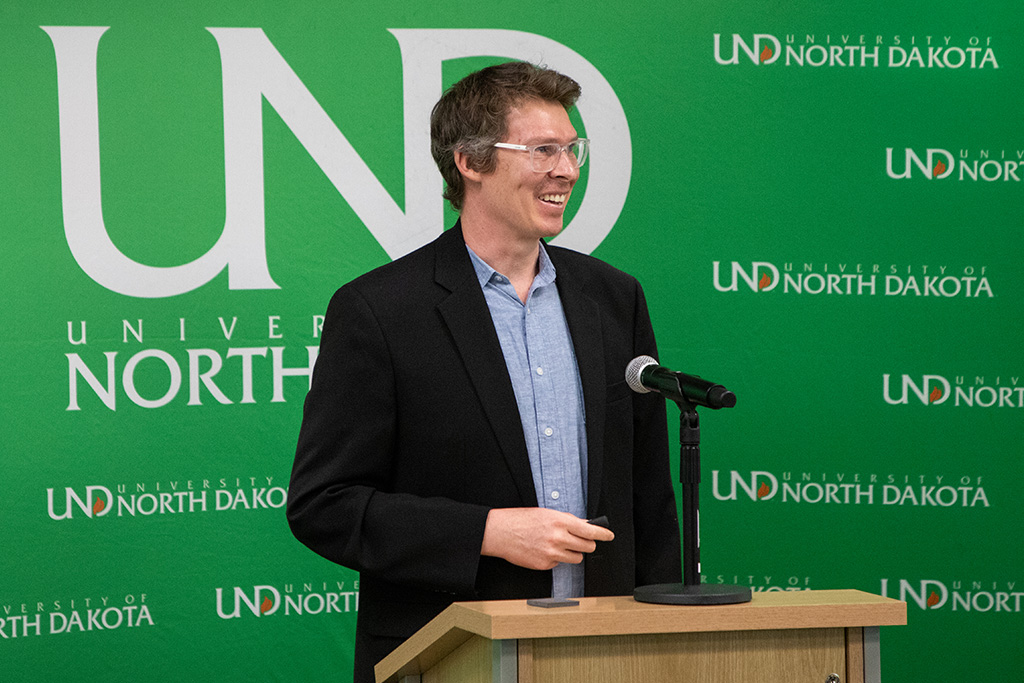
2025 Early Career Scholars award recipients
GIS Mapping Culverts and Fish Species in the Red River Basin of the North
- Vida Atashi (PI), Civil Engineering
- Mark Kaemingk (Co-PI), Biology
- Sattar Dorafshan (Co-PI), Civil Engineering
- Taufique Mahmood (Mentor), Geology and Geological Engineering
Perovskite Nanocrystal Photocatalysts for Reducing Carbon Dioxide Emissions
- Jesse Caviasca (PI), CPER
- Maria Morrell (Co-PI), Chemical Engineering
- Johannes van der Watt (Co-PI), CPER
- Daniel Laudal (Mentor), CPER
Proactive Traffic Safety Assessment at High-Risk Intersections using Machine Vision Applications
- Sherif Gaweesh (PI), Civil Engineering
- Ahmed Abdelhadi (Co-PI), Electrical Engineering and Computer Science
- Daba Gedafa (Mentor), Civil Engineering
Novel Measurement Diagnostics for Experimental Hypersonics
- Carson Running (PI), Mechanical Engineering
- Binglin Sui (Co-PI), Chemistry
- Clement Tang (Mentor), Mechanical Engineering
Towards HPC-Powered Autonomous and Adaptive Host Anomaly Behavior Analysis System
- Sicong Shao (PI), Electrical Engineering and Computer Science
- Tingjun Lei (Co-PI), Electrical Engineering and Computer Science
- Chonglin Zhang (Co-PI), Mechanical Engineering
- Prakash Ranganathan (Mentor), Electrical Engineering and Computer Science
Carbon Lowering Efforts in Agriculture using New Effective Methods (CLEAN-EM)
- Johannes van der Watt (PI), CEMRI
- Tarek Elderini (Co-PI), Electrical Engineering and Computer Science
- Clement Tang (Mentor), Mechanical Engineering
- Derek Sporbert (Mentor), TRIO Programs
Intensifying Polarization and Hostility? Analyzing Media Coverage of Politicians’ Discourse Using Artificial Intelligence
- Xudong Yu (PI), Communication
- Jielun Zhang (Co-PI), Electrical Engineering and Computer Science
- Naima Kaabouch (Mentor), Electrical Engineering and Computer Science
Linking Electric Field Measurements and Fog Events – Investigating a Novel Approach to Enhance Fog Weather Prediction
- Daile Zhang (PI), Atmospheric Sciences
- Shawn Wagner (Co-PI), Atmospheric Sciences
- Dave Delene (Mentor), Atmospheric Sciences
Editor’s note: Information on the 2026 Early Career Scholars cohort will soon be forthcoming.