A math mind’s view on leadership
Professor and chair of Mathematics at UND, Ryan Zerr, joins 18:83 Speaker Series for talk about career lessons
Is leadership a turbulent weather system to navigate? Is it unpredictable, or perhaps stormy?
Or is the practice of leadership something that can be boiled down to a mathematical equation? Is it a neat formula that can be applied repeatedly to reach the best results?
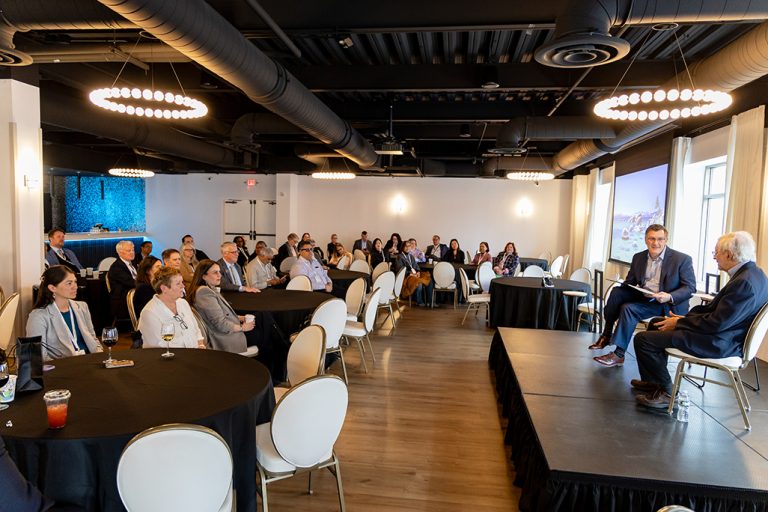
Ryan Zerr, standing on stage for the most recent installment of the 18:83 Speaker Series, rejected both premises for his talk on leadership — continuing the University’s year-round series inviting leaders from the campus and broader community to speak at the Memorial Union for around 18 minutes and 83 seconds, coinciding with UND’s founding year.
Given his undergraduate degree in atmospheric sciences and his graduate-and-onward focus on mathematics, he said he spent time considering the framing of those experiences. Both were found to miss the mark on the true leadership experience.
But, Zerr said, “There’s more that connects how mathematics is done and how good leadership is practiced than you might expect.”
Today, not only does he help lead UND’s Department of Mathematics as chair, but he serves as an associate vice president and co-chairs the UND Strategic Plan Implementation Committee.
As he grew from an “unlikely leader” in his undergraduate days to a far-reaching presence on UND’s campus, he picked up on the characteristics of leaders that make even the most turbulent situations navigable toward good outcomes.
Showing your work as a leader
“Things that I’ve tried to teach students about mathematics have also been important for how I see leadership,” Zerr remarked. “The characteristics embedded in what you might call my mathematical DNA have been critical in helping me lead effectively.”
So, what are the parallels if math is about abstract objects (numbers, shapes) and leadership is about people and organizations?
Math problems, he said, require clarity about the question in precise terms.
Most students have come across the stereotypical word problem: two trains are traveling at different speeds to a destination, etc.
To address this style of problem, there needs to be a clear setting — which direction, which destination? One also needs to know the goal — determining where those trains meet. There are also the constraints, such as the track only accommodating a single train, for instance.
“In the same way you need to know that problem precisely, a leader is going to create clarity about where you’re going and why it matters,” Zerr said.
“They’re able to understand the setting of the situation, articulate a goal and help navigate the path to the goal by addressing the constraints, whether they’re political, legal or cultural.”
He also likened steady leadership to the demands of the math instructor: showing your work.
People follow honest, fair leaders who can explain their thinking to get others on board. In math, showing how you work through the principles of arithmetic, or an equation, demonstrates believability. It’s about integrity and trustworthiness, he said.
“Success requires people knowing they can count on your actions being correct and believable,” Zerr said.
Good example to follow
Zerr went on to concede that not everything fits this parallel vision of leadership and math.
He spoke of an experience he had being nominated by a senior colleague for a committee leadership role, and how being noticed in that way was a surprise, at the time.
“Part of developing leadership toolkit relates to how you receive others’ support,” he said. “This characteristic isn’t about what you do, per se, but how mentorship can position you to grow into roles that may seem out of reach.”
He urged listeners to carry such moments forward in how they recognize others — to repay the trust others have offered them by doing the same down the line.
“Help those around you achieve their best,” Zerr said. “Make it easy for others to do their job well by helping them rise to high expectations.”
He also suggested giving praise and credit often while also creating empowering environments that give others a seat that the table, which in turn resist typical hierarchies.
Whether in a stormy or formulaic situation, remaining consistent, dependable, flexible and prepared to explain the purpose and direction of your actions will leave good examples for others to follow.
In turn, that will make you someone that others want to follow, Zerr said.
The next installment of the 18:83 Speaker Series will take place on April 8, featuring Tess Wall, director of Grand Forks Public Health.