Graduate student research shines at UND GRAD event
Projects and proposals go on display to show work and research of UND’s graduate students
By Michaela Richards
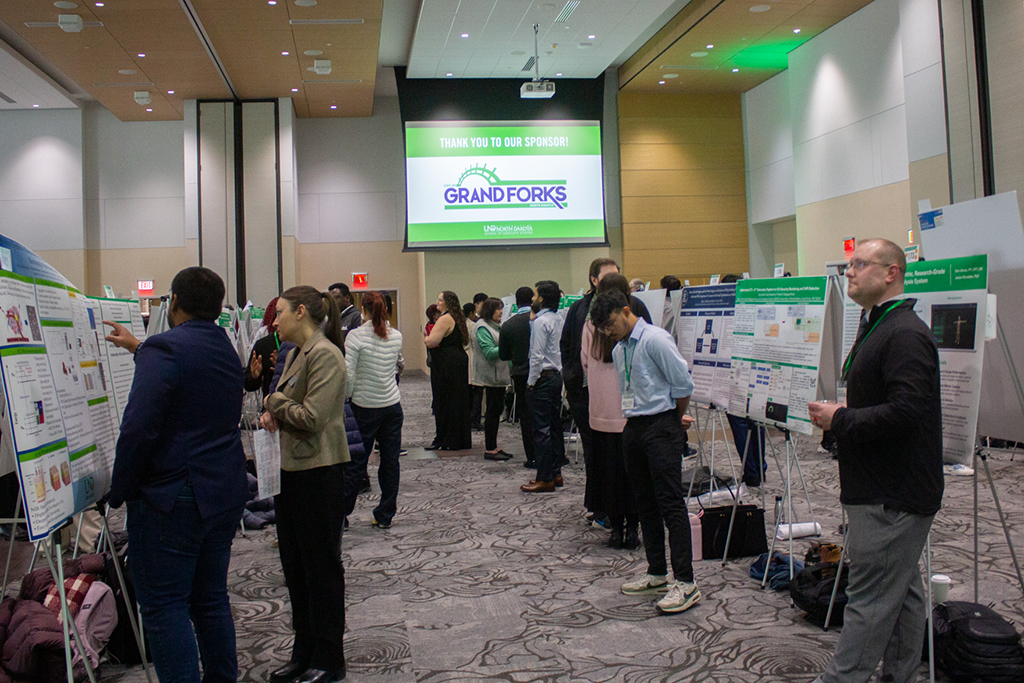
With topics ranging from species conservation to various uses of Artificial Intelligence, UND’s Graduate Research Achievement Day or GRAD showcase on March 5 displayed research from students in these areas and many more.
Online students also had the chance to present their research through GRAD’s virtual event on March 3. Students gave three-to-five-minute presentations for their posters, which were then judged by faculty.
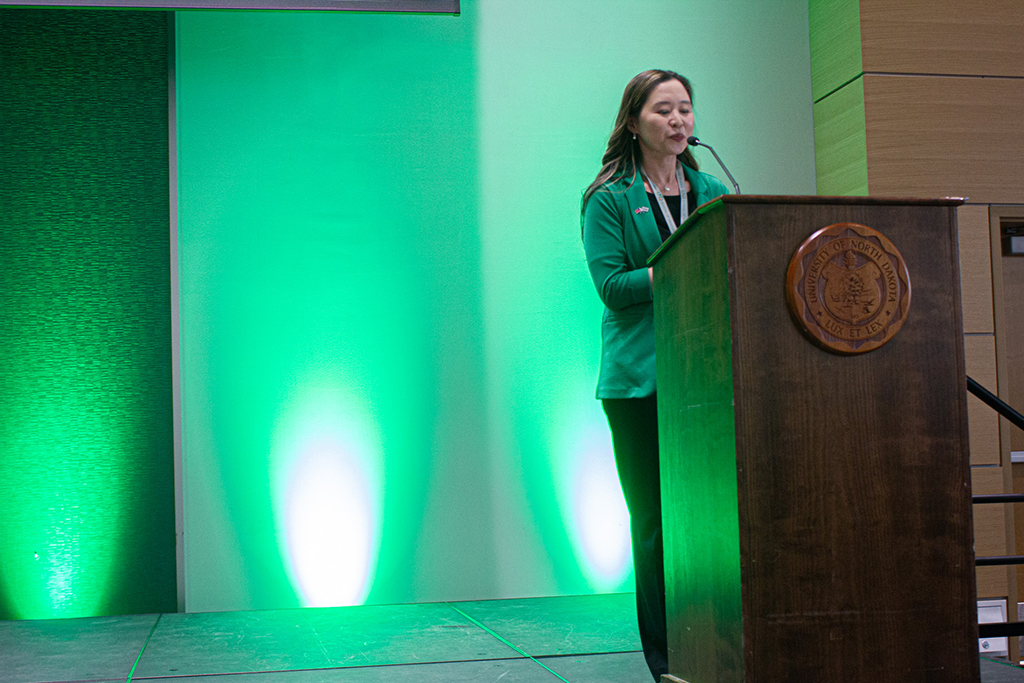
Donna Hastings and Chester Fritz Distinguished Professor Jonathan Geiger, a Grand Forks couple who are contributing sponsors for the event and originators of the Geiger & Hastings Excellence in Graduate Research Endowment, spoke at the event about why the GRAD showcase is important to UND and the Grand Forks community.
“I think it’s so wonderful to have all these students get to explain what they’re working so hard at and be able to defend what they’re doing,” Hastings said.
Geiger agreed, adding: “It’s also important to have it as an open forum like this, so that there’s cross-fertilization. We like how much fun it is to interact with the students and sense their enthusiasm for what they’re doing.”
The March 5 event was packed with more than 200 students, all of whom used poster boards to present their work in a way that attendees could understand and discuss.
“GRAD is a wonderful opportunity for our campus to celebrate the innovative research conducted by graduate students across every corner of UND,” said Soojung Kim, interim dean of the UND School of Graduate Studies.
“Graduate students often spend much of their time working within their labs or departmental spaces, with limited opportunities to engage with peers in other disciplines or general public. GRAD creates a space for meaningful interdisciplinary exchange and helps us appreciate the breadth and depth of our graduate research enterprise.”
Here are summaries of just a few of the research projects the UND grad students presented during the Graduate Research Achievement Day events.
Research in species conservation and habitat management
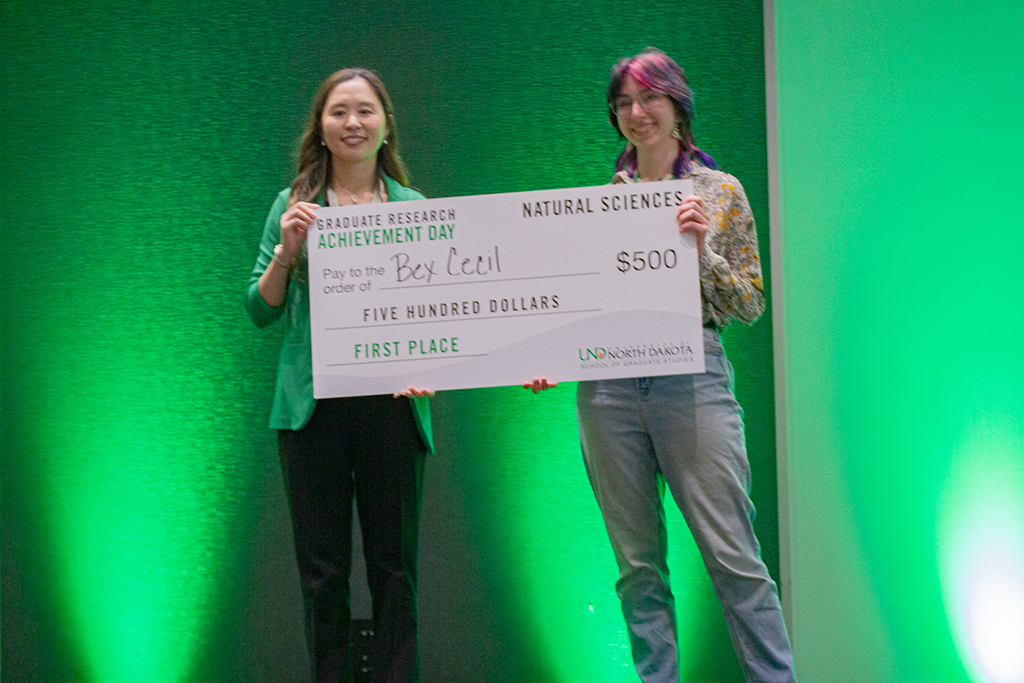
Bex Cecil, a UND Biology grad student and the first-place winner in the Natural Sciences category, described the importance of knowing the current state of our landscapes and the role of birds and other species in protecting them. To document this, Cecil is conducting a seasonal inventory of birds, mammals, plants and pollinators on a military landscape.
“We’re using both traditional and new techniques,” she said. “We’re doing point counts and other surveys. I’m walking out there with a net and literally catching butterflies and bees.”
Among other collection efforts as part of her inventory, Cecil recorded more than 8,000 hours of on-site audio, which was then validated through an AI classifier to help pick out various species and bird calls from the data.
Military lands cover a significant amount of the United States, and the sensitive habitats and wildlife they contain need to be managed for both military success and wildlife protection, Cecil explained.
“This is the baseline: in order to do any kind of management to improve habitats or make it better for species (especially species of concern or those that are endangered), you need to know what’s on the landscape and how to improve it,” she said.
Gardening with AI
Lacey Anderson, a Ph.D. candidate in Educational Foundations and Research and an adjunct faculty member in Sociology at UND, also dedicates her time to the GRO.UND Learning Gardens, which are run by Joshua Hunter and Cheryl Hunter, both faculty members in the College of Education and Human Development. The gardens are meant to be a space to not only grow fresh produce, but also teach others — especially young children — about produce, where produce comes from and the benefits of gardening.
Anderson’s dissertation focuses on how to effectively teach children about the environment without giving them “climate anxiety.”
“During a time of climate change, how do you teach kids without traumatizing them?” she asked. “A major cause of anxiety in young kids is climate change; but research shows that you need to help kids learn about the environment young.
“And so, my research is on how you can do this in ways that get students to care about the environment, and enable you to proceed to the point where you can have those climate conversations.”
Anderson’s method is to get students actively involved in the garden. The GRO.UND Learning Garden is open to the public and often invites schools to participate in field trips.
In particular, she proposed an experiment with planning and managing a garden using AI, specifically ChatGPT.
“It seems counterintuitive that if we’re doing sustainability research, we are using AI,” said Anderson. But students’ exposure to and use of AI is inevitable; and in any event, “regardless of what technology you use, there still needs to be human interface,” she said. “We still need critical thinking.”
Food allergies and brain chemistry
Food allergies are known to have physical effects on the human body, ranging from swelling and hives to breathing problems. But according to Demilade Afolabi, a UND graduate student in Biomedical Sciences, mild food allergies do not only involve life-threatening reactions.
“There are people who can tolerate this offending food, yet may still experience less visible effects in the brain, such as anxiety-like behavior, depression-like symptoms or changes in cognition, including memory,” said Afolabi.
Afolabi explains that while severe allergic reactions are easier to recognize, milder responses may still trigger immune activity in the body. This immune response can influence blood vessels and oxygen delivery to tissues. For example, when the brain does not receive enough oxygen, it can promote the production of harmful molecules called reactive oxygen species, leading to oxidative stress in brain cells and potentially interfering with normal brain function.
Afolabi works in a lab that uses a mouse model of mild cow’s milk allergy to see how repeated exposure to a specific milk protein affects the brain. The mice were separated into two control groups: mice that were exposed to the allergen, and mice that were not.
The result? Afolabi found that repeated exposure to the allergen increased oxidative stress in the brain, affecting brain activity in regions involved with mood and cognition, even when severe allergic symptoms are not present.
In other words, “these harmful molecules can affect brain cells and create a stress environment,” said Afolabi. “In short, it can affect brain activity.”
Afolabi’s research highlights that individuals need to be more aware of even mild symptoms of food allergies for the sake of brain health and should be careful about consuming foods with these allergens.
Winners of GRAD Day 2026
This year’s GRAD Day is possible thanks to these sponsors:
Todd Feland of the City of Grand Forks, Scott Snyder of the UND Division of Research & Economic Development, and Jonathan Geiger and Donna Hastings of the Geiger & Hastings Excellence in Graduate Research Endowment.
March 3 | Virtual Program Award Winners
- 1st Place – Richard Hoberg, Educational Foundations & Research
- 2nd Place – Sarah Kingsbury, Aerospace Sciences
- 3rd Place – Megan Stubbs, Biomedical Engineering
March 5 | On-Campus Award Winners
Professional, Social Sciences, Arts, and Humanities:
- 1st Place – Jinxuan Guo, Counseling Psychology
- 2nd Place – Abigail Chrisman, Medical Laboratory Science
- 3rd Place – Payton Baumann, Occupational Therapy
Education:
- 1st Place – Matt Torgerson, Teaching & Leadership
- 2nd Place – Md Tahsin Rahman, Educational Foundations & Research
- 3rd Place – Robbie Lunnie, Educational Foundations & Research
Natural Sciences:
- 1st Place – Bex Cecil, Biology
- 2nd Place – Matthew Johnston, Biomedical Sciences
- 3rd Place – Christian Nairy, Atmospheric Sciences
Engineering:
- 1st Place – Riswat Musbau, Chemistry
- 2nd Place – Temitayo Ikuerowo, Energy Engineering
- 3rd Place – Raja Abubakar Khalid, Civil Engineering
About the author:
Michaela Richards is a journalism and visual-arts major at UND, and a Communications intern for the School of Graduate Studies at UND.