Teaching: The heart of UND
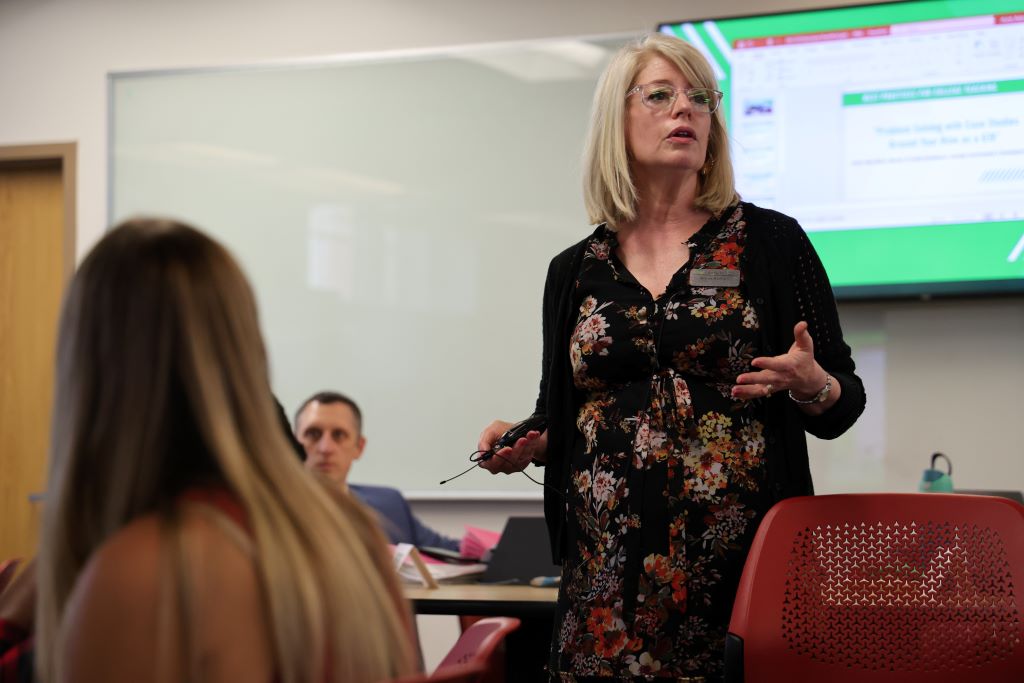
Editor’s note: Last year, Randi Tanglen, vice provost for Faculty Affairs, wrote that UND is ‘T1’ as well as ‘R1’ — top tier in teaching and educational experiences, as well as in research classification. As UND celebrates Teaching Appreciation Week (May 5-9), UND Today spoke with Anne Kelsch, director of faculty development at the Teaching Transformation and Development Academy (TTaDA) about how the unit helps keep “the heart of UND” beating.
****
Great teaching isn’t a gift bestowed upon a lucky few. It’s a craft learned, practiced and refined over time.
That idea is at the heart of the work done by UND’s Teaching Transformation and Development Academy (TTaDA), where faculty find support for the many challenges — and rewards — of teaching.
For Anne Kelsch, director of faculty development at TTaDA, the work begins with challenging a persistent myth in higher education.
“I often tell people that there’s this mythology that somebody is just a great teacher, as if one were born that way,” Kelsch said. “And that’s really counter to how we at TTaDA think about it — we should have a growth mindset. Those are skills that people learn, and great teachers intentionally cultivate those skills.”
Learning the skills of teaching
That message matters at UND, where faculty often arrive with deep disciplinary expertise but varying levels of preparation in teaching. Some, Kelsch said, still complete doctoral programs with little teaching-related instruction.
As a result, many teach the way they were taught. TTaDA’s role is to help faculty move beyond that.
“We know so much about teaching and learning, and we know so much about how the brain works,” Kelsch said. “We know a lot about evidence-based practice. So, it’s trying to shift that culture away from kind of an ad hoc approach to one that’s actually grounded in what we know — the science of teaching.”
Kelsch encourages faculty to bring the same curiosity, rigor and scholarly mindset to their classrooms that they bring to their research and creative activity.
“Teaching will always be changing. It will always be evolving,” she said. “It’s intellectually demanding, and it’s hard to do it really well.”
Building a community where learning matters most
Much of that work begins with how faculty think about students.
“Your attitude as a teacher matters almost as much as anything else,” Kelsch said. “Faculty have sometimes said to me, ‘Well, students don’t know what I think about them.’ And actually, students do.”
Kelsch encourages faculty to see themselves as part of a learning community with their students, who bring perspectives, questions and experiences that can deepen the classroom.
That mindset starts with the willingness to say, “I don’t know.”
“It takes a level of confidence to get to the point where when a student asks a question, you can say, ‘I don’t know. What a great question,’” Kelsch said. “To me, that scholarly approach to knowledge is one that has humility built into it, because we can’t know everything.”
TTaDA helps faculty make learning more relevant, too. Rather than trying to cover everything, Kelsch said, faculty can help students understand how a discipline works.
In her own teaching career, Kelsch came to that realization while teaching Western Civilization, a course that tried to cover centuries of history in a single semester.
“I finally just realized, why am I even pretending I could cover this? I can’t,” she said. “So why don’t we change it and start to think about it as a class that teaches them, ‘How do historians think?’”
Mentorship, AI and more resources from TTaDA
One of TTaDA’s signature programs is the Alice T. Clark Mentoring Program, which has supported new UND faculty members for more than 30 years. It pairs early-career faculty with mentors and brings them together monthly as a cohort.
Even when the topic isn’t explicitly teaching, Kelsch said, Alice T. Clark sessions are designed with teaching in mind. In a seminar on grant writing, for example, participants examine grant packets, form a committee and make funding decisions based on established criteria.
“We’re not just standing there talking to them about grants,” Kelsch said. “We’re saying, if you want students to start to internalize a set of criteria and really understand how something works, have them be the decision maker.”
TTaDA also offers faculty workshops, book clubs and opportunities for faculty to talk with one another about teaching. Faculty can receive individualized support from instructional designers and instructional technologists on course design, Blackboard and other teaching technologies.
The unit supports Writing Across the Curriculum – which helps faculty design writing assignments – give effective feedback and support students’ growth as writers. Kelsch said that writing, in particular, is an essential skill to learn and teach, no matter the discipline.
More recently, TTaDA has helped faculty respond to artificial intelligence in the classroom through programs led by Anna Marie Kinney, AI instructional manager at TTaDA, and UND’s AI Assignment Library. Hosted by the Chester Fritz Library, the repository lets faculty share and find peer-reviewed assignments designed for a new information environment shaped by generative AI.
Kelsch said that TTaDA’s continuous adapting is essential to their ability to support faculty and give them the resources to be the best teachers possible.
“I’ve started to realize that my job is really helping faculty manage change,” Kelsch said. “COVID, AI, new technologies — the reality is, our work is constantly changing.”
TTaDA also supports teaching through the Senate Faculty Instructional Development Committee, or FIDC, which offers funding for faculty to attend teaching-related conferences and supports faculty conducting Scholarship of Teaching and Learning research.
The heart of UND
For Kelsch, the work comes back to UND’s mission to serve students.
“At its heart, a university exists to expand knowledge,” she said. “But expanding knowledge without transmitting it is fairly pointless.”
Teaching, she said, is where the University has its most consistent human impact. Over a career, a single faculty member can shape thousands of students’ lives.
“For me, it really feels like teaching is the heart of the institution,” Kelsch said. “It’s the most important thing we do, and that doesn’t diminish research. In fact, I think it enhances our research in many ways. But it’s really how we create opportunity and access. It’s the chance we have to genuinely make a difference in the world.”
That is why, Kelsch said, faculty should not approach teaching alone.
“There are so many things out there. There are so many resources,” she said. “Your time is precious. It’s more important that you spend time engaged with your students.”
Teaching Appreciation Week events
UND faculty members are invited to take part in Teaching Appreciation Week events May 4-6.
The week begins Monday, May 4, with a Faculty Affairs Open House from 9 a.m. to 2 p.m. at O’Kelly Hall, featuring build-your-own goodie bags and stress-relief therapy dogs.
On Tuesday, May 5, faculty are invited to stop by Room 142 of the Memorial Union from 10:30 a.m. to 1 p.m. for iced coffee and donuts, sponsored by UND AAF.
The week continues Wednesday, May 6, with a Faculty Cheesecake Social in TTaDA’s O’Kelly space from 1 to 3 p.m., featuring a photo booth.
Faculty are encouraged to stop by, connect with one another and celebrate the teaching that shapes UND and its students.