VIDEO: UND’s laser focus on satellite communications
Above and below Witmer Hall on the UND campus, a nation’s first in laser communications is taking shape
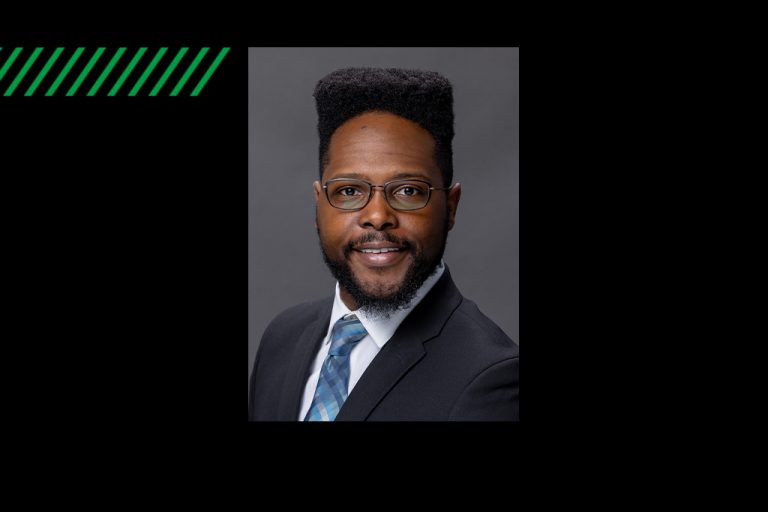
This week’s video message from President Andrew Armacost features a conversation with Markus Allgaier, assistant professor of Physics & Astrophysics.
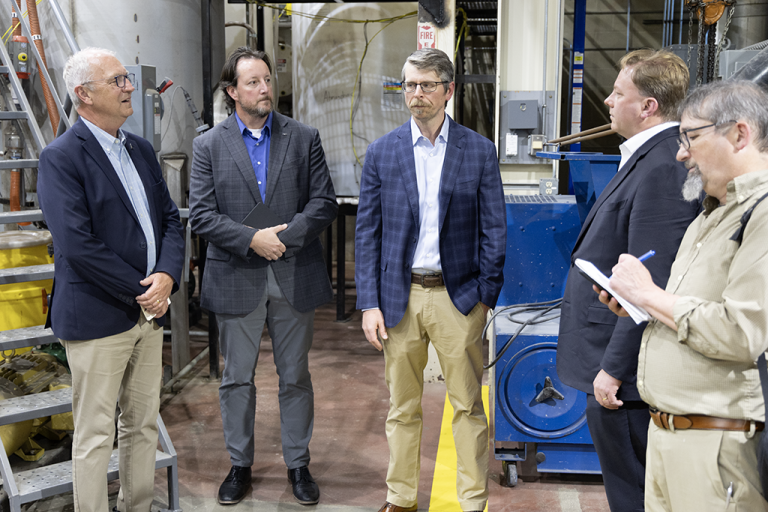
In the basement of Witmer Hall, the two talk about Allgaier and his research team’s work on what will be the first fully operational, university-operated laser communications ground station in the country.
Allgaier, who’s now been at UND for around two years, explains that his research and development is focused on creating faster, more secure communications using light instead of radio waves.
From the space race of the 1960s until now, radio frequencies have been used to communicate with spacecraft and satellites, Allgaier explains. Though radio frequencies have been mostly reliable, the requirements on the ground are expensive, and the flow of data is limited.
Allgaier says the cap of radio frequency data transfer is similar to that of fiber-optic home internet speeds, around one gigabyte per second. By comparison, the technology he is working with is anticipated to reach speeds 1,000 times faster, he says.
With new satellites collecting exponentially more data than space-race-era fixtures, laser communication stations could be more effective and maintained at a lower cost despite current difficulties aligning lasers with spacecraft through the turbulence of Earth’s atmosphere.
Armacost remarks that looking at the roof of Witmer Hall shows evidence of Allgaier’s work on campus. Several students under Allgaier’s supervision are working on the station’s development, as well as experiments using its capabilities.
More information on this work is available in a UND Today feature from December, and Allgaier welcomes people to reach him directly with questions. The project is also featured on the College of Arts & Sciences website.