Women’s History Month panel focuses on community in STEM
Recognition, belonging and supportive networks are keys to success and innovation in STEM, panelists say
Strong workplace relationships, meaningful recognition and a sense of belonging are among the most important drivers of success in science, technology, engineering and mathematics fields.
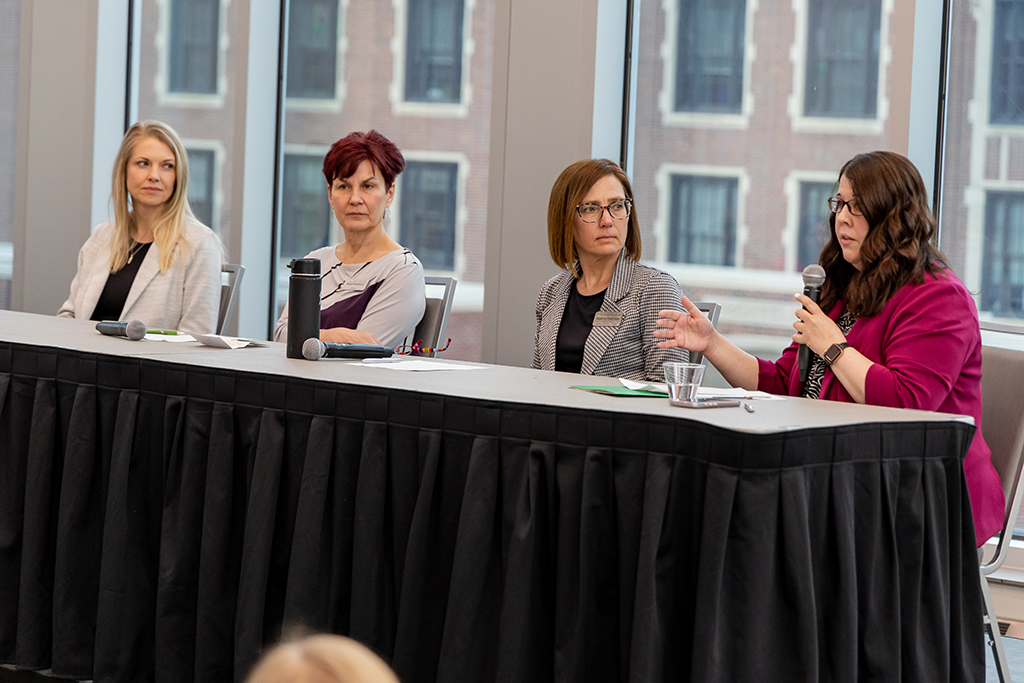
That’s according to a UND faculty panel that spoke during the recent Women’s History Month discussion on Tuesday, April 14.
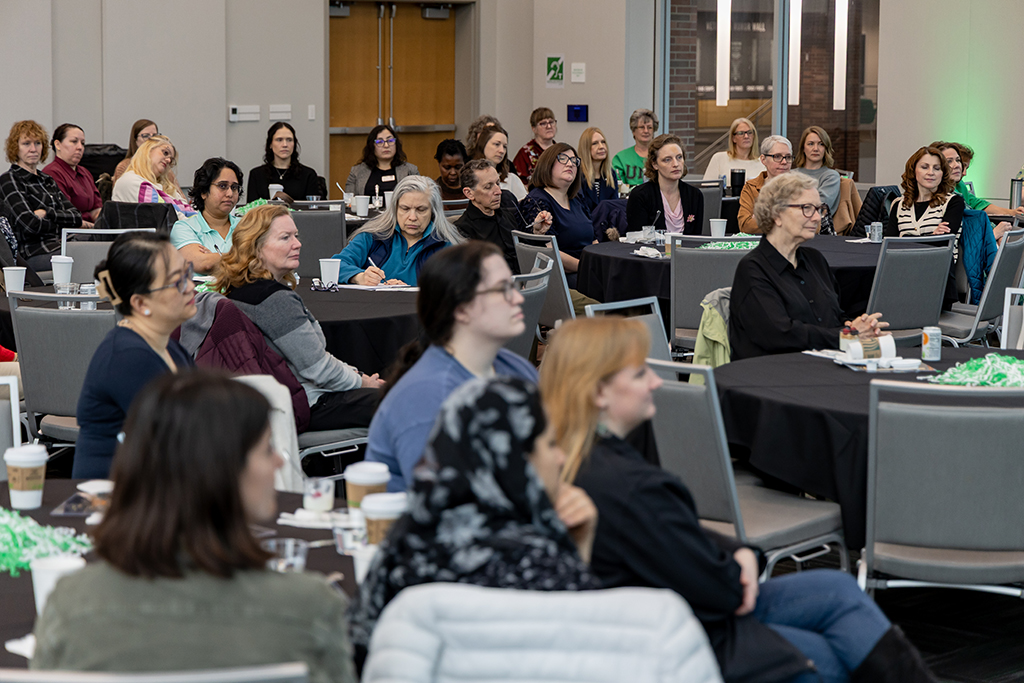
The discussion was moderated by Krista Lynn Minnotte, professor of Sociology, and brought together faculty leaders from across disciplines to share research, personal experiences and advice. The audience filled the Henry Family Ballroom on the second floor of the Memorial Union.
“What blows my mind is that, over and over and over again, of all of the outcomes on the personal level, individual level, or the organizational level, the No. 1 predictor every single time is coworker support,” said Daphne Pedersen, Chester Fritz Distinguished Professor of Sociology and associate dean in the College of Arts & Sciences, referencing years of research on faculty outcomes.
“It absolutely matters.”
Support from colleagues influences everything from job satisfaction to retention — and can shape whether individuals stay in STEM fields at all, Pedersen noted.
Other panelists echoed that theme, emphasizing that community is of foundational importance to not only workplace success, but also student confidence, identity and long-term career paths.
“Community is an environment of people who care,” said Alena Kubatova, Chester Fritz Distinguished Professor of Chemistry and associate dean for research in Arts & Sciences.
“It’s all about caring and caring about students getting the best experience and eventually jobs,” she continued.
For Sarah Sletten, associate professor of Biomedical Sciences and director of Learner Research, community also means recognizing and elevating the strengths of others.
“Finding the best people for the job … and letting them excel, and then making sure to celebrate them as they succeed,” she said.
Community drives innovation and belonging
Panelists stressed that building strong communities is especially critical in STEM, where diversity and collaboration directly impact innovation.
Pedersen pointed out that having a diverse workforce leads to better problem-solving and more creative solutions.
At the same time, a supportive environment helps students overcome challenges such as imposter syndrome and developing a strong sense of identity in their field.
Barriers remain
Despite its importance, panelists acknowledged that building community in STEM can be difficult.
They cited challenges including competition for funding with other institutions or faculty members, professional egos, communication barriers and limited time for connection.
Identity and experiences shape STEM journeys
The panel also explored how identity — including gender and life experiences — influences STEM careers.
Sletten noted that responsibilities outside the workplace, such as caregiving and household labor, can affect career paths, particularly for women.
The panelists also encouraged students to embrace evolving interests and recognize that career paths are not always linear.
Audience questions highlight mentorship and recognition
During a brief Q&A, audience members asked about mentorship, self-promotion and the impact of supportive colleagues.
Panelists encouraged recognizing that not everyone is comfortable promoting themselves, suggesting that colleagues and communicators can instead highlight the work and impact of research rather than focusing solely on individuals.
They also reflected on the importance of mentorship and peer support, sharing that encouragement from colleagues — sometimes even a single statement — can shape careers and build confidence.
“It takes a village,” Kubatova said, emphasizing the collective role of supportive environments in helping faculty and students succeed.
Advice for students and early-career professionals
Panelists closed with reflections for students and early-career professionals:
- Don’t let intimidation hold you back
- Seek out supportive colleagues and mentors
- Recognize and uplift others
- Take initiative in pursuing your goals
“If you want to do something, you just have to do it,” Sletten said.
The breakfast was hosted by the University Council for Women+, a group that strives for “for a campus where everyone feels respected and included by providing education, networking, and leadership opportunities.” More information about the group can be found online.