S.P.A.R.K. event celebrates scholarship, service and student research
Annual College of Nursing & Professional Disciplines research gathering spotlights scholarship across disciplines
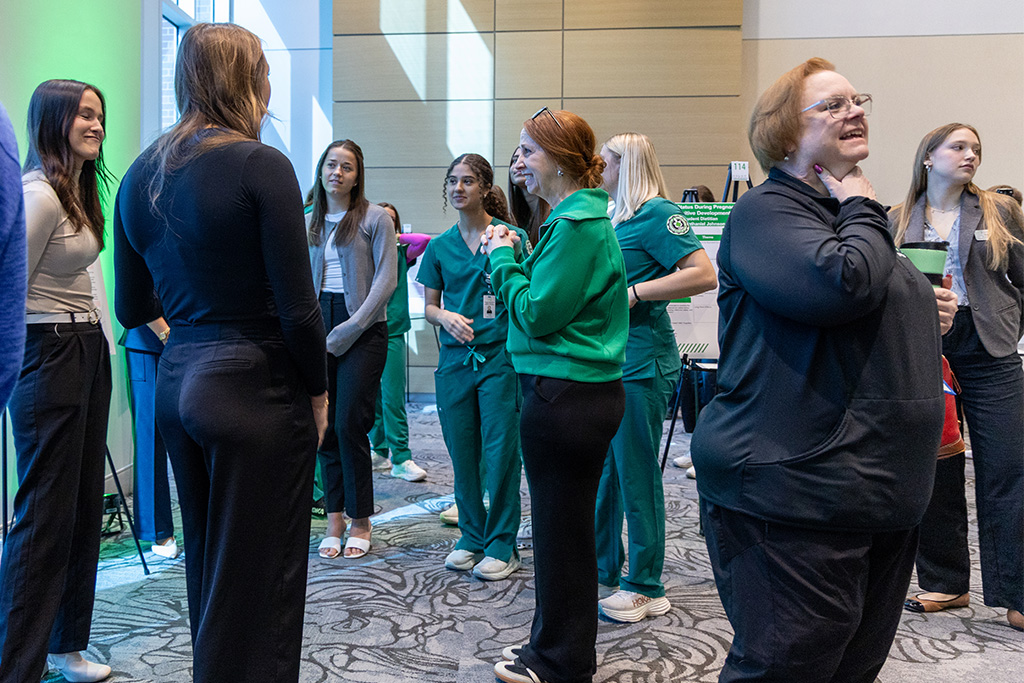
The College of Nursing & Professional Disciplines brought students, faculty and researchers together April 29 for S.P.A.R.K., a new collegewide celebration of scholarship, practice, achievement, research and knowledge.
Held in the Memorial Union, the event expanded on CNPD’s annual Research Day poster session with a luncheon, faculty awards and student presentations.
Across the ballroom, work from Nursing, Nutrition & Dietetics, and Social Work offered a snapshot of disciplines connected by a common purpose: improving health and strengthening communities.
“It reflects the foundation of our college and the values that are embedded in our mission and displayed in the work that you see here today,” said Maridee Shogren, dean of the College
Research across CNPD
Christina Erickson, associate dean for faculty affairs and research, called the poster session “the cornerstone” of S.P.A.R.K. while noting that this year’s program added new ways to recognize accomplishment and encourage conversation.
“This year, we’re adding to that foundation this luncheon,” Erickson said, pointing to the CNPD Faculty Awards and three student presentations. “All of these create new opportunities for connection, to share and highlight accomplishments and engage with each other.”
That range could be seen in the posters lining the Memorial Union ballroom, which showed research on diverse subject matter such rural mental health, aging in place, postpartum hemorrhage, neonatal sleep, diabetes management, chronic kidney disease, nurse mentorship, trauma-informed care and nutrition across the lifespan.
For Angie Muhs, who presented her dissertation research on rural teachers’ perceptions of their preparedness to respond to adolescent mental health concerns, the event offered a chance to discuss a challenge felt acutely across North Dakota.
Eighty-nine percent of the state is considered rural or remote, Muhs said, and many counties have little or no adolescent mental health care access.
In those settings, teachers often become a key resource.
“They’re really a frontline option,” Muhs said, adding that teachers in rural K-12 settings often know students for years and can recognize behavioral changes.
Even without formal training, she said, many teachers bridge gaps through relationships, colleagues and self-directed learning. She hopes that research like her own can be used to develop formal programs to support teachers and their students.
Student voices at center of luncheon
S.P.A.R.K. also introduced a live presentation format for selected student work.
Autumn Thompson, a graduate student in Nutrition & Dietetics, opened her literature review on nutrition intervention for premenstrual syndrome by addressing the topic’s stigma directly.
“Women’s health, particularly women’s nutrition, is a public discussion that’s often shied away from due to the social stigma surrounding it,” Thompson said. “But without discussion, we can’t move forward in academia and research.”
Her presentation examined dietary recommendations for PMS symptom management, with attention to micronutrients including vitamin D, zinc and magnesium.
Thompson argued that the subject deserves more research grounded in patient-centered care and the lived experience of menstruating women.
Other live presentations included Alexis Crane’s “From Stanley, N.D., to Columbia: Don Schmid’s Journey to Becoming One of the Most Influential Social Workers of His Time” and Matthew Weisgarber’s “Bridging the Mentorship Gap: A Case for AI Decision Support for Novice Nurses.”
Together, the presentations reflected the student and faculty work that moved from historical biography to bedside practice, from rural health care to the emerging role of artificial intelligence.
Faculty excellence recognized
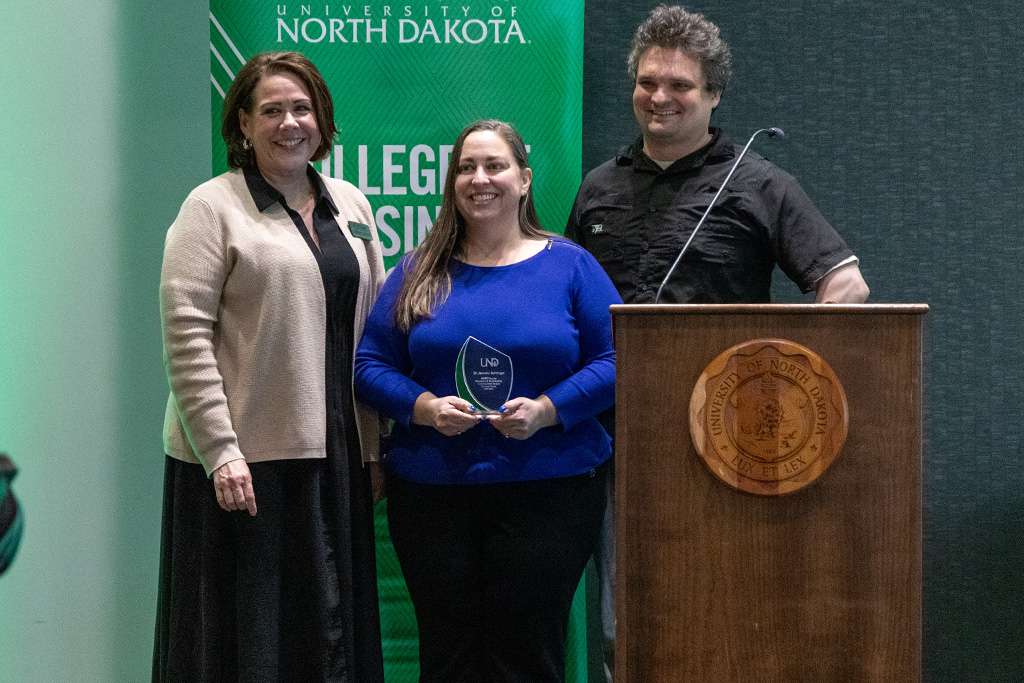
The luncheon also honored faculty for research, scholarship, teaching and service.
The 2025-26 Faculty Research & Scholarship Contribution Awards went to June-Yung Kim, assistant professor of Social Work, in the Tenure-Track Faculty category, and Jennifer Schlinger, clinical assistant professor of Social Work, in the Clinical-Track Faculty category.
Kim was recognized for work at the intersection of mental health, neurobehavioral teratology and social welfare, including research on the intergenerational impacts of substance use and mental health among people exposed to early biological and environmental risk factors.
Her scholarship includes 26 peer-reviewed publications, 41 presentations, a book chapter and five translated books, with support from CNPD Seed Awards, an NIH-funded pilot study and the Indigenous Trauma and Resilience Research Center.
Schlinger was recognized for scholarship on trauma education in social work curricula and trauma-informed care.
Her work includes regional presentations, interdisciplinary continuing education for social workers, nurses and dietetic professionals, and a trauma-informed care elective that became a permanent course offering.
The luncheon also recognized Professor Kaitlyn Kelly Shikanai for distinguished teaching, citing her engaging, student-centered approach to nursing education and her work redesigning the Capstone quality improvement project, and Professor Stephanie Homstad for distinguished academic service, including her leadership in online education and her work supporting a culturally responsive child welfare workforce for North Dakota’s tribal nations.
Keeping the spark alive
Addressing the audience during the luncheon, Shogren framed the day’s work as an expression of CNPD’s shared commitment to research across all of its disciplines.
“As we look ahead, we hope that this spark continues,” she said, “and the ideas shared today ignite new questions, new collaborations and new opportunities.”
For Muhs, the S.P.A.R.K. event reinforced the idea that learning does not stop at graduation.
Surrounded by students, faculty and professionals at different points in their careers, she said the event showed that there’s value in remaining curious and open to new ideas.
“It’s so cool to see that your education doesn’t stop,” Muhs said. “In these fields, you can always learn more.”