Hands-on and hard-earned: Engineering & Mines Expo showcases student innovation
Annual event highlights student projects in STEM fields while connecting classroom learning with real-world innovation
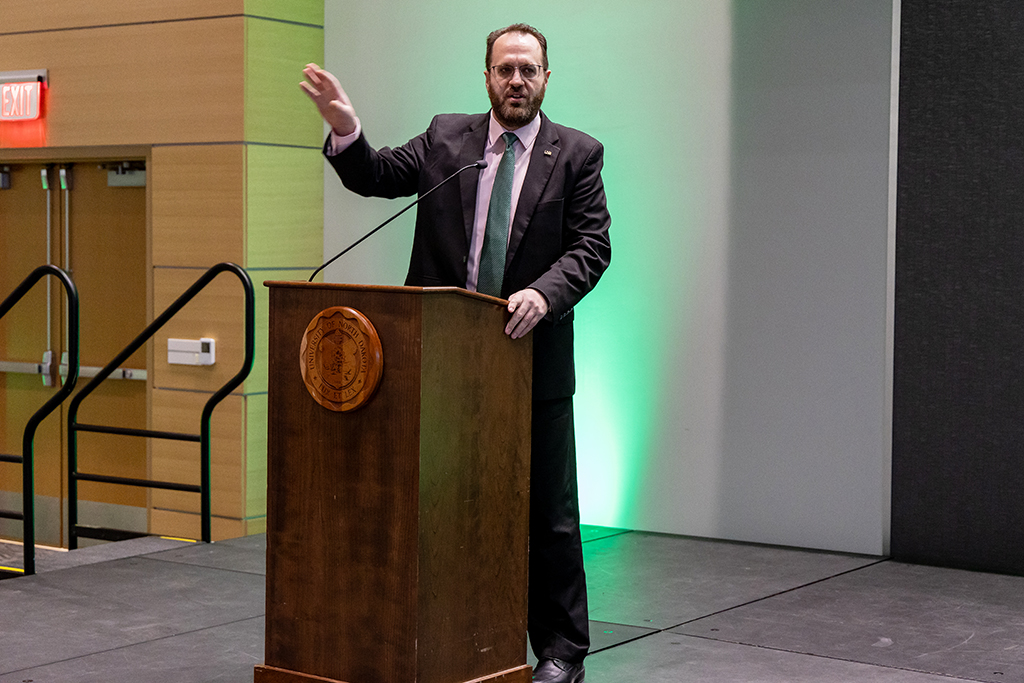
At UND’s College of Engineering & Mines Expo, the projects on display represent more than coursework.
They represent progress.
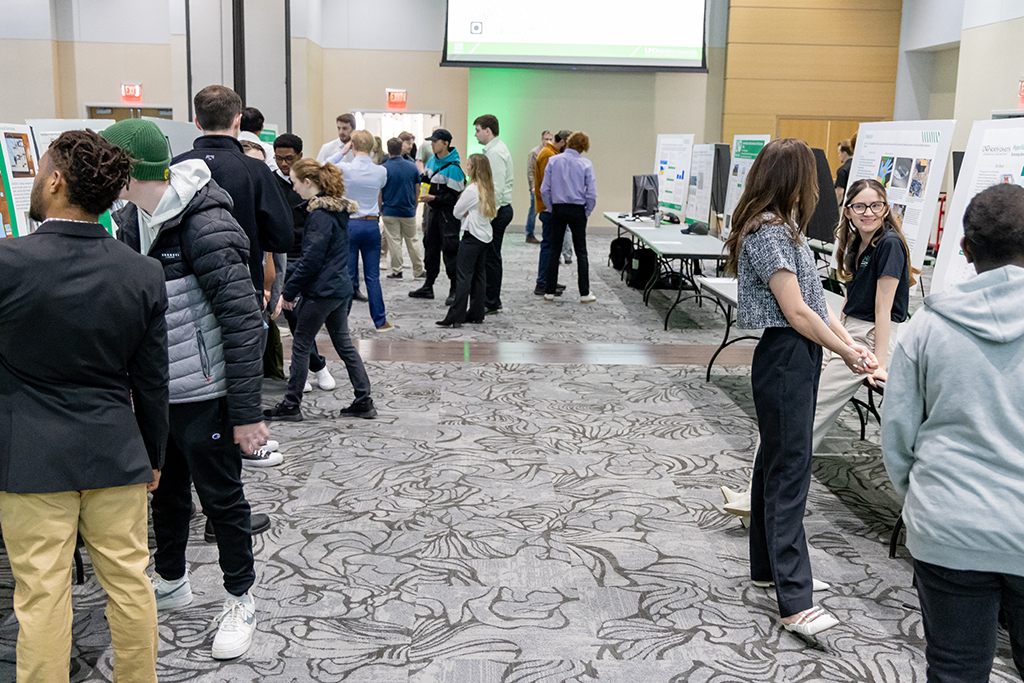
From first-year students tackling complex biomedical challenges to seniors designing industry-ready systems, the annual event, held on April 28 in the Memorial Union, highlights the hands-on learning that defines UND’s engineering experience, through poster presentations and technology demonstrations. Viewers then vote on projects in different categories.
“This is the culmination of all of the work that you students have put in over the last several years in your programs,” said Ryan Adams, dean of the College of Engineering & Mines, while opening the Expo. “Today is built on collaboration and dealing with all the challenges you have overcome.”
“Enjoy this day, and enjoy sharing your knowledge.”
From idea to impact
For many students, the Expo marks the final stage of senior design — a two-semester effort built on years of preparation.
But across the Expo floor, the range of projects shows how UND students are applying their skills to real-world problems — from health care to sustainability.
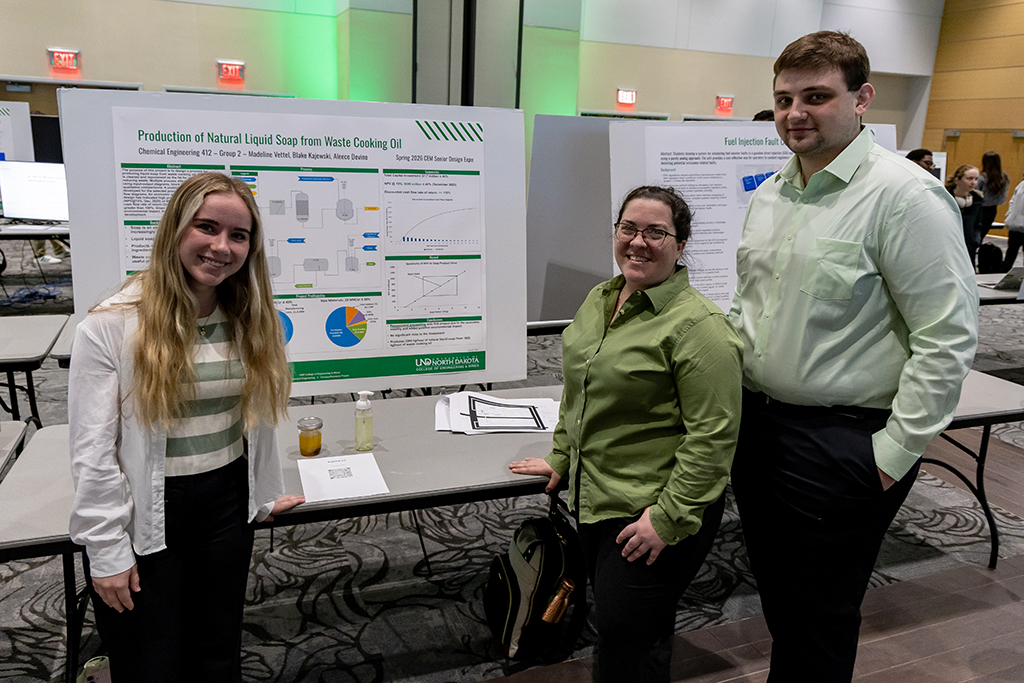
One team of chemical engineering students is working to transform used cooking oil into liquid soap, combining environmental awareness with product design.
After filtering out solids and impurities, the oil is processed through a system that removes discoloration and odor before entering a saponification reactor, where it reacts with potassium hydroxide to form soap.
“The end game is creating a product we could sell,” explained Aleece Devine, who along with Madeline Vetterl and Blake Kajewski, worked on the project.
The system also produces glycerol as a byproduct and includes a neutralization step to ensure the final product is safe for use.
While parts of the filtration process already exist in industry, the team’s focus is on adding value by converting waste into a usable, marketable product.
Tackling challenges in health care
Across the room, biomedical engineering students are exploring how to improve quality of life through technology.
Freshman Claire Boynton is part of a team developing a machine learning approach to one of medicine’s most difficult challenges: measuring pain.
“Pain is one of the main reasons people end up in the doctor’s office,” she said. “But the way we measure it right now is very subjective.”
Her team is working with physiological datasets to build a model that can interpret signals from the body and estimate pain levels objectively — particularly useful for patients who cannot communicate their pain.
Nearby, another biomedical team is designing a wearable device aimed at reducing chronic pain, especially during sleep.
Freshman Isabella Snobl said the group is focused on comfort and usability, exploring both battery-powered and wireless energy options.
“We’re working on what’s going to be the most comfortable for people — what’s going to be appropriate and the easiest to use,” she said.
One concept includes a pad placed under a mattress that could deliver energy wirelessly to help block pain signals.
Learning starts early
While many Expo projects represent senior capstones, students say the hands-on approach begins much earlier at UND.
“I like that we do a lot of hands-on projects,” Boynton said. “At other schools, you might not do something like this until your junior year.”
At UND, even freshmen are immersed in project-based learning — gaining technical experience while developing communication skills through frequent presentations.
“It’s a little nerve-wracking,” she said. “But we present pretty much every two weeks, so it really builds your skill set.”
Bridging classroom and career
The Expo also reflects the College’s emphasis on collaboration — both across disciplines and with industry.
Through collaborative experiences, students from multiple engineering fields work together on projects sponsored by companies, simulating professional environments.
“It’s as close as we can get to acting like a consulting firm in an academic setting,” said Dominik Steinhauer, director of collaborative experiences at the college.
These partnerships give companies early access to talent and provide students with valuable insight into potential careers.
“Companies get to test-drive students … and students get to test-drive companies,” Steinhauer said.
A moment of reflection
Throughout the day, students presented their work to judges, faculty, alumni and industry representatives — any of whom could shape their next steps.
“You never know who’s stopping by,” said Adams.
As the Expo concluded with awards and recognition, students were encouraged to reflect on how far they’ve come.
“You certainly couldn’t have done what you’re doing today when you started,” Adam continued.
From first-year students building machine learning models to seniors designing market-ready processes, the Expo captures the full arc of engineering at UND.
And for many participants, it’s a clear sign that their work — and their careers — are just getting started.
This year’s winners are:
Best Prototype
“AI-Enabled Multi-Sensor Threat Detection for Critical Infrastructure”
Hazem Amjaour – Lewis Takwa – Dylan Kiley – Weldsh Berhe
Best Process/Research
“Intersection Design of 62nd Ave & South Washington Street (Grand Forks, ND)”
Spencer Robbins – Tiffany Lowe – Kyle Schill – Christian Olson – Joel Alvarado Lopez – Joshua Edwards – Jason-Fred Miavivululu – Jack Conner