On Prairie Public, a Q&A with President Armacost
UND’s president talks all things higher education — including AI, college sports, career planning and student debt — in extended interview on ‘Main Street’ program
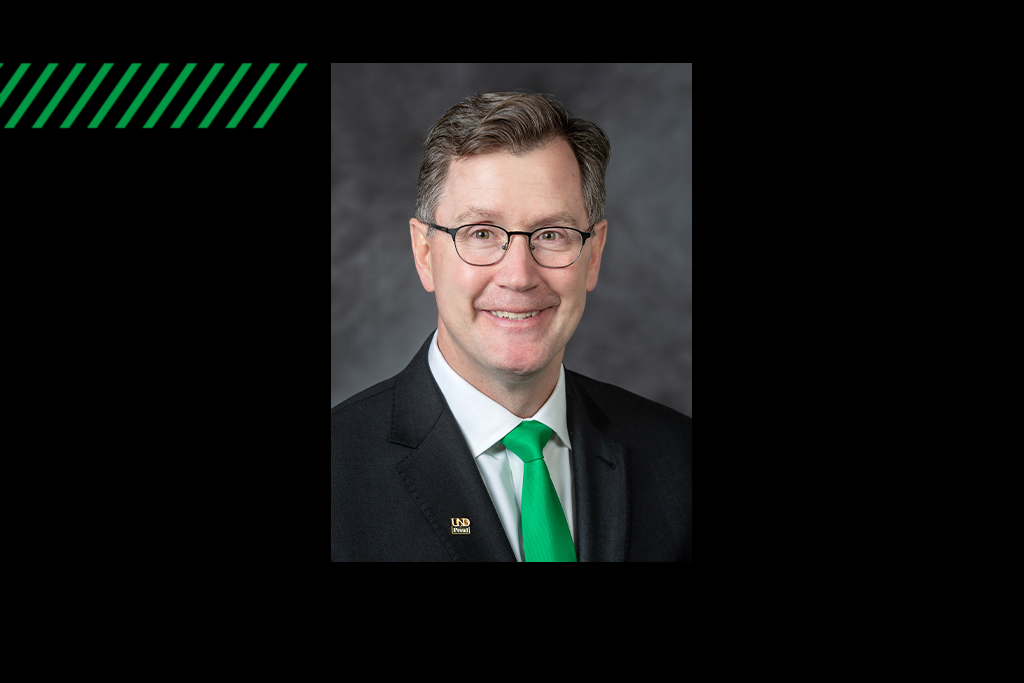
Editor’s note: On May 18, UND President Andy Armacost sat down for an interview with Craig Blumenshine, the producer and host of the flagship public affairs program on Prairie Public Broadcasting’s radio network: “Main Street.” During the 40-minute interview, Armacost and Blumenshine talked about the president’s first six years at the helm of UND, the influence and importance of college sports (such as hockey and football), the political and regulatory challenges the University has faced and the president’s message to parents and prospective students who are wondering, “Is college worth it?”
The interview is available for listeners via the website of Prairie Public’s newsroom. In addition, the questions that Blumenshine asks Armacost are listed below, along with a time stamp indicating the approximate place in the broadcast where the question can be found.
Enjoy!
****
Introduction
Welcome to Monday’s edition of Main Street here on Prairie Public. I’m Craig Blumenshine, glad that you are with us today. Coming up in just a bit, Plainsfolk, historian and essayist Dr. Tom Isern reflects on “Aurora,” the new poetry collection by Thom Tammaro, published by North Dakota State University Press.
But first, a visit to the campus of the University of North Dakota, and a visit with its president, Dr. Andrew Armacost, on graduation weekend.
This is Main Street on Prairie Public, I’m Craig Blumenshine.
Few institutions in North Dakota shape the state’s future more directly than the University of North Dakota. From workforce development and research to athletics, student life, artificial intelligence and public policy, universities are increasingly being asked to do more while navigating political pressures, changing demographics, rising costs and fast moving cultural expectations.
Since taking office in June of 2020, UND President Andrew Armacost has led the university through a period marked by enrollment growth, increased state support, athletic visibility, and a growing national attention surrounding issues ranging from academic freedom to NIL and the transfer portal. Today, we’re visiting about the future of higher education in North Dakota, the challenging role of college athletics, student mental health, AI, affordability, and what UND hopes to become in the decade ahead. President Armacost, welcome to Main Street.
Past six years
01:02: So happy that you are with us today. So, if you had to give our listeners the short version of the past six years of your time here, what do you think has changed the most under your watch? And what would you point to first as evidence of real progress?
Stability and athletic challenges
03:02: You mentioned the word “stable” just a moment ago — stability. What does that mean in plain English for students and for taxpayers and faculty? What is stability at the University of North Dakota?
03:55: We talked about in my open that enrollment is growing here at the University of North Dakota. Is that sustainable in your eyes, Mr. President? And how much of that support depends on continued increasing state support or philanthropic support?
Is everything that is going on here that looks so positive sustainable?
05:30: We’ll talk more, I think, about the fiscal stability and what drives a person to come here in just a little bit. But I want to turn the page briefly to athletics. Looking ahead, how do you believe the university positions itself competitively in this era of NIL and the pressures, the financial pressures that that world brings to schools like the University of North Dakota that didn’t exist two or three years ago?
06:40: What’s the solution to this problem (of how expensive college sports have become)? … (And) do you have a solution in your mind?
07:14: I have visited with families who have members of their family that coach at the Division I level, and their remarks to me were, “student athletes are not loyal to their schools anymore.” Is that a concern of yours? Do you see that here?
08:37: Two more questions about athletics, and then we’ll return to the academic side of the institution. What did it mean to the University of North Dakota to return to the Frozen Four?
09:06: Do you view that (pursuit of a championship) as an expense on your balance sheet — to do that in competing at the highest level in collegiate hockey?
09:50: Last, I want to talk about football. What did you think when you read that NDSU has went to the Mountain West Conference? And are you happy with where your team is today?
Political and regulatory landscape
10:34: Enjoying my conversation with Andrew Armacost, he’s the president of the University of North Dakota. We discuss the changing landscape of higher education now in North Dakota and across the country.
We’ve talked about athletics, a little bit about institutional growth.
I want to talk about other things relative to that side of your world. The federal government, Washington now, is more interventionalist than many university leaders are used to dealing with. How much of a university president’s job has it been for you to be consumed by political and regulatory navigation, for lack of a better word?
13:00: It seems to me, Mr. President, that universities across the country now have found themselves balancing compliance issues, student belonging and institutional autonomy. What have recent national debates taught you about maintaining that balance, and has it been hard?
14:35: We’ve talked about federal issues relative to this. I want to bring in the state conversation and then ask you a question. Lawmakers continue in this state to debate issues surrounding tenure, accountability, academic freedom and free speech.
Has academic freedom been impacted at the University of North Dakota?
16:10: Is there a line between legitimate public accountability and legislative micromanagement of the university that has entered into your thoughts?
18:29: There’s another force, Mr. President, that I want to visit with you about the same question, really. Donors and activists and what you see on social media and pressures that come from ways that didn’t exist, you know, 10 or 15 years ago. Have those impacted the institution in ways that you’re concerned about?
Student success and AI
20:36: This is Main Street on Prairie Public. I’m Craig Blumenschein, and we now continue our conversation with President Andrew Armacost. He’s the president of the University of North Dakota.
And we explore where higher education is headed at a time of rapid change here in North Dakota. We’ve talked about athletics, we’ve talked about some external pressures that are facing campuses today, and I wanna focus more on students and families, Mr. President, if I could. Career readiness is something, I think, that all students and families are concerned about.
How do you keep career preparedness central without turning a university into nothing more than just a job training pipeline?
22:34: You mentioned earlier that North Dakota has now considered reduced credit bachelor degree programs, pilot programs, where some student leaders here and at other places have expressed concern about now shortening those degrees. Where do you land in that debate? Is it smart innovation? Is it necessary experimentation?
Is it a potential dilution of what you just talked about a bachelor’s degree should mean?
24:46: Take me into students’ minds, Mr. President. If you will, I know you think about what students are thinking all the time. UND has leaned into artificial intelligence through campus initiatives and academic programs.
What would you tell an incoming freshman, an incoming student who’s excited about AI, but worry that it’s going to erase an entry-level job that maybe he or she had in mind just a year ago or two years ago? And then I’m going to ask you, Mr. President, what majors are you concerned about being most impacted by AI?
27:16: Okay, that’s the student side of the world. What about the university side of the world and how it conducts its business of educating young people?
28:34: UND has posted strong retention numbers comparatively to I think many other public universities in the country. What concerns you most and the greatest points of student attrition, those that don’t stay here? Is it mental health issues?
Is it other issues that are impacting why their students stay in school?
30:28: Some of UND’s largest programs are highly demanding academically. How do you talk to students about ambition and excellence without normalizing burnout, with understanding of the other pressures that they endure, that they may not have endured 10 or 15 years ago?
31:22: Mr. President, I want to talk about costs. Let’s make it concrete here. What do you wish every family understood before that first tuition bill arrived to them?
33:11: Are you confident that’ll remain the case (that the student’s investment will be worth it) with all of the workforce pressures that we hear about to automation with AI? We talked about that earlier with robots doing a lot of the things maybe that humans used to do earlier, more with less.
33:53: I’ve watched my kids and their kids now communicate, and they can communicate instantly with one another. When years ago, I didn’t have that capability. It was maybe the long distance call home on a Friday or Saturday. … So it begs the question: parents, it seems to me, are more helicopter-like now than they used to be. What’s your advice to those parents who have kids in school now, but they’ve been instantaneously able to communicate with their kids through middle school and high school?
Campus infrastructure and outlook
35:36: Mr. President, I want to talk to you about the capital needs of the institution. As I walk around campus, you see a lot of new building that’s happened here recently. I understand about how heat is distributed on campus in an incredibly new, beautiful and powerful facility.
The place still must have capital needs. What are they?
37:47: Finally, Mr. President, if you were going to speak directly to a high school senior in North Dakota, who’s weighing tuition, career risk, mental health, family expectations, and whether college is still worth it, that has entered into the national conversation more and more recently.
And we’ve talked about that a little bit in the interview, but what do you hope they consider first for choosing UND or any other university?
39:07: Thousands of University of North Dakota students graduated last weekend. They walked across the stage. We’re visiting Friday, the day before commencement.
What are you thinking about next year already? What’s on top of your mind for next fall?
40:39: Andrew Armacost, he’s the president of the University of North Dakota. It’s been a pleasure, Mr. President!