Language and identity intertwine at Bilingual Writing Camp
UND’s first Bilingual Writing Camp helps bilingual students explore their identities and experiences through writing
Editor’s note: In the UND LEADS Strategic Plan, the Service core value includes a call to “strengthen services and cultivate programs for recruiting, mentoring and advancing historically underserved and marginalized students and employees.”
The following story describes a UND-led initiative to celebrate and empower the voices, identities and well-being of bilingual and multilingual youth through writing.
Students and parents are not identified in this story to protect their privacy.
****
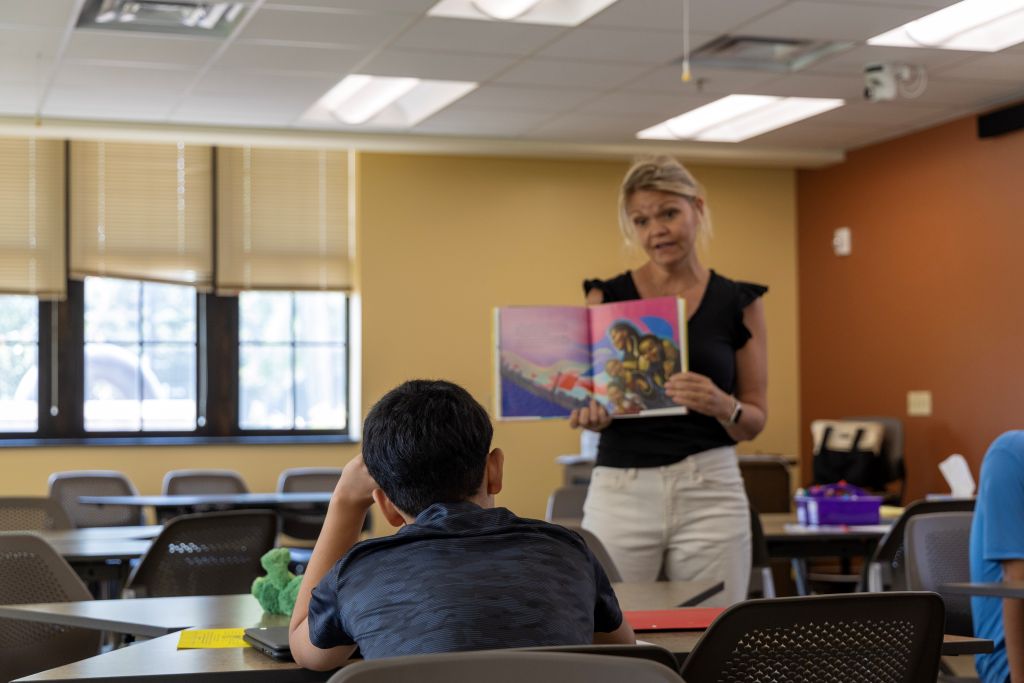
“How is writing like a rope?” asked Mary Drumm, an English teacher at Grand Forks Central High School.
Curious faces turned upward as five grade- and middle-school students awaited the answer. Then Drumm cheerfully explained that writing, much like a rope, can be used as a tool.
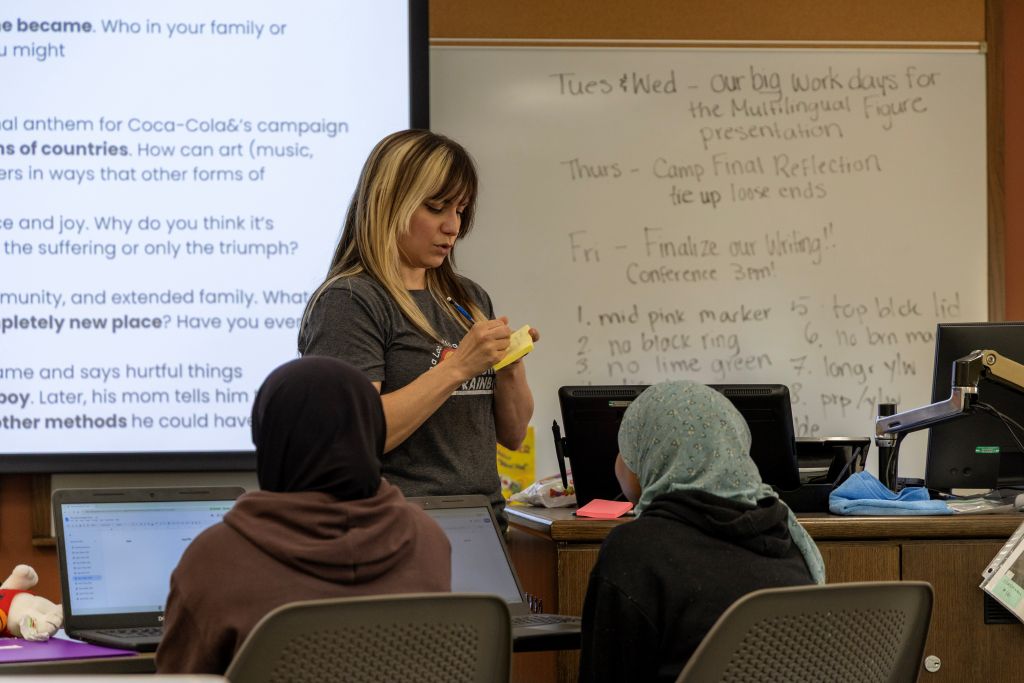
And over the next two weeks, that metaphor was proven at UND’s first Bilingual Writing Camp, as 15 students in grades 5 through 8 discovered how language and writing could help them express their identities.
The camp is part of UND Associate Professor Hyonsuk Cho’s research project examining how bilingual youth across the Midwest use writing to explore their identities and express their experiences. The camp was funded by the Spencer Foundation and supported by UND’s College of Education and Human Development.
“They are bilingual, but they attend school like monolingual students,” Cho said. “They do not have the opportunity to discuss their multilingual identity and experiences in school. They haven’t had a chance to explore their bilingual identity, so this camp can be really helpful and powerful for them to reflect on their identity and express it through writing.”
Helping students trace the ties between language and identity were three teachers from Grand Forks Public Schools. After being selected through an application process, they completed a professional learning course focused on writing and multilingual students.
Ashley Loe, who teaches fifth grade at Kelly Elementary School, said the camp gives students a chance they may not find in their usual classrooms.
“Here, students have the opportunity to use their home language as a strength while learning, collaborating, and having fun,” Loe said. “They can express themselves freely, connect with peers from different backgrounds, and celebrate their multilingual identities.”
Pulling at the threads
It doesn’t take long after the introductions for students to start showing their personalities. Students introduce themselves through simple lists of likes and dislikes, using those details to define their cultural identities. Through special poems and reflection prompts, students explore the different parts of themselves that appear at school or with family when speaking different languages.
Those details give way to stories describing family traditions, language, food and memories. Many know the words for a favorite dish, holiday or family saying, but this space invites them to uncover the identity held within those words, giving texture to their stories.
Students pull at those threads even further in their largest project. What begins as research into the life of a multilingual figure becomes an examination of how language shapes that person’s identity. Along the way, students begin recognizing pieces of their own lives in the figures they chose.
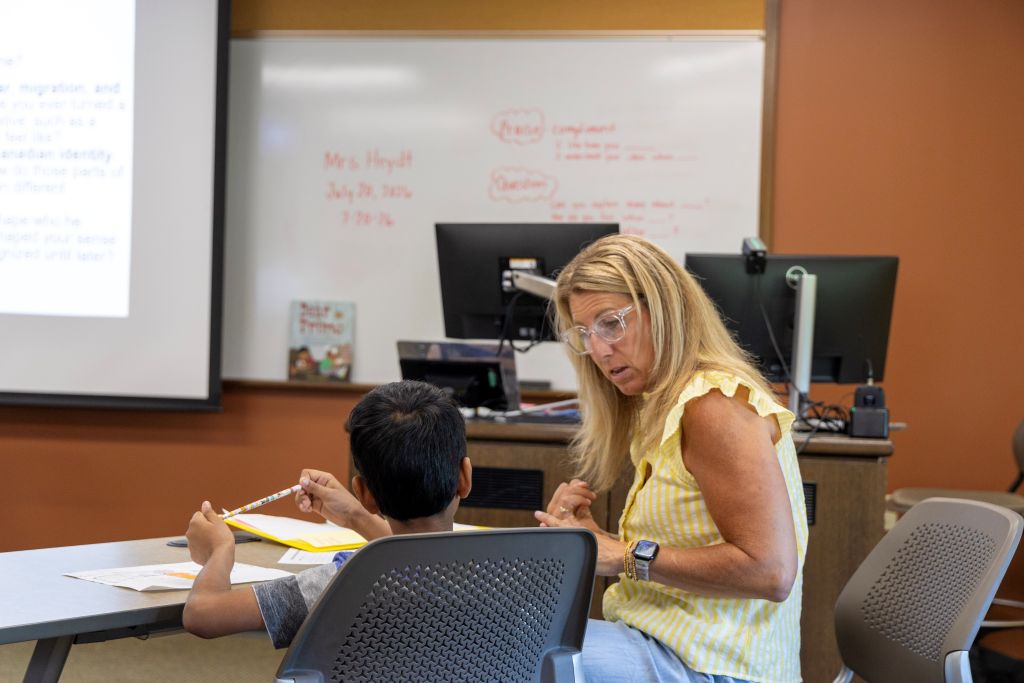
Across the camp, students bring knowledge of Bengali, Chinese, French, Igbo, Japanese, Korean, Persian, Somali, Spanish, Tagalog, Tamil and Vietnamese, in addition to English. They eagerly point out cognates and exchange words, and step into the role of teacher for classmates and instructors alike.
“You guys know a lot of things that I don’t know,” said Lori Heydt, a literacy specialist for the Grand Forks Public Schools. She reminded the class that the languages they carry are not barriers but knowledge worth sharing.
Loe agreed. “Seeing students confidently switch between languages, help one another and take pride in their cultural identities has reminded me how important it is to create classrooms where every language and culture is valued,” she said.
As students examine how language shapes identity, they also explore what bilingualism allows them to do. One student’s answer is simple: “We can connect with more people.”
Finding themselves in the story
The camp concluded with a Writers’ Conference, where one student presented her research on Somali Canadian musician K’naan, whose experiences reflected parts of her own family’s story.
K’naan moved to Toronto after war made it unsafe for him to remain in his home country. The student explored how K’naan used Somali to communicate with his grandfather and other family members, while English allowed him to communicate with teachers, peers and a broader audience. She explained that bilingualism became one of K’naan’s strengths because it helped him reach more people.
Through his music, including “Wavin’ Flag,” K’naan transformed the difficult experiences of leaving his country and becoming a refugee into something that could inspire others, the student noted. She said his story taught her that a person can still accomplish big things even when life is difficult.
“I feel like I can personally relate to K’naan because some of my family is from where he is from,” she said. “I was able to learn a little bit more about Somalia and what they’re known for.”
Another student’s project braided together the two cultures that make up her identity. The child of a Vietnamese mother and an American father, she filled her presentation with symbols from both parts of herself. So, the Statue of Liberty and her favorite food — mac and cheese — appeared beside Vietnam’s water buffalo, Lunar New Year traditions and áo dài, the brightly patterned tunics her family wears during celebrations.
Through the project, she explored her family’s history, including her mother’s experience leaving Vietnam during the war and eventually building a life in the United States. The stories her mother shares gives her a glimpse into the differences between life here and in Vietnam.
Her family continues to celebrate Vietnamese culture by traveling to the Twin Cities for Lunar New Year. There, they eat traditional foods, watch dragon dances and weave through crowded streets brightened by colorful clothing and firecrackers. For this student, those sights, sounds and traditions provide a connection to a culture she is still learning how to call her own.
She ended her presentation by stating “I’m part of two cultures. There’s only one me and I’m proud to be who I am.”
The value of bilingualism
As the Writers’ Conference came to an end, one mother stood to explain what the camp had meant to her. For her child, the two weeks had been filled with writing. But for this mother, watching students share their languages and cultures tugged at something deeper.
“If you have one language, you can serve one community, but if you have several languages, you can serve several communities,” she said.
Two weeks earlier, Drumm had asked how writing is like a rope. By the Writers’ Conference close, as students exchanged words across languages and excitedly traced their families’ histories, the answer was apparent and it stretched across the room.
****
>> Questions or comments about the UND LEADS Strategic Plan? Your thoughts are welcome! Please contact Ryan Zerr, associate vice president for Strategy & Implementation, or Brandon Wallace, senior financial accountant, the co-chairs of the UND LEADS Implementation Committee. You also may offer your thoughts by visiting the UND LEADS Strategic Plan home page and clicking on the “Provide your feedback” link.
Thank you for your support of the UND LEADS Strategic Plan!