UND helps debut ‘North Dakota Row’ on global stage of AUVSI Xponential
University presence at annual international conference highlights research, partnerships and ‘pioneering spirit’ driving statewide innovations
Editor’s note: In the UND LEADS Strategic Plan, the Discovery core value calls on the University to “facilitate and enhance connections, where new and existing partners ― including industry, government, and inter-institutional collaborations, among others ― can easily engage, and where internal efforts to foster partnerships can be supported and flourish.”
The partnerships being forged around UND’s expertise in the field of uncrewed air systems are evident in the story below.
This story first appeared in UND Today on May 22.
****
In the American heartland, at the historical center of American manufacturing, the gears of progress and innovation were turning at Xponential 2026, the annual conference hosted by the Association for Uncrewed Vehicle Systems International in partnership with Messe Dusseldorf North America.
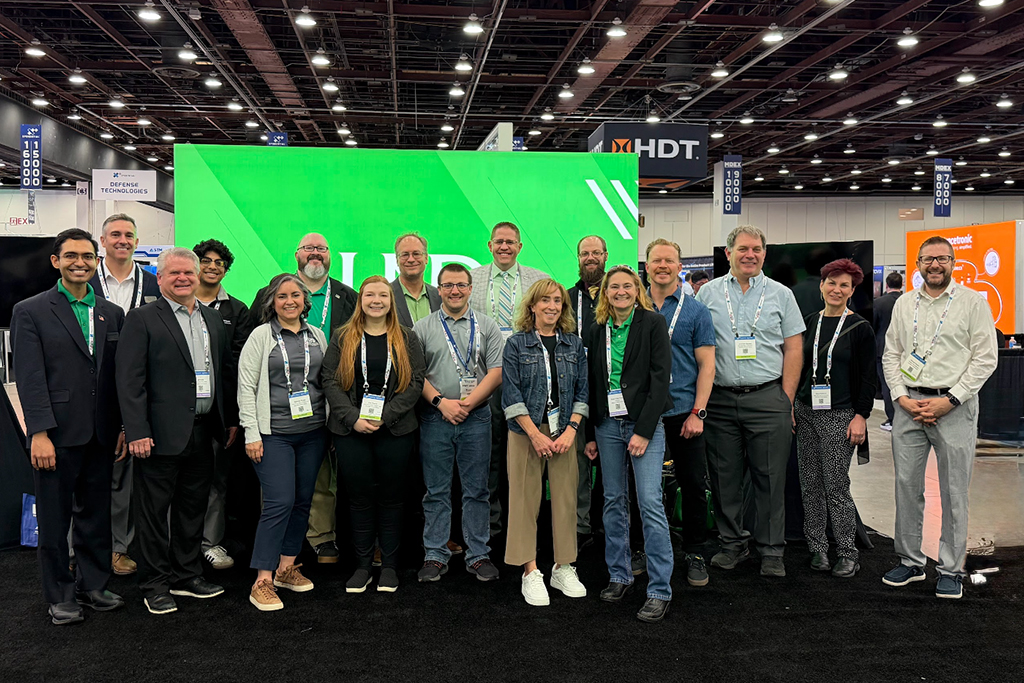
Amidst the bustling show floor at Huntington Place, smack dab in Detroit’s downtown, the Kelly-green glow of the University of North Dakota caught the attention of thousands of attendees during the week of May 11.
This year, the Motor City played host to more than 7,500 people and organizations involved and invested in autonomous technologies that descend on Xponential each year from across the globe. Companies, nonprofits, universities, state and federal entities and seemingly all “spokes of the wheel” comprising industries for uncrewed air systems and autonomy had a booth or badge in representation.
UND has been an Xponential mainstay for the past several years, boasting participation from several teams, divisions and colleges on campus including the Division of Research & Economic Development, Center for Innovation, John D. Odegard School of Aerospace Sciences, College of Engineering & Mines, College of Arts & Sciences and the Research Institute for Autonomous Systems. UND also once again sponsored the Drones in School National Championship held annually at the conference.
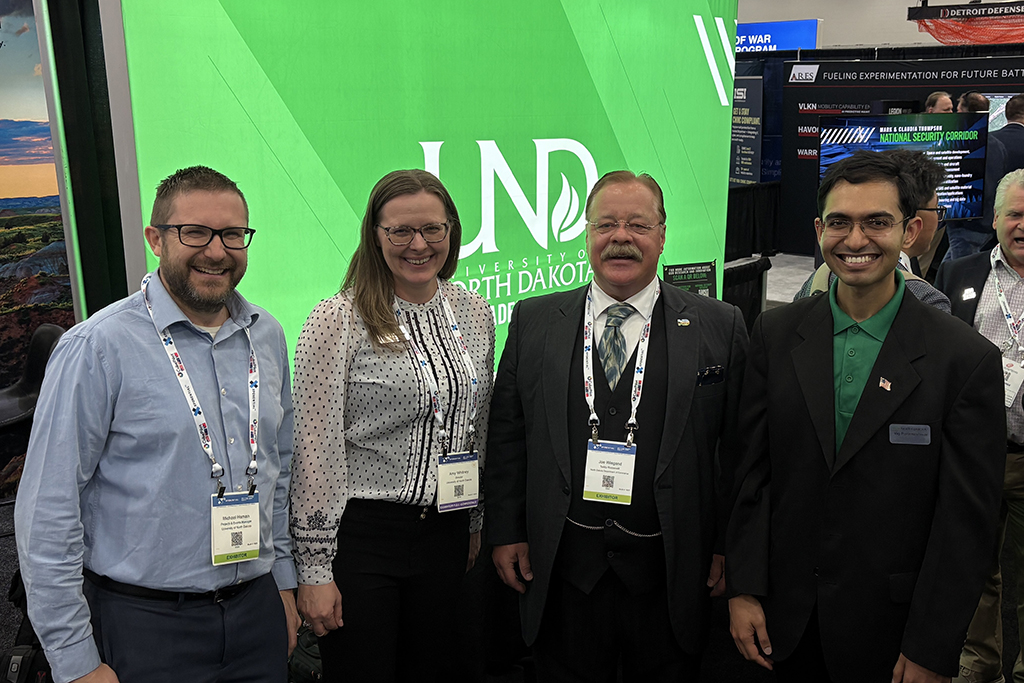
And in 2026, the University played a significant role in debuting what’s been referred to as “North Dakota Row,” a coalescence of several key players and emerging companies in the state’s development as a unified autonomy ecosystem.
Immediately behind UND’s backdrop were booths for the North Dakota Department of Commerce and the Northern Plains UAS Test Site. Across the way were stations for NDeavor Tech Park, the National Science Foundation’s AgTech Engine in North Dakota and Grand Forks Region Economic Development Corp., among others.
“For a long time, UND has had a really strong presence at this show and has engaged very well with our partners in the state,” said Cortnee Jensen, executive director of Economic Development at UND. “What we’re starting to do is say, ‘Hey, if we’re all together in the same place, we can reinforce each other’s messages in a better way.’”
In other words, the alignment at Xponential — literally and metaphorically — shows North Dakota for its strengths as a tight-knit and highly motivated corps of stakeholders across the spectrum of education, research, innovation, economic development and policymaking.
Broadened focus for UND and Xponential
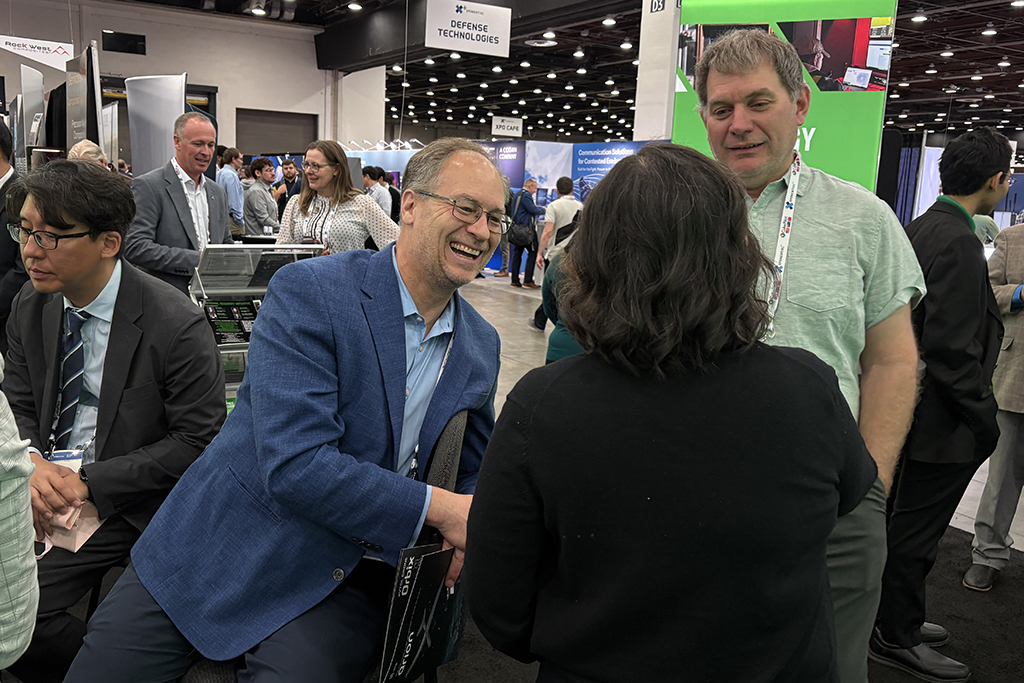
On the show floor, situated in the bannered section for “Defense Technologies,” the University has taken on a stronger presence since first appearing at Xponential several years ago, thanks to the arrival of more campus elements than aviation and drones alone.
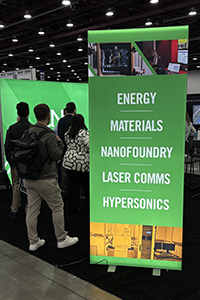 For example, posters near the booth listed subject areas including AI, counter-UAS, satellites, hypersonics, laser communications and space tracking.
Moreover, under the University’s ongoing National Security Initiative, UND’s presence at Xponential has paralleled the conference’s own shifts into becoming a wider autonomy and defense-focused event.
Mark Askelson, associate vice president for Research—National Security, remarked that Xponential is a key, annual engagement for spreading awareness of these burgeoning research areas on campus.
“Being here is an important element of our broader strategy to build and expand partnerships,” he said. “Years ago, when we were getting more involved with UAS, we realized that we had to be present, physically, otherwise people wouldn’t realize the solutions we could bring to the table.”
And just as word started to spread years back on UND’s competency in UAS operations, the University’s multidisciplinary cohort at Xponential 2026 highlights its ability to work across boundaries to solve challenges and provide solutions for others, Askelson said.
Jeremiah Neubert, professor of Mechanical Engineering, said newcomers to the UND booth are consistently impressed by the opportunities and facilities available through working with the University and in North Dakota. He looked forward to the opportunity to interact with others interested in defense-related research, as that presence has recently expanded at Xponential.
“Especially when it comes to autonomy and UAS, we’re a real leader,” Neubert said. “And now with hypersonics, I think UND is probably one of the top 10 places in the nation working in that area.”
Debuting ‘North Dakota Row’
Within hours of the show opening, Ryan Adams, dean of the College of Engineering & Mines, noticed the impact of bringing North Dakota-based entities closer together.
“I’ve had several times where a person from another booth on North Dakota Row brought someone over here and said, ‘Can you help them?” Adams said. “And when they have some other questions, there’s someone else right there to engage with them.
“It’s huge, to be honest … I think this layout, trying to get North Dakota in a row, was a brilliant idea.”
For Amy Whitney, director of the Center for Innovation, the concept is a true showcase of the familiarity between, for example, the Department of Commerce and UND, and the ability for everyone to work with each other.
Likewise, the fusion highlights the connecting role the Center itself plays between university-based research and industry to drive collaboration, innovation and commercialization.
“If someone wants to work with the University, the Center for Innovation can provide a way to enter that conversation,” she said. “Being able to connect with people and talk about that at Xponential is a wonderful shortcut.”
Chris Theisen, executive director for UND’s Research Institute for Autonomous Systems, said the “North Dakota Row” concept is one that’s likely to grow in future years as autonomy is more widely adopted — something the team at RIAS focuses on as a multi-disciplinary unit.
“Use of autonomy at the University has grown, and we see more departments getting involved,” Theisen said. “We have a whole group of people here now understanding that autonomy and the systems being shown at Xponential are important to their own fields.”
“At this conference, we have people with booths here for the first time,” Theisen continued. “It’s good to see that growth within the state, and how that translates to what people experience of North Dakota at Xponential. It’s fun to see that grow.”
A ‘pioneering spirit’ leads the way
Among several opportunities on “North Dakota Row” to network and promote the state as the place to research and develop the next big thing in UAS or autonomous tech, there were ample chances for UND’s delegation to tell the state’s story and characterize the ecosystem’s growth.
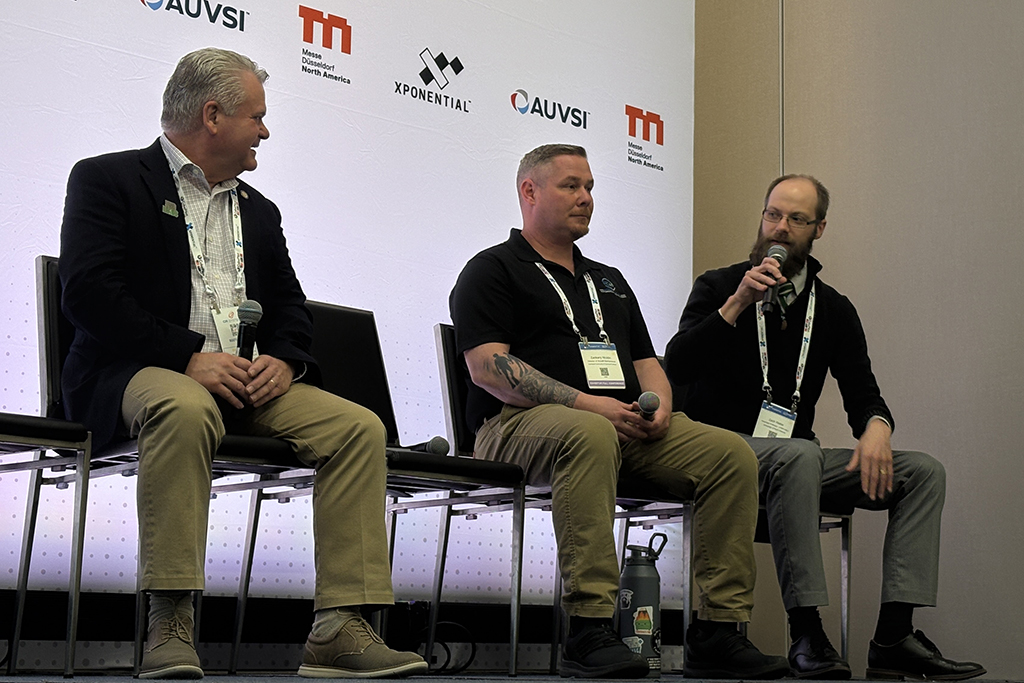
Speaking on a panel titled “Grand Things are Happening in the Northern Plains Region” the morning of Tuesday, May 12, Jeff Barta framed North Dakota’s progress as being culturally rooted — a “pioneer spirit” of survival that led to treating these emerging technologies as tools for rural sustainability and economic diversification.
From his dual-role perspective as director for Small Business Innovation Research/Small Business Technology Transfer at the Center for Innovation and as a State Senator for North Dakota’s District 43, Barta said that the choices and investments made from the local to state levels over the past decade-plus have fostered a network that can improve quality of life in the region and help the state weather more volatile markets in oil and agriculture.
He used the example of Project RuralReach, which last year saw a successful delivery of medicine by drone over an 80-mile journey. Led by the Center for Innovation, the project also involved the Northern Plains UAS Test Site and the Vantis network it administers for beyond-visual-line-of-sight flight, among other regional partners.
Panel moderator Aaron Sykes, assistant director for the National Center for Autonomous Technologies, remarked that North Dakota’s statewide commitment to leadership in these fields “set us collectively up for success in a way that hasn’t been seen elsewhere.”
Zack Nicklin, director of Aircraft Maintenance for St. Cloud Community and Technical College, followed by saying, “That’s the reality of North Dakota, specifically.”
“They may not be vertically integrated as an individual company,” he said. “But as a community, it’s all there. You have manufacturing, workforce development and the state’s economic environment that all comes together to support this … I’d love to see more states replicating it.”
Also on the panel was Zach Waller, associate professor of Aviation at UND. Through his position over the past 10 years with UND’s UAS degree program, Waller was able to share how the University’s “early seat at the table” helped the program quickly grow and respond in its curriculum to an industry that’s often just as quickly evolving.
“The opportunities for relationships with end employers and the ecosystem that has developed in the state has allowed us to foster two-way communication that not only informs us of what’s expected of graduates, but also directly connects graduates with these organizations,” he said.
And while the terminology of “ecosystems” and “habitats,” is tempting, Waller said, the progress to come in North Dakota won’t be a passive, natural ordering as one would see in a nature documentary.
“The process toward the goal of realizing the opportunity of autonomy is one that’s going to be active, requiring a lot of different perspectives,” he remarked. “That’s where the University of North Dakota has a unique role to play.
“The organizations at UND that have arrived since that watershed moment of the 2010s are going to help think about the opportunity of autonomy deeply and well. Because of their diverse perspectives and disciplines, they’ll have a finely tuned way to approach that opportunity in the years to come.”
****
>> Questions or comments about the UND LEADS Strategic Plan? Your thoughts are welcome! Please contact Ryan Zerr, associate vice president for Strategy & Implementation, or Brandon Wallace, senior financial accountant, the co-chairs of the UND LEADS Implementation Committee. You also may offer your thoughts by visiting the UND LEADS Strategic Plan home page and clicking on the “Provide your feedback” link.
Thank you for your support of the UND LEADS Strategic Plan!