UND initiative tackles flight challenges of hypersonic speed
Flying coast-to-coast in minutes, not hours? UND’s multidisciplinary Hypersonics Initiative may one day help bring that about
When an aircraft is traveling at more than a mile per second, encountering even the smallest particles in the atmosphere can be dangerous..
And at UND, researchers are working to address those dangers and more through the UND Hypersonics Initiative, a growing effort that brings together faculty across disciplines to study how vehicles behave at extreme speeds.
The initiative builds on foundational research led by Hallie Chelmo, associate professor of Mechanical Engineering and director of the initiative. In earlier work featured by UND Today, Chelmo led a federally funded project examining how atmospheric ice crystals form and interact with hypersonic vehicles — research that could improve the safety and design of spacecraft and other high-speed systems.
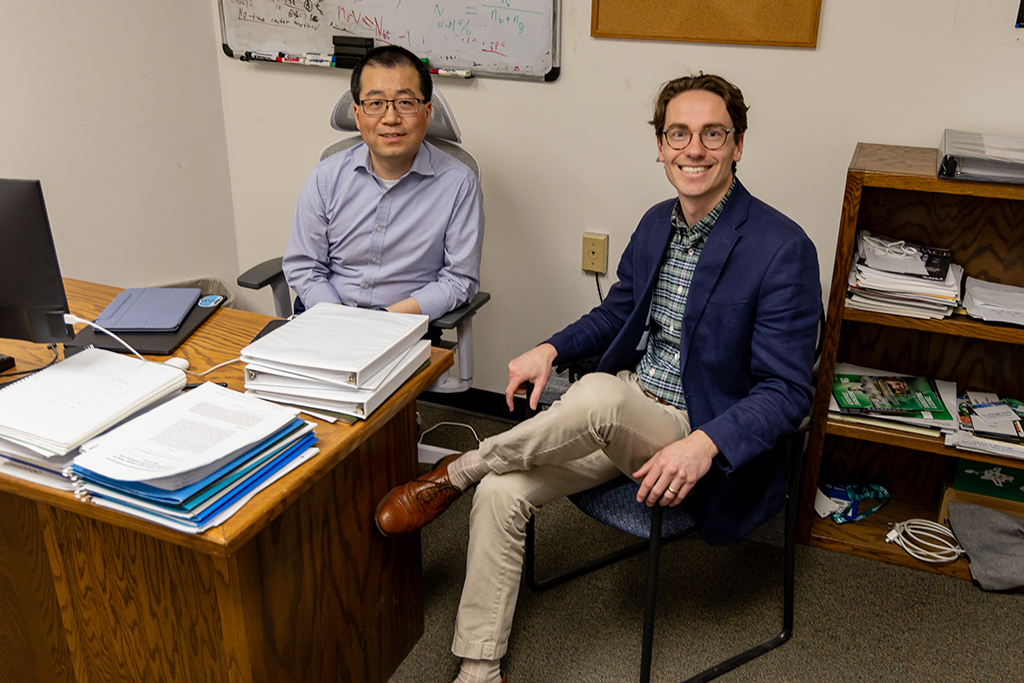
“The UND Hypersonics Initiative is a strategic investment from the university to pull together faculty researchers across campus, across a number of different disciplines, to try to tackle the current research problems facing hypersonics,” said Carson Running, assistant professor of Mechanical Engineering, and experimental area lead of the Hypersonics Iniative.
A different approach to hypersonics research
Hypersonic flight — generally defined as speeds above Mach 5, or five times the speed of sound — presents challenges far beyond conventional aerodynamics. At those speeds, the air surrounding a vehicle can reach temperatures of thousands of degrees, becoming ionized and forming plasma.
“You’re not just flowing through gas or air,” Running said. “You’re impacting those air particles with so much kinetic energy that you’re actually changing the structure of the air.”
That extreme environment can lead to communication disruptions, intense heating and material stress — all of which must be understood to ensure safe and effective flight.
While many large research programs focus on scaling up traditional hypersonics work, UND is taking a different approach.
“We don’t want to just build a wind tunnel and then do the things that everyone else is doing,” Running said. “What we can do is target a small number of distinct, niche areas and build deep expertise in them.”

One of those niche areas, first advanced through Chelmo’s research, is the interaction between hypersonic vehicles and atmospheric particles such as ice crystals.
What happens inside a cloud?
For vehicles traveling at hypersonic speeds, flying through a cloud is not a simple matter.
Chelmo’s earlier research established the importance of understanding how ice crystals behave in these extreme environments. Her Office of Naval Research–funded project (on which she worked with David Delene, research professor of Atmospheric Sciences) examined how ice particles form in the atmosphere and how they interact with hypersonic vehicles, including spacecraft reentering Earth’s atmosphere.
Now, researchers are continuing that work by investigating what happens when tiny ice particles encounter the shockwave at the front of a vehicle moving at such a high velocity as Mach 5.
“We don’t actually know what happens as that ice crystal first encounters that shockwave,” Running said. “It could pass right through. It could melt due to the extreme temperatures. It could break up due to the extreme amounts of energy that that shockwave imparts on it.”
What happens next could have significant consequences.
“If any parts or the entire ice crystal gets through that shockwave, the next thing that ice crystal is going to impact is the surface of the vehicle,” he said. “That could damage the vehicle surface, potentially. It could affect our aerodynamics. It could affect our propulsion device.”
Those unknowns have real-world implications for safety, performance and mission success.
From lab to simulation
To study these interactions, the UND researchers combine experimental work, atmospheric science and advanced computation.
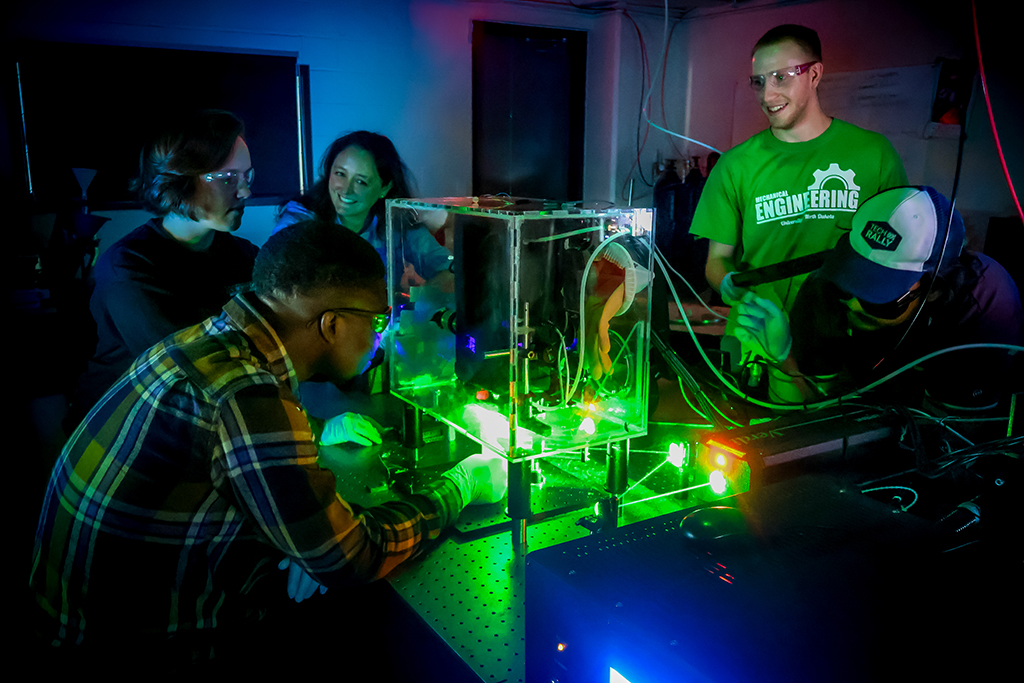
Ice crystals are created in laboratory settings based on real atmospheric measurements. They then simulate hypersonic conditions using specialized facilities, including shock tubes, where particles are subjected to high-speed shockwaves and observed using advanced diagnostics.
At the same time, computational models are used to simulate conditions that are difficult or impossible to recreate experimentally.
“There are things very hard to do in a lab environment,” said Chonglin Zhang, assistant professor of Mechanical Engineering, and computational area lead of the Initiative. “For example, you have very high temperature, around 10,000 degrees. How can you reproduce that? … I use computer models to study the process.”
Zhang’s work focuses on modeling high-temperature gas behavior, including chemical reactions and plasma formation. Together, the experimental and computational efforts allow researchers to compare results and refine their understanding.
“That’s kind of where it all comes full circle,” Running said.
Built on collaboration
The initiative grew out of Chelmo’s early research success, including her collaboration with partners at Purdue University.
That work showed the value of combining atmospheric science and hypersonics — two fields not traditionally studied together — and helped establish UND’s role in this emerging area.
With the addition of faculty such as Running and Zhang, the effort expanded into a broader, campuswide initiative.
Researchers from Mechanical and Aerospace Engineering now regularly brainstorm alongside experts in Atmospheric Science, Physics, Chemistry, Mathematics and Space Studies to address complex problems from multiple angles.
“We have folks that are the leading researchers and faculty in all of those areas,” Running said. “We come together, we say, what are some of the main problems that are facing hypersonics right now? And how can we come up with unique solutions from all these different angles?”
That collaborative model is already yielding results, including multiple federally funded projects supported by agencies such as the Office of Naval Research and the U.S. Air Force.
“Program managers really think we’re coming up with unique ideas, cross-disciplinary approaches that they’ve never seen come across their desk,” Running said.
Looking to the future
While hypersonics research is often associated with national defense, UND researchers emphasize its broader potential. Applications include spacecraft reentry, satellite systems and future high-speed travel. “It’s not only about hypersonic aerodynamics,” Zhang said. “It’s about having a lot of commercial potential.”
Running points to the possibility of dramatically reduced travel times. “You could fly from Grand Forks to Japan in less than two hours,” he said.
As research continues, UND’s goal is to build expertise in areas where it can make the greatest impact — a vision that began with Chelmo’s work and continues to grow.
“We want people to know that hypersonic research is going on here,” Running said. “We want to put UND hypersonic research on the map.”