Conference tackles challenges of health care workforce
Strengthening North Dakota’s health care workforce is the goal of multiple programs at UND, speakers say at Dakota Conference on Rural Health
By Jena Pierce
In the UND LEADS strategic plan, the core value of Service calls on UND to “engage in collaborations that serve the evolving needs of our people, tribal nations, the state of North Dakota, and our global community.” This includes preparing students for, and working to improve, the North Dakota workforce.
And with that in mind, the University’s commitment to improving the state’s health care workforce was evident at the recent Dakota Conference on Rural Health.
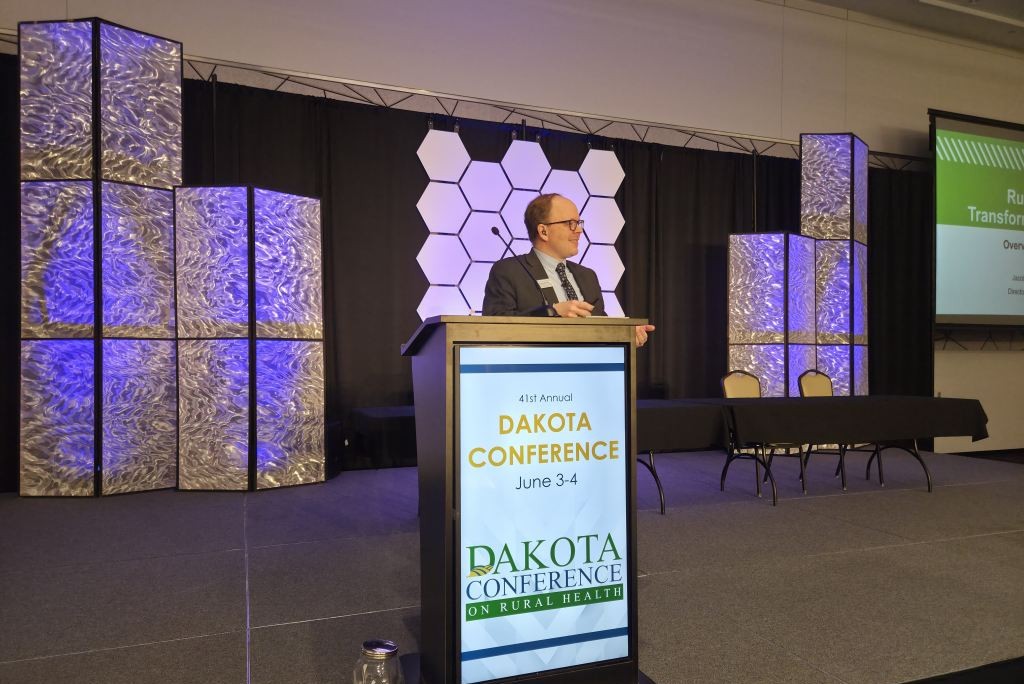
At the conference, which was held June 3-4 at the Alerus Center in Grand Forks, a keynote address and several breakout sessions examined how UND can best serve the health workforce in the state.
The state of the health workforce
During his keynote address, Jacob Warren, director of the UND Center for Rural Health and associate dean for rural health at the UND School of Medicine & Health Sciences, spoke about the North Dakota Rural Health Transformation Program and how 16% of the $198 million recently awarded to the state will focus on workforce issues. As a part of that effort, the Center is contracting with the North Dakota Department of Health and Human Services to comprehensively assess the health care workforce.
“The state wants a full snapshot of the health care workforce for everyone,” said Warren. “This includes Critical Access Hospitals, Federally Qualified Health Centers, long-term care centers, local public health units and behavioral health providers. They want to see the magnitude of the need to know where and how to fund programs where North Dakota needs workforce.”
The assessment includes information about current staffing, vacancies and what will be needed in 5-10 years. “Part of the goal of the investment in recruitment is not just what we need now, but what we will need in the future,” Warren added.
Holistic wellness
With the health of the health care workforce in mind, the conference also considered burnout — in particular, practical approaches to holistic wellness and resilience for rural health and human service professionals, among whom burnout is a risk. Grace Karikari, assistant professor of Indigenous Health within the UND Department of Indigenous Health, and Isaac Karikari, associate professor and Master of Social Work program director for the UND Department of Social Work, shared frameworks and ways to address the strain current health care workers are experiencing.
Rural work offers unique stressors for providers, the presenters pointed out. Professional isolation, along with chronic understaffing and moral injury, can cause burnout.
Through their work, Grace and Isaac Karikari want to help providers in North Dakota improve their mental health and overall well-being. Knowing that the audience for this breakout session included social workers, public health workers, community health workers, nurses and educators, Isaac Karikari shared why the topic of burnout is so important: “We have been putting bandages on many of the broken things for so long, how long are we going to keep covering up our own burdens in the workforce?” he said.
The Karikaris shared three frameworks to help with these issues: The Substance Abuse and Mental Health Services Administration’s Eight Dimensions of Wellness; Trauma-Informed Care Principles; and the TRUE Thriving Framework. The frameworks offer practical approaches that providers can use to not only teach others how to improve their mental health outlook and overall well-being, but also help themselves stay healthy, they said.
Rural nurses for rural communities
With the goal of boosting North Dakota’s nursing capacity, the UND College of Nursing & Professional Disciplines has a program to increase the number of nursing graduates with enhanced training in age-friendly care. The program’s students receive mentoring, specialized training, tutoring, and financial support through stipends and scholarships.
The Gero-STARR (Specialized Training to Advance Recruitment and Retention of Nurses in Acute and Long-term Care) program trains nurses to work in acute and long-term care settings.
The program focuses on developing nurses who are trained to work with North Dakota’s aging and tribal populations in rural communities. “Rural areas have unique challenges with recruitment and retention,” said Tracy Evanson, professor of Nursing at UND.
“It is tough for rural areas to compete with more urban areas for competitive salaries and benefits and opportunities for specialization, along with issues such as available housing and child care.”
In North Dakota, elderly individuals (65 years and older) make up 15-17% of the total population, with those 85 and older making up 2.2%. Moreover, on average, American Indians do not live as long as people of other backgrounds and ethnicities in the state. This suggests there are growing nursing needs for both of these populations.
Dawn Denny, associate professor of Nursing and director of the Gero-STARR Program, intends for the program to increase nursing capacity in the state. “We want to recruit from North Dakota, so the students will want to stay in North Dakota after they graduate,” she said. “Specifically recruit from rural North Dakota, with the increased likelihood they will return to rural, to the communities they know and love.”
The program requires students to agree to accept their first position at an acute or long-term care facility within a rural area of North Dakota for the first year. “We will track their progress to see if they only work in rural for one year, or if they choose to stay longer.”
Home-grown providers
Even the actions of the North Dakota Legislature reflect the importance of the state’s health workforce. For example, that’s why lawmakers passed Senate Bill 2003 in 2025, setting a goal of 85 percent of medical and physician-assistant students in the UND School of Medicine & Health Sciences being North Dakota residents by the fall 2030 semester.
Since ND85 was passed, the School of Medicine & Health Sciences has moved into high gear by increasing its recruitment efforts to all corners of the state. Among the school’s other actions over the last year and a half, Emily Evers, assistant director of admissions and recruiting, and Adrianna Jackson, coordinator of outreach and recruiting coordinator, have visited high schools in 28 counties across the state.
“We want to be in these rooms, and we want to talk to these people,” said Evers. “We have heard a lot about recruiting providers, but it all starts with recruiting these students to choose the path of health care. That is a big part of what we are trying to accomplish.”
Along with increased high school visits, Evers and Jackson are working with two Center for Rural Health programs: North Dakota HOSA, a student organization promoting health careers, and Scrubs Camps, one-day camps for middle and high schoolers to learn about health careers.
In short, North Dakota clearly recognizes the importance of the health care workforce, and UND has made building that workforce across the state a priority. The speakers at the 2026 Dakota Conference on Rural Health showed how multiple disciplines are working to not only identify and care for current needs but also increase the availability of providers, all with the goal of keeping North Dakota’s rural communities healthy and safe.
About the author:
Jena Pierce is communications manager for the Center for Rural Health at UND.