Stopping ovarian cancer before it starts
UND researchers explore the link between radon exposure and ovarian cancer
Editor’s note: In the UND LEADS Strategic Plan, the Discovery core value calls on the University to “enhance and deepen UND’s Grand Challenge areas, which foster and sustain cross-disciplinary teams dedicated to identifying solutions to pressing challenges.”
One of UND’s Grand Challenges is to help rural communities solve their unique health and social problems, and that’s what the story below is about.
This story was originally published in the Summer 2026 edition of North Dakota Medicine, the quarterly journal of the UND School of Medicine & Health Sciences.
****
A first-of-its-kind study published by University of North Dakota researchers recently in JAMA Network Open reveals a significant association between residential radon gas—a common, modifiable environmental hazard—and an increased risk of ovarian cancer incidence and mortality among postmenopausal women.
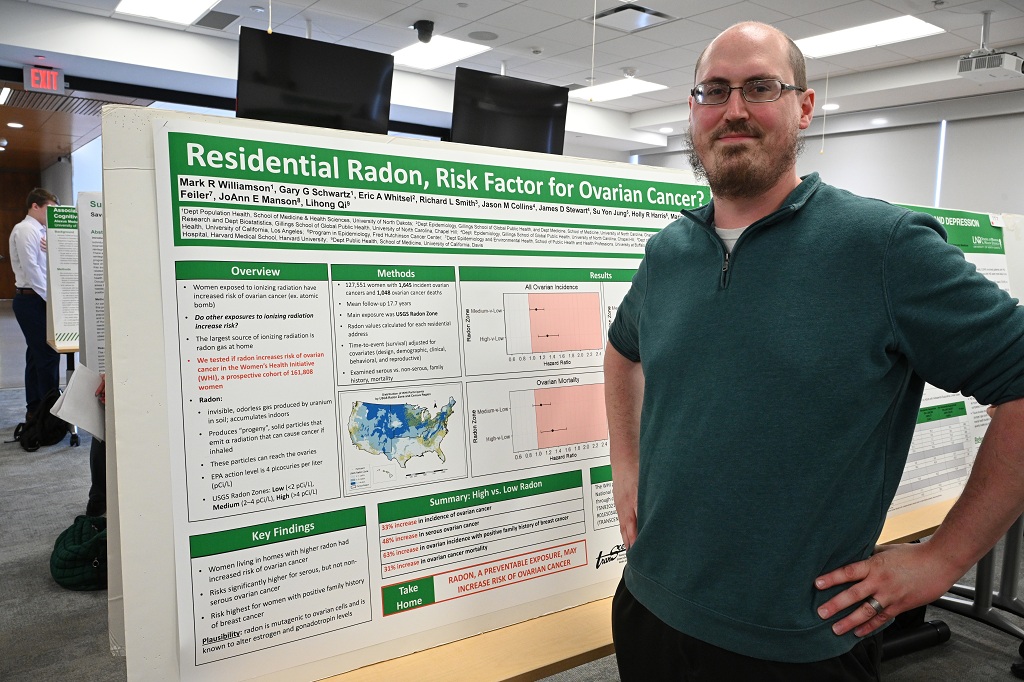
The prospective cohort study, led by researchers at the UND School of Medicine & Health Sciences (SMHS) and the University of North Carolina at Chapel Hill, analyzed data from over 127,000 women participating in the Women’s Health Initiative (WHI) over a 31-year period. The findings suggest that women living in “high” radon zones, as defined by the U.S. Environmental Protection Agency (EPA), face a significantly higher risk of developing ovarian cancer compared to those in low-exposure areas.
A novel approach
According to the Ovarian Cancer Research Alliance, ovarian cancer remains the fifth leading cause of cancer deaths among women in the United States. While genetic factors and reproductive history are well-known risk factors, environmental causes have remained elusive.
“We have known for decades that radon is a leading cause of lung cancer, but its impact on other organs has been a subject of intense debate,” said Mark R. Williamson, research assistant professor in the SMHS Department of Population Health, and lead author of the study. “This research provides the first individual-level evidence that the ionizing radiation from radon gas may be a target for mitigating ovarian cancer risk.”
The research team linked geocoded home addresses of 127,547 postmenopausal women to US Geological Survey (USGS) radon zones. Over an average follow-up of nearly 18 years, the study observed 1,645 ovarian cancer cases and 1,048 ovarian cancer deaths.
The study found that women in high radon zones (levels exceeding 4 picocuries per liter [pCi/L]) had a significantly higher “hazard ratio” for ovarian cancer compared to those in low radon zones (<2 pCi/L). The association was particularly strong for serous ovarian cancer, the most lethal and common type, with a 38% increased risk in high radon areas.
Even more, the risk of dying from ovarian cancer was also 31% higher for women residing in high radon zones.
Colorless, odorless
Radon is a naturally occurring radioactive gas produced by the decay of uranium in soil. It enters homes through foundation cracks and can accumulate to dangerous levels. While primarily inhaled, radon gas is soluble in blood and can reach internal organs.
For this reason, the study posits two biological mechanisms for the association between radon and ovarian cancer. First, as radon decays, its “progeny” (solid waste products) may be carried to ovarian tissues via particulate air pollution, acting as a “Trojan horse” to deliver alpha-particle radiation directly to the cells. At the same time, previous research has indicated that radon inhalation can significantly increase levels of estradiol and other hormones in the blood, making radon a hormone “disruptor,” the consequences of which can include cancer.
Unlike many genetic risk factors for cancer, though, radon exposure can be mitigated through radon testing and removal. Unfortunately, noted Gary Schwartz, professor and chair of the SMHS Department of Population Health, only about 18% of U.S. homes have ever been tested for radon, despite approximately 25% of the population living in high-radon areas.
“Residential radon is a ubiquitous exposure, but it is one we can control,” said Schwartz, who was senior author on the study. “If these findings are replicated, radon testing and mitigation could become a vital component of ovarian cancer prevention strategies.”
Next steps
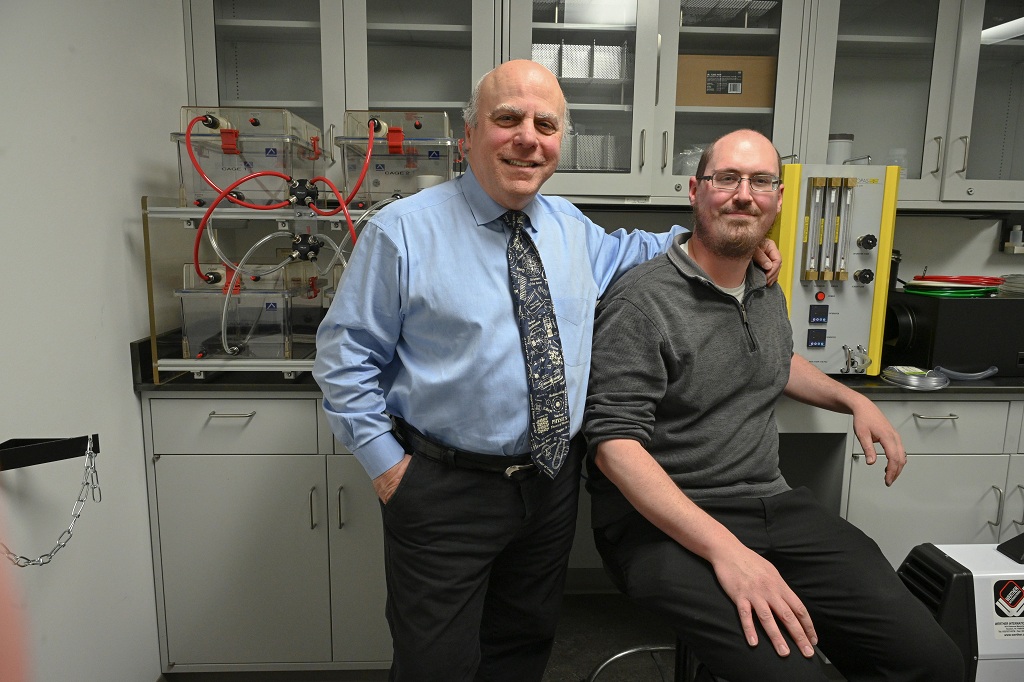
The researchers cautioned that while the study is robust, it focused exclusively on postmenopausal women. Additionally, because the radon data was based on regional estimates rather than individual home tests, the results may not reflect personal exposure levels for every participant. Even so, Williamson and Schwartz said that the next step is further research, which is already underway at UND. The pair is hard at work finalizing a radon test chamber at UND – one of only a few in the country – that will enable area researchers to test the effects of radon on cells directly.
The team is pursuing all of this because, as this new research demonstrates, lives are at stake.
“If we can change a common exposure and do things like make sure new homes have radon resistant construction and make sure women at high risk for ovarian cancer check their radon levels and change them,” Schwartz concludes, “we’d be saving lives.”
****
>> Questions or comments about the UND LEADS Strategic Plan? Your thoughts are welcome! Please contact Ryan Zerr, associate vice president for Strategy & Implementation, or Brandon Wallace, senior financial accountant, the co-chairs of the UND LEADS Implementation Committee. You also may offer your thoughts by visiting the UND LEADS Strategic Plan home page and clicking on the “Provide your feedback” link.
Thank you for your support of the UND LEADS Strategic Plan!