Where big ideas become energy reality
As part of its 75th anniversary celebration, the EERC explores how the annual ‘Energize’ summit helps shape North Dakota’s energy future
Editor’s note: In 1948, Congress authorized the establishment of a national lignite research laboratory at UND. Construction of the Charles R. Robertson Lignite Research Laboratory was completed in 1951; and that’s why, in 2026, the facility — now known as the UND Energy & Environmental Research Center — is this year celebrating its 75th anniversary as a global leader in advanced energy and environmental solutions.
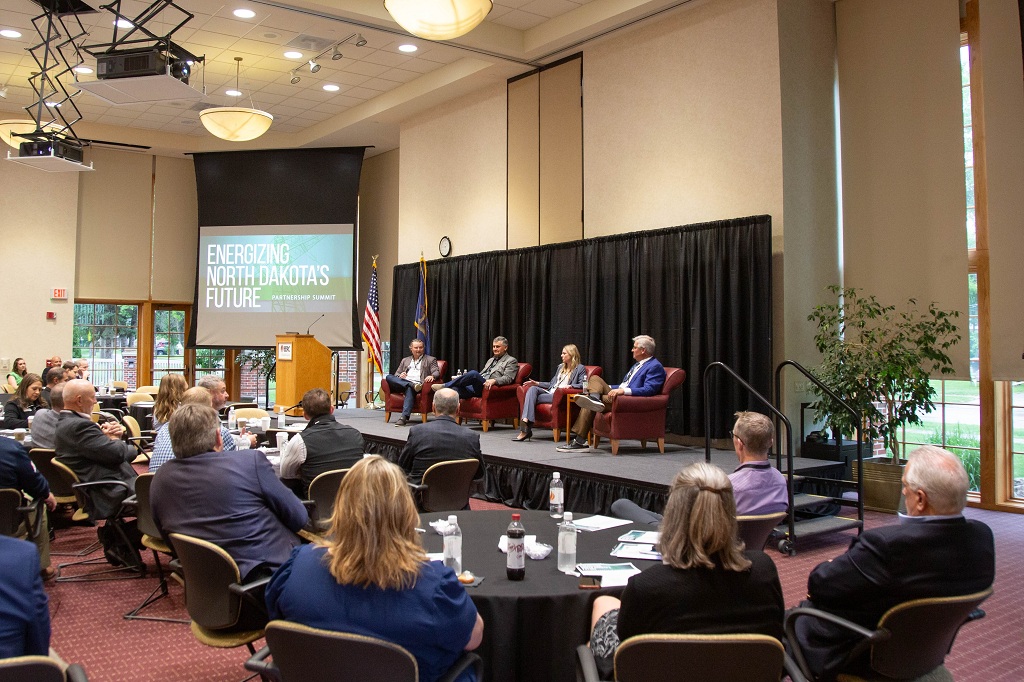
With the anniversary in mind, UND Today is running a series of stories to celebrate the EERC and its exceptional legacy. This week: a recap of the 2026 Energizing North Dakota summit, an annual summit that (as the story reports) explores North Dakota’s abundance of energy opportunities.
This story was originally published on July 9, 2026, on the EERC Solutions website.
****
Ten years ago, a simple conversation between Energy & Environmental Research Center leaders sparked an idea that has inspired the EERC and North Dakota’s energy industry. Their vision was straightforward: invite decision-makers to the EERC, demonstrate the technologies being developed here, and create an environment where intentional conversations could foster meaningful action. That idea grew into Energizing North Dakota (Energize)—an annual summit bringing together industry leaders, policymakers, researchers, and innovators to tackle the state’s greatest energy opportunities.
A decade later, those conversations have helped shape North Dakota’s energy industry.
The 10th annual Energize summit in early June celebrated the partnerships built over the last decade and the remarkable progress made toward seven energy goals established during the event’s early years. Together, those goals have guided research priorities, strengthened collaborations, and positioned North Dakota as a leader in developing practical energy solutions.
The seven goals were intentionally ambitious. Rather than focusing on short-term wins, they outlined a long-term vision for how North Dakota could maximize its natural resources while advancing technology, improving environmental performance, and expanding economic opportunity.
Goal 1: Increase North Dakota’s oil recovery
When this goal was established, North Dakota produced approximately 1 million barrels of oil per day, with hopes of reaching 2 million. While production has peaked above 1.5 million barrels per day and currently averages roughly 1.2 million, the focus has shifted toward an even more impactful objective: increasing the amount of oil ultimately recovered from existing reservoirs. Projects such as the Bakken Production Optimization Program and Crack the Code 2.0 unlock additional production while extending the productive life of North Dakota’s oil fields for decades.
Goal 2: Capitalize on agricultural and energy synergies
Research supporting carbon capture at ethanol facilities, biofuels, hydrogen production, and fertilizer technologies demonstrate how linked our agriculture and energy are to one another. These synergies not only help each sector, but also show North Dakota’s economy can create a new industry. Initiatives such as the Heartland Hydrogen Hub (HH2H) and the Richardton CCS Project illustrate how these industries are working together to create new economic opportunities while reducing emissions.
Goal 3: Maximize the use of natural gas
Over the past decade, investments in gas utilization technologies, storage, transportation infrastructure, and hydrogen production have expanded opportunities to convert natural gas into higher-value products while reducing waste. Efforts within HH2H aim to utilize abundant natural gas for fertilizer production with CO2 captured for enhanced oil recovery. We are also advancing patented technologies developed through the Polar Bear program to reduce emissions and enhance efficiency for the oil and gas industry by capturing and compressing flare gas. Both efforts could transform North Dakota’s abundant natural gas resources into energy solutions.
Goal 4: Eliminate pipeline leaks
Safe and reliable infrastructure remains essential to North Dakota’s energy future. Advanced monitoring systems and leak-detection technologies developed through projects like the intelligent Pipeline Integrity Program are improving pipeline safety by allowing operators to identify issues more quickly and accurately than ever before. These innovations strengthen public confidence while helping ensure reliable energy transportation across the region.
Goal 5: Enhance reliability and expand energy export opportunities
As energy systems evolve, reliability becomes even more important. Research involving carbon capture, utilization, and storage (CCUS); grid modernization; energy storage; and advanced power generation technologies is helping North Dakota remain a dependable energy supplier while opening new opportunities for domestic and international energy exports. Major initiatives including Project Tundra, CarbonSAFE, and solid oxide electrolysis cell (SOEC) projects continue advancing technologies that support a resilient, lower-carbon energy future.
Goal 6: Unlock the full value of North Dakota’s lignite
North Dakota’s approximately 25 billion tons of recoverable lignite are far more than fuel. Today, our researchers are developing innovative ways to transform lignite into high-value products including graphene, graphite, engineered carbon materials, and critical minerals. Projects such as the Williston Basin CORE-CM Initiative and multiple patented lignite-derived technologies demonstrate how one of the state’s most abundant natural resources can support entirely new industries.
Goal 7: Inform the world on energy and environmental topics
Perhaps the most enduring goal centers on education and collaboration. The relationships formed through Energize directly contributed to the creation of the State Energy Research Center (SERC), which has since invested $25 million in research projects and generated an additional $43 million through follow-on activities. Educational programs such as the Energy Hawks, along with the EERC’s broader outreach efforts continue to help policymakers, students, industry leaders, and communities better understand evolving energy technologies and North Dakota’s role in meeting global energy needs.
Achieving goals through collaboration
These goals would not be possible without the summit’s greatest strength: the people it brings together. Throughout the 2-day event, attendees hear from industry executives, elected officials, researchers, and innovators working across oil and gas, power generation, carbon management, hydrogen, critical minerals, agriculture, infrastructure, and national security. The agenda reflects the increasingly interconnected nature of today’s energy landscape, highlighting opportunities to strengthen domestic energy production while advancing new technologies that improve reliability, sustainability, and economic competitiveness.
Many of the collaborations that arose from past Energize summits have grown into large-scale research initiatives, commercial partnerships, and state and federal investments that continue shaping North Dakota’s energy future. The work outlined in the original seven goals is far from complete, and many of today’s research initiatives build directly upon the foundation established a decade ago.
As Energize enters its second decade, its purpose remains unchanged: bring together the right people to solve complex energy challenges through collaboration, innovation, and practical research. The conversations that began 10 years ago continue to influence projects underway today and will help define the next generation of energy technologies for years to come.