UND Office of Extended Learning expands continuing education online offerings
New commercial driver’s license and trauma-informed care programs broaden professional development options
Editor’s note: In the UND LEADS Strategic Plan, the Service core value includes a call to both “provide lifelong-learning opportunities that appeal to community members of all ages, and capitalize on the expertise at UND,” and “provide curricular and co-curricular opportunities for UND students to give back and serve their communities.”
The following story, which was first published in UND Today on June 16, describes another in an extensive series of efforts by UND to provide lifelong-learning and certificate opportunities.
####
A commercial driver’s license program and a course on trauma-informed care might seem as if they have nothing in common.
But what these two recently introduced UND online programs have in common is their responsiveness to evolving workforce needs.
In addition, through the Office of Extended Learning at UND, myriad professional development opportunities — including the above — exist under one roof.
At the Office of Extended Learning, reaching learners beyond traditional degree programs by creating flexible and focused education opportunities is key to its role at UND.
Throughout the University’s history, the Office of Extended Learning has worked as an extension of UND’s commitment to serve learners wherever they are.
“Our department can be very nimble and responsive to what’s happening beyond the academic setting, so we try to stay on the cutting edge of things,” said Julie Zikmund, associate director of the Office of Extended Learning. “If we see a need and can fill the gap, we’ll try to do it.”
In the past year, in addition to a recent partnership with Coursera offering hundreds of courses to the UND community at an exceptional value, the Office of Extended Learning has added to its reach with these new programs.

New CDL training program creates streamlined pathway
What inspired the Office of Extended Learning to consider a CDL training program had to do with what was happening around the state, Zikmund said.
North Dakota has persistently faced a shortage of CDL-holding drivers needed for the state’s prominent energy and agricultural industries. Also, regulations have evolved to require more time behind the wheel in an approved training program, Zikmund added.
Taking stock of this landscape, Zikmund and her team reached out to vendors to see how they might connect the dots between mandated classroom learning and testing, as well as driving training.
The result: an offering through UND combining two separate components into one pathway.
Those enrolled in the program will complete the CDL certified theory portion online, through CDLOnline, to earn a permit through the federally required entry-level driver training curriculum.
For Part Two, students will go to Commercial Education and Safety, a training company based in West Fargo, to gain behind-the-wheel experience.
Through UND’s offering, students have one year to complete both portions of the course — around 40 hours to complete the theory portion and 120 hours of driving with CES instructors. This combined experience prepares students for the final CDL exam.
By doing the legwork to vet the program’s partners and create a cohesive pathway, the Office of Extended Learning is a one-stop shop that removes any uncertainty around what’s needed for a license, said Moriah Opp, coordinator for Personal & Professional Development.
“When we’re looking at vendors and contracts, we know people trust the UND name and brand, and that means a lot to us,” Opp said.
“We also have people who are able to answer questions or be an advocate for you, so it’s not just you on your own if you’re stuck somewhere or need any kind of help in completing the program,” Opp continued. “I think that can be a bonus when you’re trying to pivot in your career — trusting that there are people with you along the way.”
Trauma-informed care offers continuing education opportunity for ND professionals
The new trauma-informed care course was also the result of a partnership, this time with faculty in the College of Nursing & Professional Disciplines.
Professors Anne Bodensteiner and Jennifer Schlinger developed the content of what became a six-month, online, enroll-any-time course offering continuing education units for North Dakota’s nurses, social workers and dietitians.
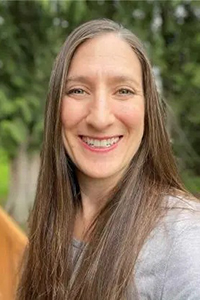
Bodensteiner, clinical associate professor of Nutrition & Dietetics, said the course resembles a “beginner’s guide” to how emotional trauma impacts the human body and behaviors. It also offers introductory tools and techniques for working professionals to use with clients.
“Trauma-informed care is about recognizing that psychological wounds show up in very different ways throughout care and working with patients and clients,” Bodensteiner said. “When we put those principles into place, we avoid causing additional harm … we’re able to better work alongside them regardless of the circumstances, without reintroducing that trauma.”
It was when Bodensteiner was previously working as a dietitian that she came to understand the impact of trauma on health outcomes. It wasn’t a concept she learned as an undergraduate. But when it came to her interactions with clients, she saw firsthand how much trauma affected overall wellbeing.
“I started looking into how trauma impacts the body and our behaviors, and I was like, ‘People need to know this is having a massive impact on our clients. We aren’t getting to the root of the issue and perhaps not making an appropriate referral, in some cases,’” Bodensteiner recalled.
Later in her career, at UND, Bodensteiner was able to connect with Schlinger, clinical assistant professor of Social Work, who studies trauma-informed care more directly.
Over the past year, the two came up with a course that combined their areas of expertise: Bodensteiner examining the clinical manifestations of trauma and Schlinger characterizing how the brain responds to trauma and how trauma-informed care can be enacted in various settings.
At the Office of Extended Learning, Opp, who took the course herself, said the content is valuable to anyone who’s in the “helping profession,” even if that job is outside of health care.
“I think this is a great, general course that can get you thinking about the people with whom you’re working,” Opp said, giving the higher education setting as an example. “It’s helpful to understand the principles, practices and what to look out for when interacting with others.”
For Bodensteiner, achieving a greater understanding about trauma and trauma-informed care changed the way she practiced and taught in her field, she said.
“I want every helping professional to know these skills,” Bodensteiner said. “No matter who, the people you’re working with have experienced some type of trauma that’s going to impact the way they show up and behave. This knowledge takes some of the pressure off you as a provider in being able to meet others where they are and support them.”
****
>> Questions or comments about the UND LEADS Strategic Plan? Your thoughts are welcome! Please contact Ryan Zerr, associate vice president for Strategy & Implementation, or Brandon Wallace, senior financial accountant, the co-chairs of the UND LEADS Implementation Committee. You also may offer your thoughts by visiting the UND LEADS Strategic Plan home page and clicking on the “Provide your feedback” link.
Thank you for your support of the UND LEADS Strategic Plan!