Art Collections shapes experiences at Chester Fritz Library
UND art curators’ latest project: Transform library study rooms into immersive learning environments
Editor’s note: In the UND LEADS Strategic Plan, the Service core value includes a call to “promote the arts and humanities, which contribute to the cultural vibrancy of the state and help attract and retain talent in our communities.”
The following story, which was first published in UND Today on July 21, describes the UND Art Collections’ extensive efforts to make art a meaningful and memorable part of the UND experience.
####
Students studying at the Chester Fritz Library this fall will find themselves stepping into more than a study room.
UND Art Collections will transform 13 study rooms into immersive environments. While studying or taking a break, students may stumble across hidden clues and stories waiting to be uncovered.
“Every room has a theme based on an area of study at UND, and nothing is really on the nose,” said Sarah Heitkamp, curator and director of UND Art Collections. “We want students to question what they are seeing.”
Art as a portal
Heitkamp defines what they are creating in the library as creative infrastructure: using art not only to enhance a space, but also to shape how people experience, question and learn within it.
Everyday objects, such as a chair or table, may remain ordinary until they are placed and given new meaning. Within these immersive installations, those familiar objects become part of the artwork and an invitation to look deeper at what is right in front of you.
“It’s about creating an environment,” Heitkamp said. “There’s no wrong way to interpret these art installations, and that’s kind of the beauty of it. We are encouraging students to engage with art on campus in a completely different way.”
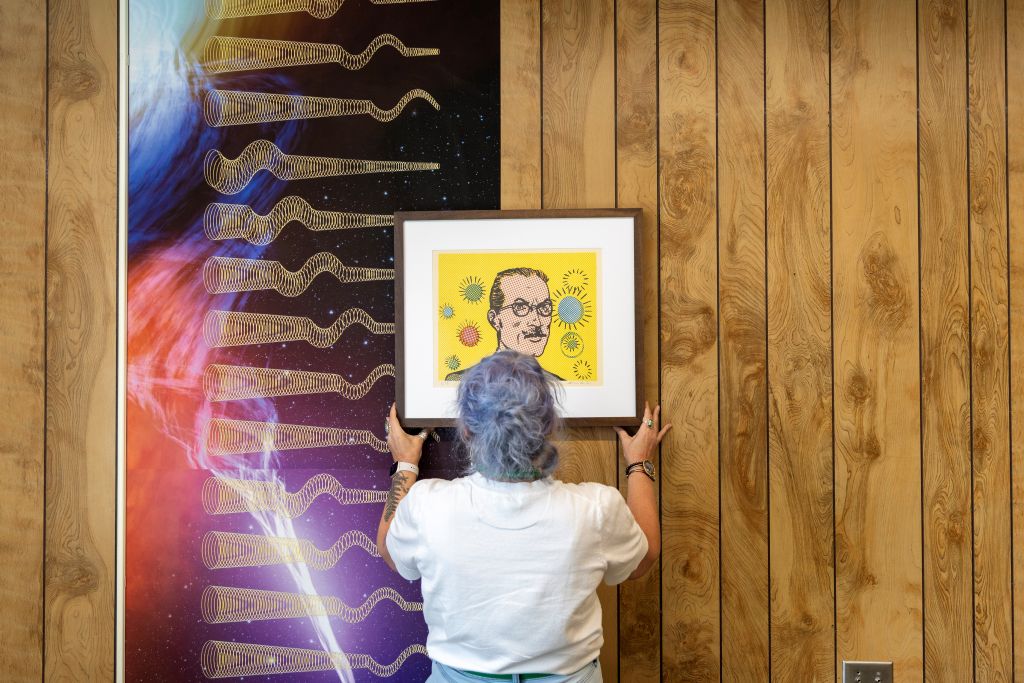
In the project’s first phase, Heitkamp and Hannah Bahlmann, gallery manager, have begun transforming the first three rooms. Students will be able to study in different dimensions as each room explores the idea behind something familiar and pushes it out of the ordinary.
One room embraces the building’s existing wood paneling with a retro ’70s aesthetic while weaving in themes of space studies. Another uses previous artwork to enhance the ’80s aesthetic and graphic design influence.
“You might find clues. You might find yourself on an adventure. You might solve something,” Heitkamp said. “You might get involved in an actual story that has to do with the library.”
While the transformation has begun, there is still so much yet to come. Students remain at the center of the process. In the coming year, graduate students will help write the stories connecting the rooms while also choosing, researching, framing and installing artwork. Students often come from a range of majors and backgrounds, including aviation and engineering, bringing perspectives that go beyond the art curators.
“When we come in and look at art, we already know what to look for,” Bahlmann said. “They’re so great at giving us perspectives, like, ‘This is how everybody else is going to look at this.’”
“It’s essential for them to have hands-on experience,” Heitkamp added.
As students themselves, the graduate assistants also understand how their peers might respond when artwork appears in the spaces they pass through every day.
“That’s the great part about having them work with us,” Bahlmann said. “They already have insight into how the student population is going to react to a change.”
As the project grows, the creative infrastructure will eventually spill beyond the walls of the study rooms. Each floor of the library will begin to feel like a different room within a house. A greenhouse-inspired space will emerge near the first-floor windows, while other areas will continue to evolve as installations and student contributions are added over time.
Behind the frame
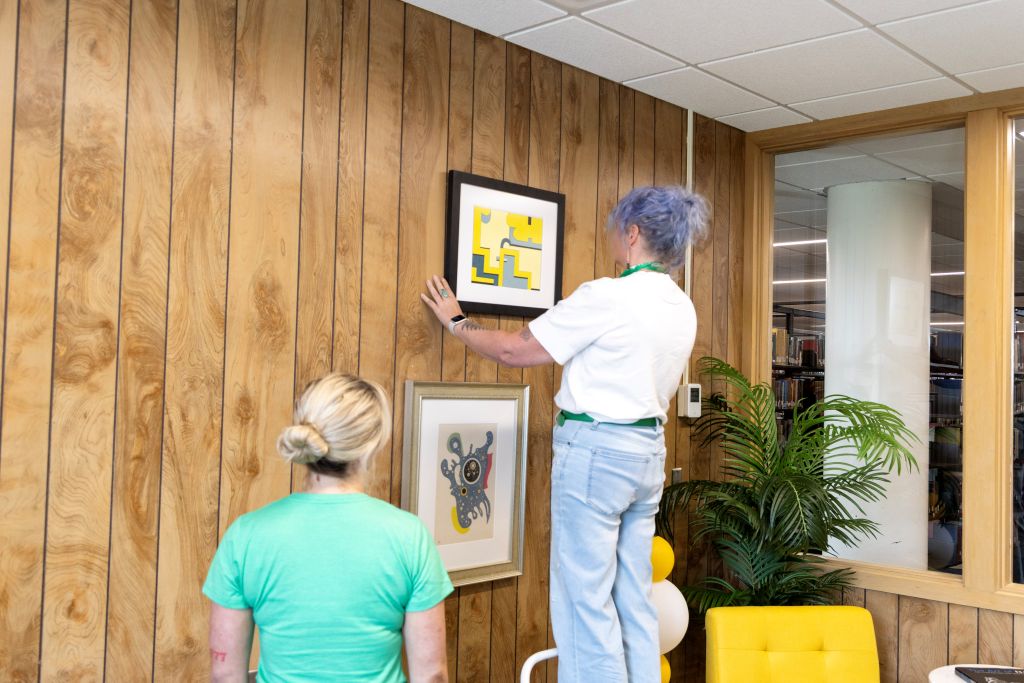
The two-person Art Collections team has displayed more than 1,500 pieces of art across campus. By the beginning of the academic year, nearly 2,000 pieces will be on display.
Their process may appear simple: begin with a blank wall and select the art. In reality, each project starts with a conversation about the people who work, study and move through the building.
“It’s really important for us to have a good understanding of what is happening in that building before we start curating and choosing art,” Heitkamp said.
Those conversations help the team uncover the story within the space. At the Chester Fritz Library, that story was built from a concept called the “Deconstructed Dollhouse.” Heitkamp and Dean of Libraries Rebecca Bichel began with the idea of the library as a home away from home. From there, they played with how art could make the library feel different.
“When you come here, the idea is you shouldn’t have to leave for anything,” Heitkamp said. “You can spend the whole day here with access to everything you need. Our job was to put a twist on that.”
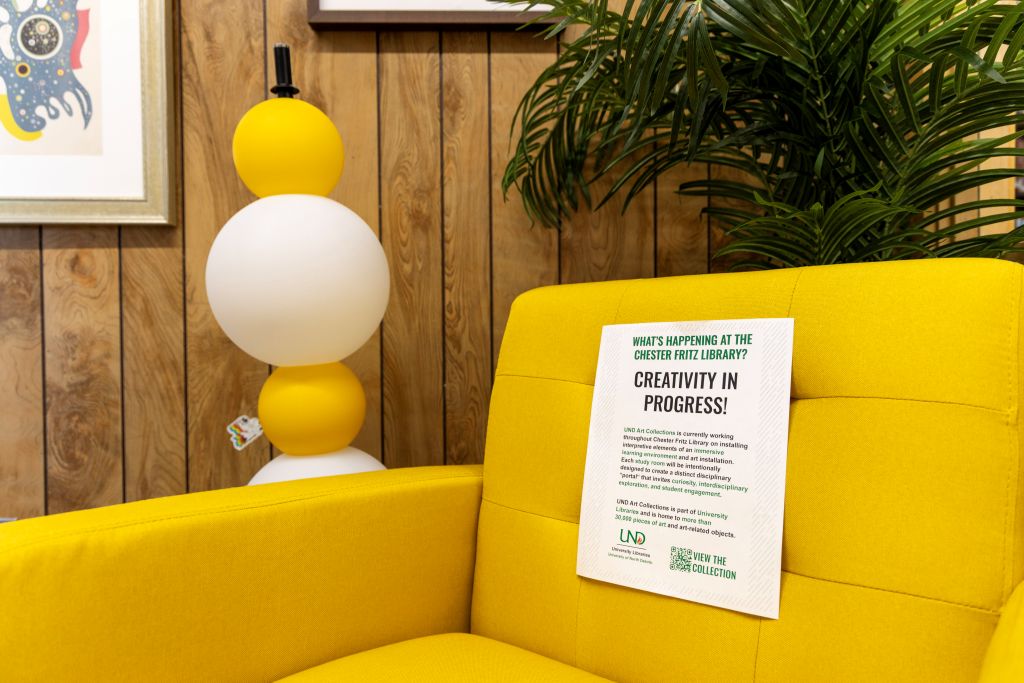
That twist became the foundation for the library’s immersive installations. The idea is to turn an ordinary day of studying into an opportunity to explore something unexpected.
But developing the concept and choosing the artwork are only the first few stages. Bringing that vision to life requires mathematical calculations, carefully measured placements and decisions on framing, lighting and everything else.
Each choice influences how a piece is perceived and how it contributes to the story surrounding it. Much of that work may go unnoticed once the artwork is on the wall, but it shapes how students and faculty experience it.
“UND sees art as creative infrastructure, something crucial and pivotal to a learning environment,” Bahlmann said.
Across campus, some pieces may become part of a daily routine, while others could interrupt the ordinary. but, each piece invites students to look closely and consider how art connects to the spaces where they learn.
****
>> Questions or comments about the UND LEADS Strategic Plan? Your thoughts are welcome! Please contact Ryan Zerr, associate vice president for Strategy & Implementation, or Brandon Wallace, senior financial accountant, the co-chairs of the UND LEADS Implementation Committee. You also may offer your thoughts by visiting the UND LEADS Strategic Plan home page and clicking on the “Provide your feedback” link.
Thank you for your support of the UND LEADS Strategic Plan!